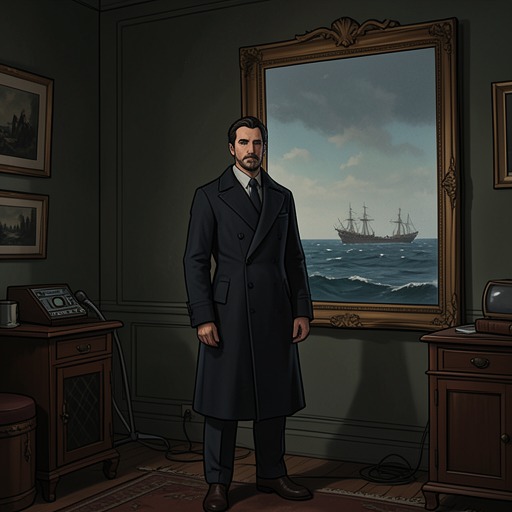
Benedict Singer and Masao Tanaka's Collaboration and Falling-Out
The TrenchBenedict Singer and Masao Tanaka’s partnership is recast as a betrayal when Masao discovers that intelligence agencies used the Tanaka Institute to steer Geo-Tech toward Singer’s expedition into the Mariana Trench. The Institute’s financial collapse and the lucrative UNIS contract were not simply business circumstances: they made Masao desperate enough to seek Singer’s help, while providing Singer with a respectable reason to enter the Trench. The revelation turns a commercial alliance into a conflict over who was used, who was endangered, and who had the right to decide what those costs were for.
The Partnership and the Covert Background
The relationship is identified as a partnership in an account given to Masao by Dave Ross. Ross says Israeli intelligence learned about four years earlier that Singer had attended a secret meeting in Sudan with a small group of Islamic terrorists. Six months later, construction began on the Benthos, the Prometheus, and the Epimetheus. Their construction was paid for with funds discreetly channeled into Geo-Tech from the organization of Osama bin Laden, an exiled Saudi millionaire. The account places Singer’s business operations within a clandestine political and financial context, although it does not establish that Masao knew about the Sudan meeting or the source of the construction money at the time.
An intercepted communication later revealed the nature of Singer’s meeting. Intelligence agencies learned that he had discovered a fuel source capable of sustaining fusion energy. For them, the partnership therefore connected Masao not just to a powerful technology company but to a secret with major strategic value. The revelation explains why the agencies would engineer access to Singer’s project, but it also exposes how little control Masao had over the political uses made of his business relationship.
The Institute as a Route to the Trench
The new UNIS project and its lucrative JAMSTEC contract appeared to offer the Tanaka Institute a chance to recover. Ross explains that the project was also useful to intelligence planners: completing UNIS would give Singer a legitimate scientific reason to enter the Mariana Trench. The investigation of the Proteus accident was meant to serve a different purpose, allowing authorities to force Singer out of the Trench before he could locate the manganese nodules. Together, the contract and the investigation show how the same institutional relationship could be used both to draw Singer in and, later, to try to remove him.
Masao recognizes the design as he hears it explained. He connects the UNIS project and JAMSTEC contract to the lawsuits and the Institute’s financial ruin, then accuses the intelligence agencies of setting his company up to fail. Standing and knocking his chair back, he says they used his Institute as bait, enticing Geo-Tech to buy it so Singer would have a lawful pretext to enter the Trench. His anger is directed at the conversion of his organization into an instrument: what had been his Institute’s project and financial emergency had also become part of an operation whose purpose he had not been told.
Betrayal, Bankruptcy, and the Cost to Masao
Ross acknowledges that the Tanaka Institute was used as a buffer. He says the agencies could not approach Singer directly without making him suspect they knew what he was doing; timing mattered, and the Institute offered an indirect route. Ross also distinguishes the real lawsuits from the decisions surrounding them. The suits were not fabricated, but when Masao asks about the Institute’s closure and frozen assets, Ross declines to explain them directly. He does say that the agencies wanted Masao desperate enough to contact Singer for assistance once JAMSTEC offered the UNIS contract.
That admission sharpens the betrayal. Masao had been forced to sell, and the planners expected Singer to take the opportunity. Ross describes Geo-Tech as the only organization with the resources to complete the project and the money to relieve Masao’s financial difficulties. In the operation’s logic, Masao’s need for help made the takeover predictable; in Masao’s understanding, it meant his vulnerability and his family’s losses had been made useful to strangers. He demands that James Adams account for the damage inflicted on his family. Adams appeals to the stakes of the mission, while Ross apologizes and promises that reparations will be made. Neither response undoes Masao’s discovery that the crisis was allowed to deepen to make the desired approach to Singer more likely.
The Partnership’s Fracture and Its Consequences
The agencies’ plan does not unfold as intended. Masao’s daughter sends JAMSTEC a positive report on Geo-Tech’s activity in the Trench, and Jonas Taylor inadvertently tells Celeste Singer the secret location of the dive site. Ross says these actions leave the Benthos on its way to collect the nodules, beyond the agencies’ ability to stop. The revelation therefore binds Masao’s personal grievance to the wider contest over the expedition: the project he was manipulated into helping facilitate is now advancing toward its objective despite the attempt to redirect it.
Ross’s account presents the partnership as a channel through which Singer could be reached, while Masao experiences it as the means by which his Institute was sacrificed. The distinction is central to their falling-out. There is no scene here of Singer and Masao directly confronting one another; instead, Masao learns from the people who exploited the relationship how it was used. His chair kicked back, his questions about the lawsuits and frozen assets, and his insistence on the harm to his family give the disclosure its human measure. The partnership’s decisive change is not a documented quarrel between the two men but Masao’s recognition that the business alliance gave others leverage over him, and that the promised public benefit was pursued through losses he had never agreed to bear.