Benthos
The TrenchBenthos is Geo-Tech Industries’ billion-dollar mobile deep-sea laboratory and submarine docking station: a 46,000-square-foot structure designed to shelter people, deploy equipment, and receive submersibles in the abyss. Its immense scale and elaborate pressure-resistant architecture make it a technological base for exploration and mining, but its fate turns that promise into a warning. A vessel that appears to impose order on the deep ultimately becomes stranded there, its protective dome and hull unable to withstand the forces around it.
Identity and Design
Benthos hovers above the seafloor in neutral buoyancy, its domed mass compared to a sports arena and, from another perspective, to an enormous globe cut in half along its equator. A false, flattened underside gives the spherical pressure hull a broad base for ballast tanks. Three massive, clawlike legs hang below it; their scale makes the ship seem at once like a floating platform and a creature moving through the abyss. Its bulk is not merely visual: at 46,000 square feet, Benthos is a large working environment carried into a setting where ordinary surface-based infrastructure cannot follow. The vessel’s outer shell is described as eighteen layers of six-inch titanium, a total thickness of 108 inches, designed to resist compressive forces exceeding ninety-six billion pounds. At the top, A deck forms a domed observation space with a separate inner shell of ten-inch-thick LEXAN. Thirty percent of the titanium hull along this deck can retract, opening the dome’s view onto the deep. That transparency is an important part of Benthos’s purpose: the ship is engineered not only to withstand the abyss but also to make it visible to the people inside. The contrast becomes consequential when the clear barrier later proves vulnerable.
Internal Systems and Submersible Operations
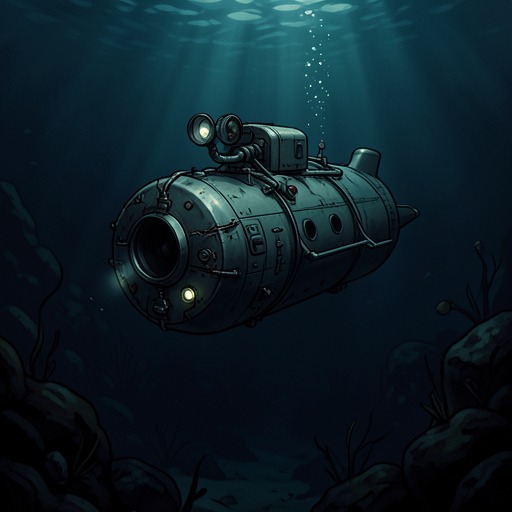
Benthos’s undercarriage contains an abyssal docking station for Proteus, Prometheus, and Epimetheus. A pressurized vault begins beneath G deck, where mechanical arms position a submersible and lift its conning tower into a flooded docking bay. Once the sub is sealed, the compartment drains and repressurizes. Ten pumps, each rated at 500 horsepower, provide the force required for this operation. G deck also contains an 1,800-square-foot underwater hangar; hydraulic ram pumps on F deck can pressurize or vent it for heavy equipment and robotic vehicles. The ship is therefore both shelter and logistical mechanism, built to move people and machinery between its protected interior and the surrounding seafloor. A view from Prometheus makes that mechanism tangible. Its bow slides into the docking assembly beneath Benthos; the sub stops, the arms raise it, a pressurized sleeve fits over the conning tower, and the compartment seals and repressurizes. The sequence presents docking as a carefully controlled transition between two vessels and two pressure environments. The same architecture later receives Epimetheus: Benthos descends around it, its three legs settling on the bottom while the docking station’s clamps open to guide the sub into position and raise it into the sealed chamber. These operations show the ship functioning as a mobile port in a place without a conventional harbor. The bridge and control room occupy level B. Navigational computers and other electronics line the oval room’s circular walls, while a dozen manned stations curve around the captain’s plotting area. A floor-to-ceiling computerized bathymetry map displays the underwater canyon; closed-circuit monitors show high-resolution views from cameras along Benthos’s hull. The helm has a steering wheel and pedals controlling the ship’s single screw and rudder, with ballast controls and communications nearby. This concentration of maps, cameras, and controls gives the crew instruments for interpreting and navigating the deep, but it cannot eliminate uncertainty about what lies beyond their field of view.
Mission and Command
Benthos supports a planned week-long mission in the abyss to deploy at least three UNIS robots. When the arrival of the submersibles is delayed, Benedict Singer changes the schedule because the ship’s air purifiers and scrubbers must be replaced before carbon dioxide levels become too high. Epimetheus is to descend first with supplies and part of a replacement crew, then return topside after two days with the A team. Benedict and the rest of the B team are scheduled to descend aboard the sister sub, Prometheus, after Epimetheus returns. The plan reveals the ship’s reliance on a linked system of life-support maintenance, crew rotation, and submersible transport: the laboratory’s ability to remain below depends on managing its enclosed atmosphere as well as its external machinery. The ship’s movements also reflect disagreements about risk. Captain Hoppe objects when Prometheus is sent too far ahead of Benthos, distinguishing an acceptable danger from foolhardiness. Earlier, a team leader complains that the pilot seems unsure of what he is doing, while another crew member reports that they have moved too far ahead of Benthos. These moments place operational confidence under strain: the craft and the main vessel can be separated, and judgments made about distance and timing carry consequences in an environment where assistance must travel through the same hostile terrain. Benedict’s authority aboard the vessel is presented as unusually dominant. Heath Williams tells Terry Taylor that, on Benthos, the only laws observed are Benedict’s, and that people who consider themselves guests are treated by Benedict and his crew as outsiders. Benedict gives orders from within this hierarchy, including a direction for Captain Hoppe to have Sergei join him in the laboratory. The ship’s advanced systems thus coexist with a social order that is not shared equally by everyone aboard; technical organization does not mean open access or independent authority.
Exploration, Secrecy, and the Abyss
Benthos moves through a landscape that resists the rhetoric of mastery. The surrounding canyon contains hydrothermal vents sending dark mineral plumes into the water, extensive fields of tube worms, and a luminous patch of sea crossed by bioluminescent jellyfish. The ship’s scale and cameras can frame this environment as an object of observation, while its work extends beyond observation to the deployment of robots and, later, the extraction of seafloor nodules. The contrast between the ordered vessel and the active abyss gives the setting more than scenic importance: the environment remains a force that exploration must encounter, not simply a space the machinery can make safe. Benthos also becomes the center of a concealed commercial operation. After Epimetheus docks, Benedict orders the sub back into the Trench while keeping Benthos close by. Terry has no clear account of Geo-Tech Industries’ activity there, but comes to suspect that deploying the UNIS robots is a cover for Benedict’s personal objective. Later, Benedict says Benthos will reach Devil’s Purgatory within forty-eight hours and describes using Prometheus and Epimetheus together to clear nodules from the seafloor. He credits the Tanaka Institute with helping keep the actual mission undisclosed. The contrast between the announced research program and the mining plan makes the ship an instrument of both exploration and concealment.
Stranding and Destruction
Benthos’s operational role changes when it becomes stranded on the bottom. The crew rigs powerful underwater lights to the hull of Prometheus to deter nearby creatures while preparing to rescue the remaining people aboard. The immense structure that had moved above the seafloor now cannot leave it, and the rescue effort depends on another vessel operating outside Benthos. Closed-circuit monitors show the underside of the stranded ship, reducing its once-commanding bulk to an image watched anxiously by Captain Vladislav Prokovich and his crew. The final collapse overturns the assurances built into the vessel’s specifications. A Kronosaurus smashes through the LEXAN window; the resulting pressure implodes Benedict’s skull and collapses Benthos’s dome, crushing the creature beneath more than twelve thousand tons of titanium. The upper level is flattened, and bubbles, blood, and debris rise from the wreck. Elsewhere in the escape, Terry Taylor frees her wrists from a coil of electrical wire and hears metal groan; the LEXAN cylinder then blasts away from Benthos as the ship implodes behind those escaping. The collapse turns the vessel’s defining materials into part of the danger: titanium and transparent shielding, intended to separate the occupants from the abyss, become components of a catastrophic failure. Benthos’s arc therefore runs from engineered enclosure to structural ruin, exposing the gap between calculating pressure resistance and surviving the unpredictable conditions of the deep.