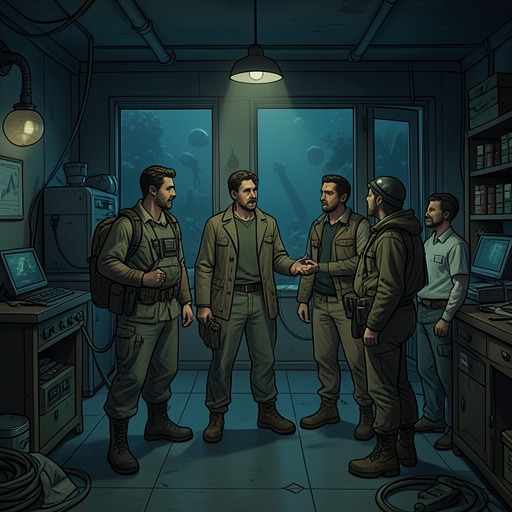
Dave Ross
The TrenchDave Ross is a Central Intelligence Agency officer whose briefing in Guam reframes the search for fusion fuel as a covert contest over the Mariana Trench. By tracing Benedict Singer’s financing, the evidence in manganese nodules, and a failed effort to keep the Benthos away from them, Ross turns a family concern about Terry into an international struggle over who will control a new energy source.
Identity and Introduction
Ross enters the story at the office of Base Commander James Adams, who has arranged a private meeting with Masao Tanaka and introduces Ross as a Central Intelligence Agency officer with information concerning Terry. The secretary closes the office door behind Adams, establishing the confidentiality of the setting before Ross begins his account. He is described as a short, slender, intense-looking man in his early forties. He stands to greet Masao and offers his hand, a formal introduction before the conversation turns to classified intelligence.
Ross makes the terms of the briefing explicit: what is said in the room must stay there. Masao agrees to listen, and Ross addresses him formally as Mr. Tanaka. The insistence on secrecy marks Ross not simply as a source of information but as an agent managing its circulation. He is bringing Masao into a sensitive account while also asking him to accept the constraints under which it is delivered.
The Intelligence Behind Singer’s Project
Ross dates the first key intelligence to roughly four years earlier, when Israeli intelligence learned of a secret meeting in Sudan between a small group of Islamic terrorists and Benedict Singer, then Masao’s partner. Six months after that meeting, construction began on the Benthos, the Prometheus, and the Epimetheus. Ross connects the vessels’ construction to funds discreetly channeled into Geo-Tech from the organization of exiled Saudi millionaire Osama bin Laden. In his account, the expensive deep-sea fleet is therefore not an isolated research venture: its financing is tied to a political network with interests beyond ocean exploration.
A second intelligence thread arrived eighteen months before the meeting. Ross reports that the National Security Agency intercepted a communication revealing the nature of Singer’s meeting. Singer, he explains, had discovered a fuel source capable of sustaining fusion energy. That distinction makes the discovery more than a scientific prize: Ross’s briefing presents it as a durable source of power that could give its controller exceptional leverage. James Adams states the security concern plainly, warning that the factions backing Singer must not be allowed to monopolize fusion.
Ross then explains why conventional surveillance has not solved the problem. The source of Singer’s fuel lies somewhere in a remote area of the Mariana Trench, and the Benthos is so deep that satellites cannot detect it. Sonar reconnaissance is difficult, while the ship’s engines produce barely any detectable signature. Ross also points to the practical obstacle of reaching a vessel after it has descended into the Trench. The account makes the ocean’s depth an operational shield: Singer’s project is hard to locate and harder to confront directly.
Evidence, Strategy, and Failure
The crucial material evidence comes from the Seacliff dive. Ross says analysis of the remaining manganese nodules collected by the two scientists revealed inert gases trapped inside the rocks; Adams identifies those gases as the fusion fuel. Knowing the exact location of these particular nodules changes the government’s options. Rather than beginning with a direct confrontation against Singer, Ross says, they have started preparing remote submersible robots to mine the rocks themselves. He presents this as an effort to obtain the resource while avoiding a clash with a man who retains considerable financial and political power.
That plan depends on keeping Singer away from the nodules long enough for the robots to act. Masao challenges Ross on how they expected to force the Benthos out of the Trench without arousing Singer’s suspicions. Ross identifies the JAMSTEC investigation of the Proteus accident as their intended pretext: it was meant to compel Singer to leave before he found the nodules. The strategy thus relied not only on technical access to the seabed but on directing the investigation toward a political purpose.
Ross also reveals why the plan has unraveled. Terry sent JAMSTEC a positive report on Geo-Tech’s activities in the Trench, while Jonas unknowingly disclosed the dive site’s secret location to Celeste Singer. Ross links those separate disclosures to the immediate consequence: the Benthos is now on its way to collect the nodules, and the briefing ends with his admission that there is nothing they can do to stop it. The intelligence officer who has patiently assembled the chain of financing, interception, and geological evidence can explain the danger, but cannot reverse the movement already under way.
Narrative Role
Ross functions as the bearer of a larger political explanation for events that Masao first encounters through the question of his daughter. His briefing joins the secret Sudan meeting, the vessels’ financing, the intercepted communication, and the gases in the nodules into one causal account. Its structure steadily narrows from international funding to a particular resource in the Trench, then opens onto an immediate failure: the Benthos is already heading for it.
His role is also defined by the limits of intelligence. Ross and his colleagues have analyzed samples, prepared remote mining robots, and devised an investigative pretext, yet their operation depends on secrecy and timing. Terry’s report and Jonas’s unwitting disclosure defeat that timing. Ross is therefore both the figure who makes the hidden contest legible to Masao and the messenger who confirms that knowledge alone has not given his side control of events.