Deep-sea hydrothermal ecological refuge
The TrenchThe Deep-sea hydrothermal ecological refuge is the novel’s explanation for how ancient marine reptiles might have persisted in the Mariana Trench after conditions elsewhere became too cold for them. It joins two kinds of support: hydrothermal vents supply heat to animals that depend on it, while chemosynthesis sustains an ecosystem without sunlight. The idea turns the trench from a remnant of prehistoric life into an active habitat whose geological and ecological conditions continue to shape the story.
Scientific Premise
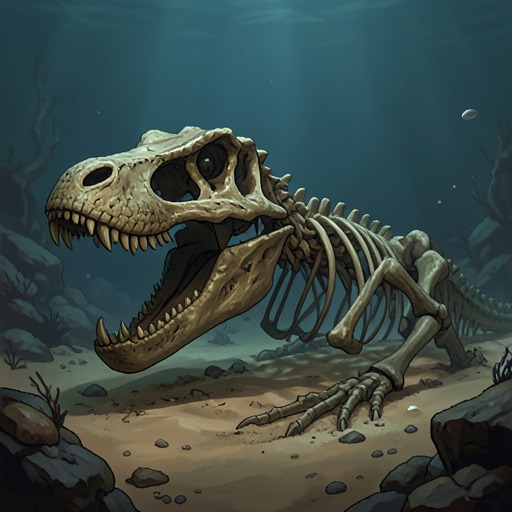
Heath introduces the refuge hypothesis while discussing a damaged marine-reptile fossil. He estimates that the specimen inhabited the waters less than two thousand years ago and points to features that may indicate adaptation to deep water, including grooves along the rib cage that appear to be gill slits. Because the fossil is badly crushed, those features are difficult to identify; his account is an interpretation of the evidence, not an unqualified description. He proposes that the species evolved over tens of millions of years to survive the Mariana Trench’s unusual conditions.
The hypothesis depends on distinguishing the source of energy for life from the source of warmth for a cold-blooded reptile. The discovery of hydrothermal vents established that bacteria and other abyssal creatures can use sulfur and other chemicals emerging from the seafloor. They rely on chemosynthesis rather than photosynthesis, so their food system does not depend directly on sunlight. For reptiles, however, the problem is also temperature: Heath argues that cooling seas would have left the sun unable to maintain their body heat. Vents could answer both aspects of the problem indirectly, supporting a food web while creating unusually warm deep water.
Geological Formation and the Refuge Hypothesis
Heath places this ecosystem within a long geological history. The Mariana Trench, ridge, and adjacent Mariana Islands formed through the continuous subduction of the Pacific Plate beneath the Philippine Plate, a process he says may have continued for billions of years. The islands were once underwater. He describes the region, around one hundred million years ago, as a warm tropical sea stretching toward the Australian landmass and populated by prehistoric fish and reptiles, with Kronosaurus at the top of the food chain.
His account then links a global catastrophe to the animals’ retreat. About sixty-five million years ago, an asteroid collision initiated mass extinctions; sea levels fell, the air cooled, and ocean temperatures dropped. In Heath’s theory, marine reptiles that could no longer maintain body heat in ordinary waters ventured into the deeper, warmer Mariana Trench. Heat rising from hydrothermal vents served as a primordial furnace, making the trench a possible refuge rather than simply a place where ancient remains accumulated. Benedict summarizes the implication as an oasis for certain prehistoric marine life, and Heath agrees. The explanation is presented as a theory about survival, not as proof that every marine reptile escaped extinction.
An Ecosystem with Limits
The refuge is not merely a warm pocket in an otherwise lifeless depth. Its vents are described as the support system for the abyss, because the chemosynthetic food chain depends on them. When the Benthos ascends through the dense layer of sulfur and minerals above the trench, it passes out of the hydrothermal environment. Benedict states that Kronosaurs cannot follow beyond that layer: without the vents, the ecosystem on which they depend would fail. The boundary therefore has ecological force. It separates a habitable deep-water system from the conditions above, rather than functioning only as a barrier imposed by the animals’ behavior.
This account also clarifies what the refuge can and cannot explain. The vents provide the conditions that make a deep ecosystem possible; they do not erase the global cooling that drove the proposed migration or establish the precise history of each surviving species. The novel keeps the argument tied to observations—the fossil’s apparent adaptations, known vent chemistry, and the trench’s geology—while allowing the possibility that those conditions preserved animals presumed lost elsewhere.
Living Evidence in the Narrative
The refuge hypothesis becomes more than an explanation delivered in a discussion when Angel, a Megalodon, returns to the abyss. Distorted magnetic cues around geological formations near the Mariana Trench guide her descent in a broad circle, allowing her body to adjust to increasing pressure. As she passes into the warm hydrothermal waters, the refuge is shown as an environment that a living animal can enter and use, not only as a setting reconstructed from a fossil.
Angel glides beneath the layer of silty debris, warms herself in heat dispersing from the vents, and continues south along the canyon floor. The narration says her ancestors followed this route over the previous one hundred thousand years. That recurrence gives the proposed refuge a history expressed through animal movement: the trench is not simply a destination but part of a continuing pattern of orientation, descent, and adaptation. Later, the vibrations of another approaching life-form stimulate Angel’s reproductive system, linking the abyssal habitat to the continuation of animal life as well as its survival.
The refuge thus connects geological time, chemical energy, temperature, and behavior. Heath’s explanation supplies the causal model; the ascent of the Benthos reveals that the ecosystem has a limit; Angel’s descent gives the model a living counterpart. Together, these moments make the trench an ecological refuge with conditions and boundaries, rather than a supernatural exception to extinction.