Destiny and fatalism
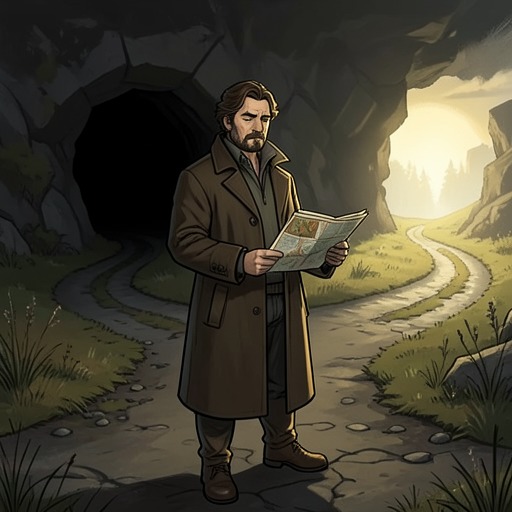
The TrenchDestiny and fatalism shape Jonas Taylor’s reading of his past survival and his fear of what lies ahead: he comes to believe that he was meant to die aboard the Seacliff and that the Mariana Trench will eventually claim him. The novel presents this belief as a powerful interpretation Jonas gives to trauma, guilt, and nightmares, not as a confirmed prophecy. Its force lies in the tension between his certainty that an ending has already been written and his continuing efforts to protect Terry Taylor and confront the Megalodon.
The Sea as Both Refuge and Threat
Jonas’s conflict begins in the divided meaning the ocean holds for him. Watching the sea from the bow, he wonders why he should fear the very thing that gives him joy. The question establishes that his fear is not simple aversion: the ocean remains a source of fascination even as it recalls danger. His experience of it therefore resists a clean division between safety and threat. What draws him toward the sea also makes him feel exposed to forces he cannot control.
That contradiction helps explain why his later fatalism is emotionally persuasive to him. The ocean is not an abstract setting against which he can imagine a secure life elsewhere; it is also the environment connected to his work, his earlier survival, and the danger he believes awaits him. His sense of destiny grows from a place to which he remains attached. The result is not a settled choice to abandon the sea, but a struggle to live with attraction and fear at once.
Survival, Responsibility, and Guilt
Jonas describes his life as already doomed and worries that the people around him will die as well. In this moment, fatalism takes the form of protective concern: he sees himself as a danger to others, not merely as someone facing danger alone. Mac Mackreides rejects Jonas’s withdrawal and intervenes when Jonas is exhausted and unable to think clearly, insisting that he come inside with the others. Jonas’s fear is thus met by a friend’s practical effort to keep him connected to life beyond his private predictions.
Jonas’s account of past decisions gives that fear a history. He says he warned Masao Tanaka that the Megalodon might escape and argued that it should be permanently sealed in the lagoon. Masao agreed, but they lacked the money to act; a court order then closed the Institute and froze its assets, leaving them paying attorneys and feeding the shark. Jonas does not treat those circumstances as absolution. He counts what happened aboard the Seacliff, his attempt to capture rather than kill the Megalodon, and the escape of its offspring as three failures for which he blames himself. His retrospective judgment turns distinct events, including decisions constrained by circumstances, into a cumulative case against his own judgment.
This accounting matters because Jonas’s expectation of death is bound to responsibility as much as to fear. He imagines a fatal ending partly because he believes he has repeatedly failed to prevent danger. Yet the same history that supports his self-condemnation also shows that outcomes arose from decisions and external constraints, rather than from a fate demonstrated to be inevitable. The narrative preserves that tension: Jonas experiences his past as evidence of a pattern, while the events he recounts do not prove that the future must repeat it.
Dreams and the Expected Ending
When Jonas tells Celeste Singer that he feels trapped, he locates the beginning of his fatalism in the Seacliff disaster eleven years earlier. He believes he should have died there and that his survival left an unfinished ending. His dreams supply that ending in a repeated scenario: descending in a deep-sea model of the Abyss Glider into the Mariana Trench, where the Megalodon appears and he cannot escape. He describes the dream as a vision of his death and interprets it as a sign of destiny.
The distinction between dream and event remains important. Jonas is convinced by what he sees in sleep, but the evidence does not establish that the dream predicts the future. Instead, it shows how his mind organizes danger: the Seacliff, the Mariana Trench, and the Megalodon become parts of a single anticipated conclusion. His certainty gives the nightmare the authority of a forecast, while its recurrence makes it harder for him to regard it as merely a fear.
Celeste’s conversation with him also complicates the idea that fatalism leaves no room for choice. She speaks of keeping close to an enemy and facing her own fears; Jonas presses her about whether she intends to carry out her plan. When she turns the subject back to his feeling of entrapment, he discloses the dream and his belief in his destined death. Their exchange makes the belief part of an intimate conversation, but does not resolve it: Celeste’s account of confronting fear and Jonas’s account of being trapped remain distinct responses to danger.
Doubt, Agency, and the Unfinished Future
Mac offers a direct counterinterpretation when Jonas treats his nightmares as knowledge of how his life ends. He calls them nightmares rather than prophecy and warns Jonas against making them self-fulfilling. Jonas says he is not trying to do so, but the exchange exposes a gap between intention and effect: even without choosing death, he may let a prediction narrow the choices he sees as possible. The narrative gives Mac’s reassurance weight without making it a guarantee that the feared events will not occur.
That gap becomes sharper when Terry Taylor’s descent into the Mariana Trench appears to Jonas to reproduce his nightmare. He believes that both he and Terry will end up there, and his fear quickly turns to anger at having begged her not to go. Mac argues that Terry is expected back aboard the Goliath within days and that the Megalodon is thousands of miles from the trench. He treats the overlap as coincidence; Jonas admits he cannot think rationally and allows that explanation may be right, but says he cannot take the risk. He decides that he needs to kill the Megalodon to remove the uncertainty.
The decision is an expression of agency, but one shaped by fatalistic pressure. Jonas acts to change the conditions that feed his prediction, yet the immediate motive is not confidence that he can escape fate; it is a need to eliminate doubt and protect Terry. Mac imagines a future in which the shark is dead and Jonas and Terry can return to their life together. Jonas cannot accept that outcome as assured, wondering whether Terry will still want him. The concept therefore remains unresolved: Jonas moves from dread toward action, but neither the dreams nor his efforts settle what the future holds.