Epimetheus
The TrenchEpimetheus is one of two identical research submersibles whose practical role aboard Goliath shifts from transporting replacement supplies and personnel to serving as the vehicle through which the abyssal expedition’s danger becomes immediate. Its name evokes afterthought, and its engraved promise of rising again acquires an irony the vessel cannot escape: it returns to the surface once, but its final ascent into Benthos ends in destruction.
Design and Place in the Expedition
Epimetheus and its sister ship Prometheus are positioned side by side on enormous hydraulic ramps at Goliath’s stern. Both are white with red trim, cigar-shaped, sixty-eight feet long, sixteen feet across, and topped by five-foot conning towers. Their comparatively bare upper surfaces conceal the equipment that defines their research function. Beneath each hull is a spherical observation pod, eight feet in diameter, from which one operator can control robotic arms, cameras, lights, and a vacuum hose for collecting samples from the seafloor. The submersibles are therefore both transport and working platform: they carry people into the abyss and provide the means to examine and sample its bottom.
The image of the two vessels together also establishes a structural parallel. They are identical in form but assigned different turns in a sequence of descent and return. Epimetheus is the first to be lowered from Goliath, while Prometheus is scheduled to follow after its sister comes back. That order makes the ships’ mythological names more than decoration: the expedition’s plan depends on one vessel going ahead and the other following, though the novel’s later events turn the promised rotation into something far more precarious.
Revised Deployment and Mythic Names
The submersibles’ late arrival forces Benedict Singer to change the timetable. The air purifiers and scrubbers aboard Benthos need replacement before carbon dioxide levels become too high, so Epimetheus is ordered to descend immediately with supplies and part of a replacement crew. It is expected to return to the surface two days later carrying the A team. Benedict Singer and the remaining members of the B team are then meant to descend aboard Prometheus, beginning a week-long mission to deploy at least three UNIS robots in the Trench. The schedule gives Epimetheus a crucial logistical task: the longer expedition depends on its return and on the crew transfer it is meant to make possible.
Masao says he will inform JAMSTEC and asks about the inscription beneath the vessels’ names. Benedict Singer explains the myth behind them: Epimetheus, the Titan associated with afterthought, distributes gifts among the animals but has none left for humanity; his brother Prometheus steals the Sun’s energy for humankind and is punished by Zeus. Benedict also explains the contrast built into the names: Prometheus means forethought, while Epimetheus means afterthought. The explanation places the pair within a story of foresight, belatedness, provision, and cost. Epimetheus’s assigned work is emphatically practical—deliver supplies and crew—but its eventual destruction makes the motto Resurgam, meaning that it will rise again, a bitter counterpoint to its fate.
Surface Returns and an Escape Possibility
After its first descent, Epimetheus breaks the surface fifty yards off Goliath’s stern. A diver rides the winch cable down and fastens clips to the hull; minutes later the sixty-eight-foot vessel swings into position and is lowered onto its docking platform. Half of the B team is already aboard Benthos, having gone down two days early to relieve their companions. Benedict Singer and the rest of the crew are expected to board Prometheus within hours for the planned week in the Trench. The return and transfer initially preserve the expedition’s carefully staged timetable, even as Terry watches Benedict Singer and wonders whether he knows she has entered his laboratory.
Later, when Terry seeks help from a captain, Epimetheus becomes a possible means of escape. The captain says the submersible should be arriving shortly and invites her to watch its descent from the observation deck, where he opens the reinforced LEXAN dome by retracting its titanium outer covering. Terry asks whether he can pilot Epimetheus. He cautions that they would not get far and could not outrun Goliath. The exchange defines the vessel’s limits as clearly as its capabilities: it can travel between the surface and the depths, but it is not an independent route to safety when its communications are routed through Goliath and the larger ship controls the situation.
Final Descent and Destruction
While Terry is confined aboard Benthos, Benedict Singer orders Epimetheus into the Trench as soon as it docks, keeping Benthos close by. The sub returns sometime after midnight. Terry does not know what Geo-Tech is doing in the abyss and comes to suspect that deploying the UNIS robots is a cover for Benedict Singer’s own quest. Her suspicion is presented as her interpretation, not as confirmation of the company’s purpose; what is clear is that the vessel’s work has moved beyond the earlier, openly stated supply and crew schedule.
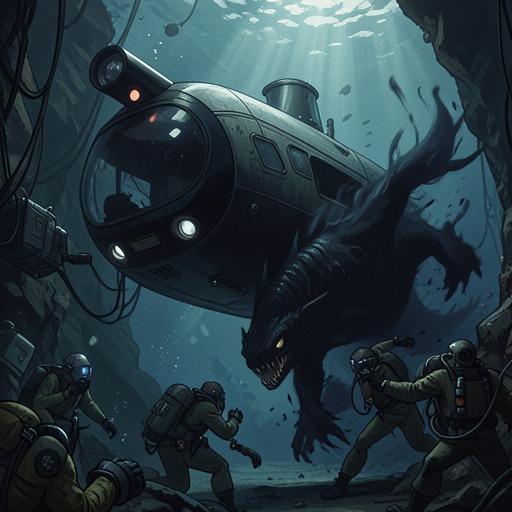
On a later descent, Benthos settles on the bottom around Epimetheus. Its three pillar-like legs frame the smaller sub, while a docking station hangs above it. Winglike clamps spread to guide Epimetheus into the docking clamps, which are designed to raise it and seal its conning tower inside a pressurized chamber. Strobe lights from Benthos illuminate the surrounding darkness. Epimetheus rises from the seafloor into the larger vessel’s docking sleeve, its conning tower guided into place as the clamps tighten. The sequence shows a sophisticated system meant to make deep-sea transfer controlled and secure; the sub’s safe passage depends on the station, the seals, and Benthos’s protective structure.
That protection fails when a fifty-thousand-pound female Kronosaurus drives its skull into Epimetheus’s underside. The impact compromises the titanium hull, and water pressure at sixteen thousand pounds per square inch causes the sub to implode almost instantly. The resulting rush of water enters the sealed docking-station vault and kills everyone inside. The chamber’s ten-foot layer of titanium prevents Benthos itself from imploding, but it cannot save those caught in the vault. Epimetheus’s final failure thus reverses its earlier role as a dependable link between surface and abyss: the docking arrangement that receives and encloses it becomes the site of catastrophe. The vessel’s name and inscription promise return; its ending instead makes the limits of engineering, planning, and rescue visible in a single violent breach.