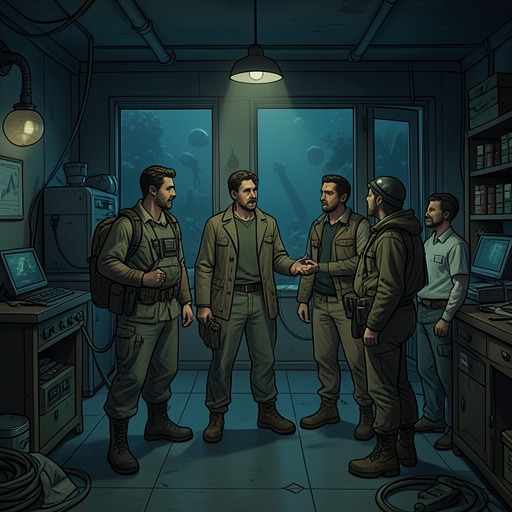
Exclusive Economic Zone (EEZ) Mineral Extraction Restrictions
The TrenchExclusive Economic Zone (EEZ) Mineral Extraction Restrictions turn the Mariana Trench into more than a remote scientific frontier: they define who may enter, who may extract its resources, and who can claim authority over what is found there. In the novel, the rules are at once a real obstacle to Benedict Singer’s mining scheme and a political instrument used to lure Geo-Tech Industries into a monitored operation. Their reach is formidable on paper, but the abyss exposes how little legal control can guarantee the safety of people working beneath it.
Jurisdiction and Access
Masao explains that the relevant area of the Mariana Trench lies within an exclusive economic zone, placing it under American jurisdiction. The Tanaka Institute has been permitted to reenter the Trench through its continuing contract with JAMSTEC. That arrangement makes scientific access conditional: the research presence is not simply an unrestricted right to descend, but depends on institutional agreements and reporting obligations.
The rule’s practical importance surfaces when JAMSTEC requests a fuller examination of the Proteus wreckage. Masao presents the request as a sensitive matter involving everyone connected to the expedition. Benedict responds by emphasizing the scale of Geo-Tech Industries’ investment in the Benthos and its fleet, and threatens to abandon the joint venture rather than submit to what he regards as an insult. The exchange makes clear that scientific access, corporate authority, and jurisdiction are intertwined: the company’s machinery can reach the Trench, but its presence still depends on a political and contractual framework it does not control alone.
The Mining Prohibition and Benedict Singer’s Aim
Terry identifies the distinction between the public rationale for the expedition and Benedict Singer’s actual purpose. She concludes that he is using the deployment of the UNIS systems as cover while illegally mining manganese nodules from the abyss. The restriction is not incidental to his plan. Benedict confirms that the law prevents other nations from mining the nodules, and treats that prohibition as a reason to keep the operation secret: what is forbidden becomes more valuable to him precisely because ordinary legal and political channels cannot deliver it.
The nodules’ value is not principally their manganese, nickel, or cobalt. Benedict explains that a particular deposit contains a blend of helium-3 and deuterium compatible with a long-burning fusion reaction. He traces the discovery to Prestis and Shaffer, whose secret dive aboard the Seacliff gathered a half-dozen nodules from a remote location they called Devil’s Purgatory. The United States Navy confiscated those samples after the scientists were killed, but did not understand their value. Benedict later obtained several of the rocks and tested them himself. The law therefore governs access to a resource whose significance was hidden even from the authority that had seized it.
Benedict’s intended extraction would be conducted by the Prometheus and the Epimetheus, with the Benthos heading to Devil’s Purgatory. He expects the combined mining effort to clear the seafloor quickly, then bring the Benthos out of the abyss without the Japanese knowing the expedition’s true mission. His stated independence from any employer accompanies a disclosed reliance on Arab investors who supplied Geo-Tech Industries with the people and money needed for the venture. The legal prohibition shapes both the secrecy and the scale of the operation: the objective is not merely to collect nodules, but to secure a new power source beyond the reach of competing states and their laws.
Law as Cover and Countermeasure
The restrictions also shape the opposing intelligence operation. Masao learns that the new UNIS project and lucrative JAMSTEC contract were deliberately used to give Benedict a legitimate opportunity to enter the Mariana Trench. Intelligence agencies expected that a scientific expedition would furnish a plausible reason for the Benthos to go there, while the Goliath shadowed it along the surface. The arrangement turns the law’s access requirements into camouflage: an officially sanctioned research project helps conceal an operation whose real purpose is unlawful extraction.
The plan’s intended countermeasure depended on the same regulatory framework. Investigators hoped JAMSTEC’s inquiry into the Proteus accident would force Benedict to leave the Trench before he found the nodules. That effort failed after Terry sent JAMSTEC a positive report about Geo-Tech’s activities and Jonas revealed the secret dive location to Celeste. Once the Benthos was already on its way to the deposit, the strategy shifted from preventing access to seizing the goods. The stated plan was for the United States Navy to confiscate the nodules under EEZ law after they had been found and loaded aboard.
This enforcement plan gives the restrictions force, but also reveals their dependence on surveillance, timing, and proof. The law cannot stop a concealed expedition merely by existing; those trying to enforce it need to know where the nodules are, establish that the operation has reached them, and intervene before Benedict can leave. The planned seizure is therefore a delayed assertion of jurisdiction, not an immediate barrier at the Trench’s edge.
Limits and Narrative Significance
The rule’s double function is central to the conflict over the Trench. For Benedict, it is an obstacle to be evaded and a source of scarcity that intensifies the prize. For JAMSTEC and the intelligence agencies, it supplies both a legitimate reason to demand information and a legal basis for eventual confiscation. The same research infrastructure can serve public scientific access, corporate cover, and state surveillance; the difference lies in who controls its purpose and what the expedition is actually doing below the surface.
Yet legal authority does not master the environment in which the dispute unfolds. As Terry frees her wrists with her teeth, the Benthos’s titanium plates begin to buckle under the abyssal pressure, and level B implodes beneath 1,160 atmospheres. This catastrophe does not erase the law or settle the intended seizure, but it sharply limits what jurisdiction can accomplish: EEZ rules can assign authority over extraction and authorize intervention, not make a fragile human presence in the Trench secure. The restrictions thus frame the contest over the nodules while the deep sea remains capable of overwhelming every institution and plan built around them.