Goliath
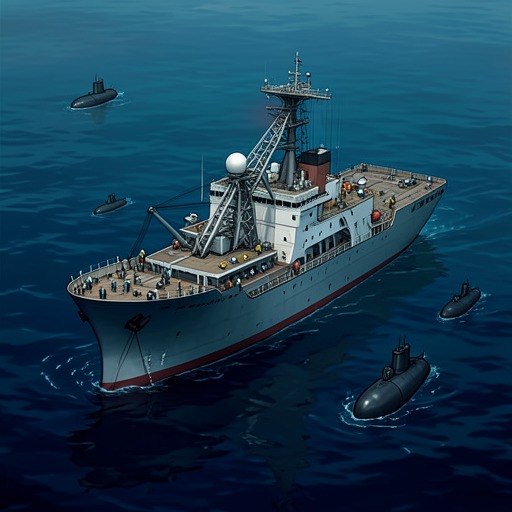
The TrenchGoliath is a decommissioned Soviet missile cruiser turned into the largest research vessel in the world and the operational hub for Geo-Tech Industries’ deep-sea program. It transports and deploys the Benthos, supports missions by its sister submersibles, and connects the remote operation to the surface. Its immense physical power enables exploration of the Trench, but the ship’s concealed laboratory and control over communications reveal a less public purpose: Goliath is also an instrument for secrecy and control.
Conversion and Capabilities
Goliath first enters view beneath the helicopter carrying Terry Taylor and Masao Tanaka, appearing as an enormous gray warship. The vessel had been donated by the Russian government to Geo-Tech Industries under a twenty-year contract to develop and supply alternative-energy resources. Its identity joins two kinds of enterprise: the inherited scale of a military cruiser and its new role as a mobile base for research and energy development.
The ship measures 813 feet long, with a beam of ninety-one feet, making it the largest research vessel in the world. Its hybrid power plant combines nuclear and steam power to drive two sets of turbines and twin propellers. Although its battle armor has been removed, it can maintain cruising speeds of thirty-three knots. These specifications are not merely a display of scale: Goliath has the power and carrying capacity required to transport and deploy Geo-Tech’s enormous deep-sea laboratory, the Benthos.
The conversion does not erase the vessel’s military origins. Its former missile silos remain part of its architecture, and one of them conceals a stairwell leading to a high-tech laboratory. That space makes Goliath more than a surface support ship. Its old military structure provides cover for work that is hidden from ordinary movement and observation aboard the vessel.
Surface Base and Submersible Operations
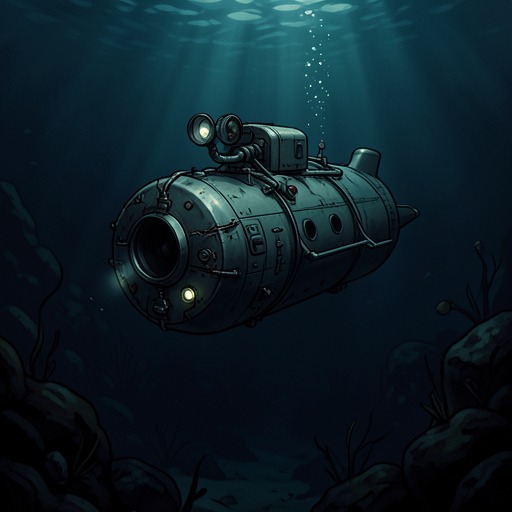
Goliath’s stern functions as a working interface between the surface and the abyss. Its helicopter pad receives the arriving delegation, while its transom and launch equipment handle the submersibles. During a change of plans caused by the late arrival of the submarines, Benedict Singer directs the Epimetheus to descend immediately with supplies and a partial replacement crew. The sub is to return two days later with the A team; the remaining B team and Benedict will then descend aboard the Prometheus for a week-long mission deploying at least three UNIS robots in the abyss.
The ship’s equipment makes that schedule concrete. When the Epimetheus returns to the surface, it breaks through fifty yards off Goliath’s stern. A diver rides the winch cable down to attach clips to the submersible’s hull; the sixty-eight-foot vessel is then swung into position and lowered onto its docking platform. The operation presents Goliath as a floating dock and heavy-lift base, able to cycle crews, supplies, and submersibles between the surface and the deep-sea habitat.
Goliath also coordinates the Benthos’s connection to the outside world. A fiber-optic cable links the Benthos to the ship, and the Benthos’s chief of the watch monitors that connection around the clock. Aboard Goliath, the communications route carries Terry Taylor’s report to JAMSTEC headquarters. The same ship relays a warning from its towed array: four biological forms are moving south-southeast through the Trench at just under twelve knots, with the Prometheus in their path. The report recalls four objects that had appeared briefly on the Benthos sonar shortly before the Proteus accident, making the new detection ominous rather than routine.
Concealment and Control
Goliath’s significance extends from logistical support to the control of information. When Terry Taylor discovers men emerging from a stairwell built inside an old missile silo, she sees a part of the ship that is not presented as an ordinary laboratory space. The men wear white lab coats and speak in a dialect she recognizes as sounding Russian. One has a small device that he aims at the open stairwell until the hatch seals. Later, Terry tells Heath Williams that she found a hidden, high-tech laboratory in the bowels of Goliath and describes the concealed access route. The ship’s physical layout thus shelters an operation that can be reached through a disguised passage rather than an openly identified facility.
The communications architecture gives Goliath a second kind of leverage. Captain Hoppe explains that every communications link aboard the Benthos and its submersibles is routed through Goliath; there is no way to bypass the system. When Terry asks whether the Epimetheus could be piloted away, Hoppe doubts it could get far and says it could not outrun Goliath. The vessel’s role as indispensable relay and transport therefore also limits the independence of the people and craft operating below it. Support and confinement are built into the same arrangement.
Goliath is also the surface endpoint for coded operational messages. Benedict Singer receives a scrambled transmission from the ship and enters an access code and a second code word to translate it. The message reports Celeste Singer’s expected arrival, completed repairs to the Prometheus, additional exterior lights, and a planned launch time. That exchange links the ship to the preparation of a new descent while showing that information moving through the operation is deliberately protected from casual reading.
The Trench Mission and Goliath’s Strategic Value
The deep-sea operation depends on keeping the Benthos difficult to find. James Adams and Dave Ross explain that the laboratory is so deep in the Mariana Trench that satellites cannot detect it; sonar reconnaissance is difficult, and its engines produce little signature. Even if its position were found, its hull is 108 inches of titanium. In this account, Goliath’s large-scale support enables an operation whose remoteness and technical protection frustrate outside intervention.
Benedict Singer’s stated plan makes the stakes of that protection explicit. He says the Benthos will reach Devil’s Purgatory within forty-eight hours, where the Prometheus and Epimetheus will mine the seafloor for nodules. He expects the work to clear the area quickly and claims that the Tanaka Institute’s involvement will keep the true mission from being understood. Goliath is the surface platform behind this venture: it supplies the ships, communications, and coordination needed to turn the remote Trench into an extraction site while the purpose of the mission is obscured.
The vessel’s role continues into the search for Celeste. Over the Western Pacific, James “Mac” Mackreides and Jonas Taylor spot Goliath on the horizon and confirm that Celeste is aboard. They learn that she left her previous vessel after discovering the location of Devil’s Purgatory; her interest was not recapturing Jonas’s shark but obtaining the information. The final appearance of Goliath in this evidence therefore returns the ship to the surface as a destination and a repository of contested knowledge. Its size makes it visible from afar, but its operations have repeatedly depended on hiding what takes place within or beneath it.