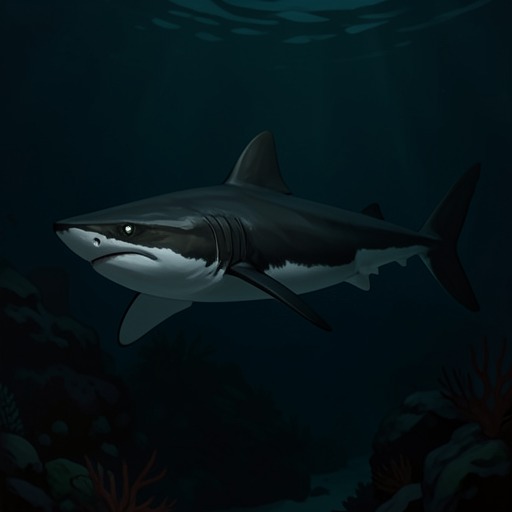
Great white shark
The TrenchGreat white sharks are more than a single threat in the novel: they appear as a coordinated group whose presence reveals the cause of Angel’s movements and makes the surrounding waters feel less governable by humans. Their encounters with Jonas Taylor, their pursuit of Angel, and their exposure to fishing gear show different consequences of the same animal behavior. The sharks are formidable in close quarters, but they are also responsive to scent, prey, and obstacles, following patterns that do not begin or end with the human characters’ plans.
Identity and Introduction
At the gateway, Jonas first notices a shark’s broad, lead-gray back moving below him before a second shark emerges through the mist directly ahead. This second animal is identified as a very large Great white shark, eighteen feet long and weighing well over a ton. Jonas backs toward the steel gate as it approaches, bringing him into a confined encounter in which he has little room to retreat. When he directs his light toward the shark, he sees the dark openings beneath its snout; the animal continues closing in, apparently following his scent.
The encounter expands from one approaching shark into a group. After the first animal veers away, Jonas looks down and sees three more Great white sharks circling below; two additional males cross in front of him. At sixty feet, he is alone against several large predators. The growing number changes the encounter from a frightening approach into a coordinated-seeming presence, although the narrative does not suggest that the sharks are acting under a humanlike plan. Their circling accelerates, and one larger animal attacks a competitor. Jonas has never observed this behavior in the species before. Flattening himself against the steel door does not prevent the group from beginning its attack.
Angel and the Males
The explanation comes when Jonas tells Mac that Angel is in estrus. He connects that condition to the gathering of male Great white sharks: they have been drawn into the area by a powerful scent and, in his account, he had become caught in their mating ritual. The conversation reframes the earlier danger. The males were not gathered because they had selected Jonas as their target; their presence was linked to Angel, whose reproductive signal reached animals nearby. That explanation does not make their behavior harmless, but it gives the encounter a cause independent of the human characters’ immediate actions.
The later account follows seven males, ranging from fourteen to twenty-two feet long, as they track the much larger female northward. They feed on remains from her kills while keeping at a safe distance. Angel has registered their presence since escaping the lagoon and tolerates them while prey is available, so long as they do not approach too closely. The contrast is important: Jonas experiences the males as an unpredictable crowd, but from Angel’s perspective they are persistent followers whose proximity she monitors. Their relationship is shaped by distance and opportunity rather than by any alliance with people.
Movement and Human-Made Hazards
The sharks’ pursuit carries them into waters where human activity creates additional danger. As Angel moves toward an inlet, two male Great white sharks become caught in a gill net. She detects the obstruction and changes course, moving alongside the net in search of a way around it. The episode places the animals’ movement against a barrier they did not choose: the males are trapped, while Angel must negotiate the same structure to continue through the area. A report that she is moving south along the net, apparently looking for an exit, turns this animal response into information for the people trying to follow her.
Near the Westport Marina pier, Angel is again forced to turn away from the shallows and move through deeper water beside the net. She catches a sixteen-foot male Great white shark weighing about 2,200 pounds and consumes it before continuing toward a new source of surface vibrations. The episode shows the pursuit’s instability: the males follow Angel, but their proximity offers no protection from her, and their presence can end in predation. Her course remains responsive to the inlet, the net, and the activity above the surface, not simply to the sharks trailing her.
Narrative Significance
Great white sharks connect the close-quarters danger facing Jonas to the wider ecological consequences of Angel’s escape. At the gateway, their number and unfamiliar behavior leave Jonas exposed; afterward, the discovery that Angel’s scent drew them supplies a causal explanation for the gathering. The later scenes widen that explanation into an ongoing pattern of following, feeding, keeping distance, and encountering human-made obstacles. The sharks are neither merely a symbol of danger nor a background count of animals: their changing positions affect what Jonas understands and shape the risks surrounding Angel’s route. Their presence also sharpens the contrast between human efforts to contain or track the animals and the independent movement of predators responding to scent, prey, and physical barriers.