Heath Williams
The TrenchHeath Williams is a Central Intelligence Agency agent whose professorial identity gives him access to the Prometheus and its scientific work. He quietly becomes a source of information for Terry Taylor, connecting Jonas Taylor’s remembered trauma to a classified United States Navy operation and revealing the political stakes behind Benedict Singer’s Tokamak project. His double role comes into sharpest focus when a paleontological explanation and a carefully concealed microcassette sit alongside his attempt to evade Benedict’s questioning.
Identity and Cover
When Terry opens her door, Heath appears as a well-built Black man in his early forties, looking nervously up and down the corridor. He identifies himself as someone who taught with Jonas at Scripps, then urges Terry to let him in before anyone sees them talking. His guarded entrance establishes that their conversation is not an ordinary visit. He has overheard Sergei discussing what happened between Terry and Sergei, and asks Terry whether she is all right; concern for her is the immediate reason he gives for approaching her.
Heath later clarifies the limits of his connection to Jonas: they do not know each other personally. About eleven years earlier, however, they worked on the same deep-sea project for the United States Navy. Terry recognizes that he means the Mariana Trench dives. Heath explains that the mission was top secret and that Jonas still does not know its real purpose. The two men who died when Jonas panicked in the abyss, Shaffer and Prestis, were Heath’s colleagues. His account recasts the tragedy behind Jonas’s fear: Heath is not a personal friend offering reassurance, but a participant in the hidden history surrounding the deaths.
Aboard the Prometheus, Heath passes as a professor associated with Scripps Institute and paleobiology. When Benedict encounters him packing, Heath says the vessel is surfacing early and that he must return to Scripps that week to host a series on the distribution and diversity of Cretaceous Chelonoids. He says he will return the following week and praises the recovered fossil as remarkable. The professional explanation is specific enough to sustain his academic persona, including a complete report he says he has left detailing the species. Yet the narration identifies him as a Central Intelligence Agency agent, making the routine signs of scholarly work part of a more precarious performance.
Intelligence and the Tokamak Project
Heath gives Terry an account of Benedict’s connection to the Tokamak project that widens the conflict beyond the Prometheus. He explains that the central engineering difficulty in fusion is containing hot plasma long enough, with radioactive tritium among the challenges posed by the fuel. He then reports that Mossad learned of a secret meeting between Benedict and Osama bin Laden, described as an exiled Saudi millionaire and financier of the National Islamic Front. Heath links that organization to the World Trade Center attack and to bombings including those at the Kenya and Nairobi embassies.
At the meeting, Heath says, Benedict demonstrated a prototype fuel that produced a fusion reaction of unprecedented scale. Bin Laden and his associates agreed to finance Geo-Tech Industries in exchange for partial control of the technology. Backed by that money and influence, Benedict recruited Russian and Middle Eastern scientists to help build what Heath describes as a possible first true Tokamak fusion reactor. This is not simply a technical project in Heath’s account: its financing and promised control make the reactor a point of political leverage. When Terry asks what would happen if Benedict succeeded, the question marks the stakes of the disclosure, though the available exchange does not provide Heath’s answer.
Science as Explanation and Disguise
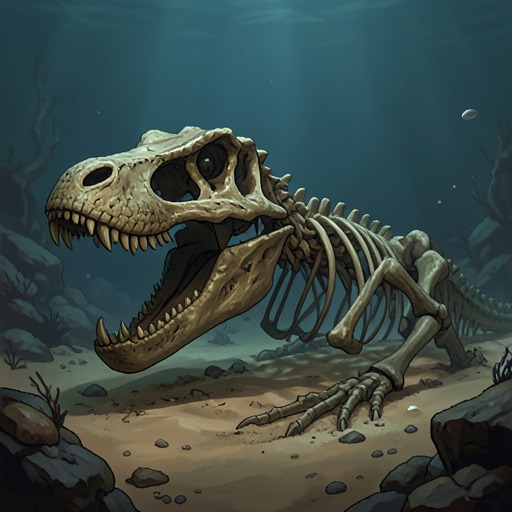
Heath’s scientific expertise is displayed most fully in the Prometheus laboratory, where he leads Benedict to a back room and presents an immense grayish-black fossil under surgical lights. Four steel tables support it. The object measures more than ten feet long and eight feet wide, and rises more than five feet at its highest point. Heath identifies it as a cross-section of a skull from an extinct marine-reptile order. He distinguishes the short-necked, carnivorous pliosauroids from long-necked forms and describes the specimen’s massive head, powerful jaw muscles, and curved, needlelike teeth. His account makes the fossil’s scale and anatomy tangible before he turns to the possibility that such animals survived in the deep.
Heath argues that the animal adapted to the Mariana Trench over tens of millions of years, developing gills to live in its particular environment. When Benedict asks whether Kronosaurus attacked the Prometheus, Heath answers that the possibility is difficult to believe but consistent with what they know. He sets that claim against the gradual extinction of ancient marine reptiles, which he attributes to falling sea temperatures, and the former scientific assumption that life depended on the Sun. The discovery of hydrothermal vents changed that picture: organisms in the abyss can use sulfur and other chemicals, relying on chemosynthesis rather than photosynthesis. Benedict says this is not new information to him, but Heath’s lecture supplies a scientific framework for the otherwise startling idea of deep-water survivors. His expertise is genuine within the scene, even as his academic position also helps him move through the ship under cover.
Secrecy and the Test at the Lab
Before Benedict confronts him, Heath slips a microcassette into a hidden compartment in his duffel bag and finishes packing. The object is concrete evidence of covert activity, but its contents are not disclosed. Heath’s stated plan to leave when the Prometheus surfaces early therefore exists alongside an undisclosed recording and the intelligence identity known to the reader; the precise purpose of the cassette remains unstated.
Benedict interrupts the packing and delays Heath’s departure, leading him to the laboratory relic. After Heath has explained the skull, the two men shake hands. Benedict does not release his grip; instead, he places his other hand over the inside of Heath’s wrist, positioning his fingertips on the agent’s pulse, and asks whether he has heard of Devil’s Purgatory. Heath’s eyes meet Benedict’s, and his pulse races. He denies knowing the place and dismisses the name as something that sounds like a children’s ride. The mismatch between denial and physical reaction leaves the exchange charged with suspicion: Benedict has turned a courteous handshake into a test, while Heath’s practiced cover does not prevent his body from registering the question. The scene ends without establishing what Benedict concludes, preserving the uncertainty around how much of Heath’s secret role has been exposed.