Hydrothermal Megaplumes
The TrenchHydrothermal Megaplumes are vast layers of warm water sustained above hydrothermal vents, a feature of the Mariana Trench that shapes both its physical environment and the descent of the Prometheus. The novel explains their formation through a specific chain of heat, rising minerals, and ocean currents, then makes that explanation tangible as Terry passes through the murky layer and reaches the trench floor.
Formation and Structure
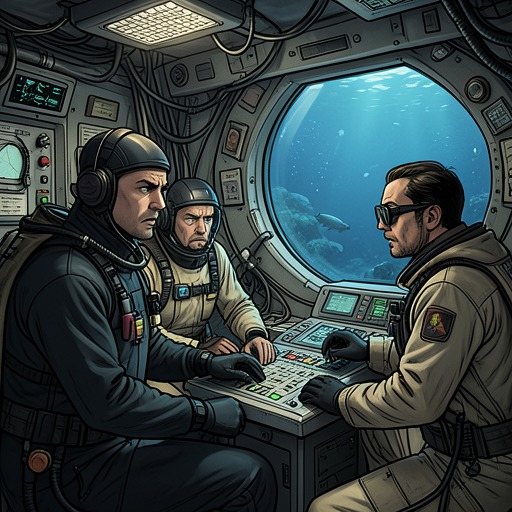
During a submersible descent, Arie Levy checks the external temperature gauge and finds the surrounding water at seventy-eight degrees. Linda explains that water issuing from black smokers reaches seven hundred degrees. As this hot, mineral-rich water rises, it warms the freezing seawater around it; at about twelve hundred feet above the trench floor, the plume reaches neutral buoyancy. It then spreads laterally with the ocean currents rather than continuing to rise as a narrow column.
The suspended minerals help form a floating layer of soot that acts as an insulating ceiling. Beneath it, a tropical layer of water is sealed along the bottom of the gorge. The account therefore presents the megaplume not simply as a hot discharge from the seafloor, but as a system: vents supply heat and minerals, rising water transfers warmth, currents distribute it, and the mineral layer limits its escape. Linda’s explanation also establishes that the warmth is not confined to the immediate mouths of the vents; the insulated layer extends across the deep environment.
Persistence in the Trench
When asked whether the layer ever cools, Linda answers that these are chronic plumes, active since the Cretaceous Period. Their duration gives the trench’s unusual warmth a geological scale: it is not a temporary change encountered by the expedition, but a persistent feature of the setting. The account does not describe a single plume’s beginning or end. Instead, the word chronic emphasizes continuity, placing the crew’s present descent within a system that has endured across an immense span of time.
This persistence also clarifies the contrast between the surrounding deep ocean and the warmer water held beneath the mineral ceiling. The plume’s heat does not make the entire trench uniformly hot. It creates a particular layered environment, shaped by the relationship between vent output and insulation. That distinction matters when the narrative later gives temperatures across the seafloor rather than treating the abyss as one consistent thermal zone.
Terry’s Descent Through the Plume
Aboard the Prometheus, Terry descends through dense, sedimentlike clouds: an abyssal ceiling of superheated water and minerals originating beneath the seafloor. The suspended material has been spewed from towering hydrothermal sulfide chimneys and helps maintain an insulated layer of warmth over many areas of the Mariana Trench. What Linda earlier describes as a mechanism now becomes part of Terry’s immediate route downward. The cloud obscures the view from the porthole; the descent is not yet a clear arrival at the bottom, but a passage through the material that sustains the warmer layer.
After minutes, the water gradually clears. The Prometheus descends another fifty feet into a canyon of shimmering black water, where temperatures range from fifty degrees along the abyssal plains to upwards of seven hundred degrees directly above the vent mouths. The range makes the structure of this environment legible: the plains remain comparatively cold, while the hottest water is concentrated over the vents. The vehicle has reached the bottom, but the floor is not a uniform expanse; its conditions vary with proximity to the sources of hydrothermal heat.
Narrative Significance
The megaplumes connect scientific explanation to the physical progress of the expedition. First, a temperature reading prompts Linda to describe how heat and mineral soot create an insulated layer; later, Terry’s descent supplies a visual and spatial counterpart in the sedimentlike clouds, the clearing water, and the measured temperature range. The sequence turns exposition into orientation: the reader learns what sustains warmth in the trench and then encounters the layered environment through which the Prometheus moves.
The imagery also preserves a tension between concealment and revelation. The mineral-rich ceiling first makes the view murky, then gives way to the black-water canyon and the seafloor. The plume is thus both an environmental barrier and a sign of the geological activity below it. By tracing the Prometheus through that barrier, the narrative makes the trench’s warmth neither magical nor uniform: it is an enduring, materially explained condition whose effects are encountered at different temperatures and distances from the vents.