James Adams
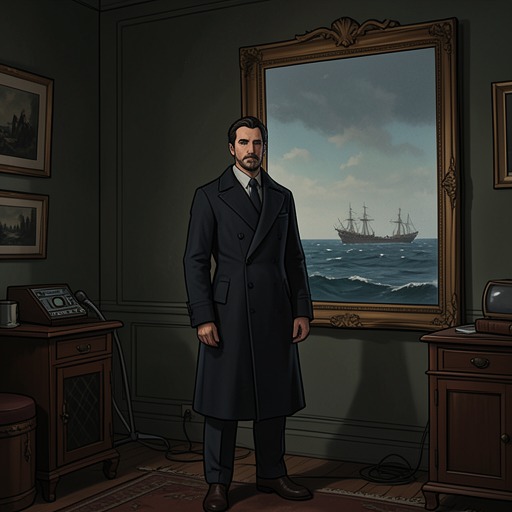
The TrenchJames Adams is the commander of the United States Navy base in Guam and a friend of Masao Tanaka. He becomes the human link between Masao and a government effort to reach fusion fuel in the Mariana Trench: Adams explains the threat posed by Benedict Singer’s backers, reveals how the investigation connected Singer to Jonas Taylor’s earlier dives, and tries to keep Masao from confronting Dave Ross. His role is defined by that divided position—responsible for communicating a strategic case while facing the personal harm that the operation has caused his friend.
Position and Introduction
Adams first enters this part of the story as the person Masao urgently wants to see. After learning that Celeste Singer has specifically requested the AG-Two, Masao asks for contact to be made with Commander James Adams at the Navy base in Guam and wants to meet him immediately. Though still in hospital and not yet discharged, Masao removes his IV and discharges himself. The urgency belongs to Masao; the evidence does not yet explain what Adams knows or why the meeting is needed. It establishes, however, that Adams is important enough to draw Masao away from medical care and toward Guam.
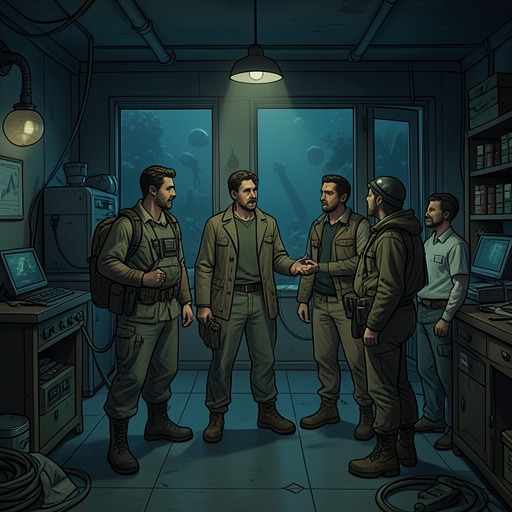
Their meeting takes place in Adams’s office at the United States Naval Base. Adams adjusts his gold-rim glasses, comes out from behind his desk to greet Masao, and signals his secretary to close the door. He welcomes his friend and introduces Dave Ross. The details make the exchange both official and personal: Adams receives Masao in his command office, but greets him as someone he knows well. The closed door and the introduction prepare the scene for information that will change Masao’s understanding of his company’s collapse and the pressure surrounding his daughter.
The Fusion Dispute
Adams lays out the government’s concern in political terms. He tells Masao that the Arab coalition financing Benedict Singer represents an organization responsible for financing terrorist acts, and argues that those factions cannot be allowed to monopolize fusion. The issue, as Adams presents it, is not simply a scientific discovery or a competition between companies. It is a struggle over who will control a new energy source and what power that control could confer.
Ross supplies the technological context: the United States, Russia, Japan, and the European Union have worked for years to complete the International Thermonuclear Experimental Reactor, while Singer’s discovery could put him decades ahead. Adams’s warning gives that advantage a security dimension. The discovery therefore links a remote undersea resource to international competition over fusion and to the government’s stated fear of its control by Singer’s financial backers.
Masao challenges the personal relevance of this explanation, asking what it has to do with him or his daughter. Ross answers that the Benthos’s depth makes it difficult to detect by satellite or sonar, and that even identifying the vessel would not solve the problem of reaching it after it descended into the Mariana Trench. He also says the fusion fuel originates somewhere in a remote area of the gorge. Adams’s account thus places Masao’s family and research institute inside a much larger operation: their connection to the trench is useful to people seeking access to a resource that is otherwise exceptionally difficult to locate and reach.
Friendship and the Cost of Secrecy
The explanation turns into an accusation when Masao connects the government’s account to his company’s ruin. He points to the class-action lawsuits, the monetary awards, and the denial of his company’s right to appeal, then accuses the government of arranging events so Geo-Tech would buy out the Tanaka Institute and gain a legal route into the trench. The scene does not present this as a detached policy disagreement. Masao stands and kicks back his chair as he confronts Ross, making the alleged damage to his family central to the argument.
Adams steps between the two men because he fears Masao may strike Ross, the Central Intelligence Agency director. He urges Masao to calm down and says the agency has assured him that reparations will be made. His intervention is both practical and conciliatory: he prevents the confrontation from becoming physical, then offers compensation as a reason for Masao to listen. But Masao rejects the reassurance as inadequate, asking Adams to consider the damage inflicted on his family. The exchange exposes the limit of Adams’s mediation. He can relay the promise of reparations, but he cannot make it answer the harm Masao describes.
Adams then says the damage could not be helped and asks Masao to understand what was at stake. That answer aligns him with the operation’s strategic rationale even as he remains personally concerned for his friend. His position is not presented as simple indifference: he intervenes to protect Ross and calm Masao, and he acknowledges the promise of compensation. Yet his appeal to necessity shows the cost of treating family and institutional ruin as acceptable consequences of a larger security objective.
The Seacliff Connection
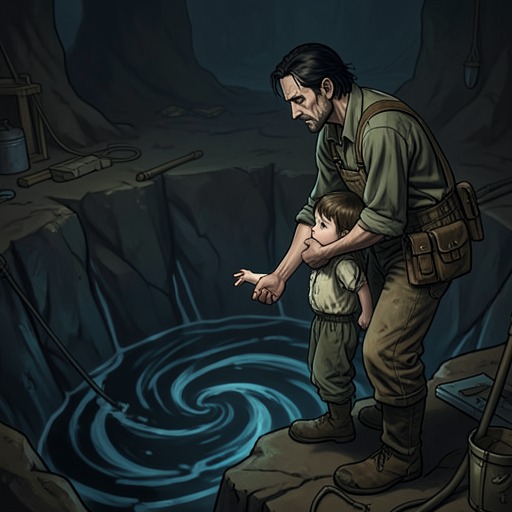
Adams also supplies the crucial history linking Jonas Taylor to the search for fusion fuel. He explains that eleven years earlier Jonas piloted a series of dives into the Mariana Trench aboard the Navy submersible Seacliff. On the last dive, Jonas apparently encountered a Megalodon and panicked; both scientists aboard were killed. Adams adds that the two scientists were fusion physicists, and that one had been a former colleague of Benedict Singer.
This account changes the significance of the earlier tragedy. The scientists’ deaths and Jonas’s encounter with the Megalodon are not only part of his past: the scientists’ fieldwork connects the Seacliff dives to the later search for Singer’s fuel. Ross explains that analysis of the remaining manganese nodules collected during the dive revealed inert gases trapped in the rocks. Adams identifies those gases as the fusion fuel. In this way, his briefing joins a chain of events across eleven years—an expedition, a fatal encounter, a scientific collection, and a discovery with international stakes—while making clear why Jonas’s history has become relevant to the present crisis.
Adams’s narrative role is therefore that of an informed intermediary whose explanations clarify the conspiracy’s strategic logic without erasing its human cost. He makes the connection between the Mariana Trench, the lost Seacliff scientists, Singer’s fuel, and the government’s fear of a monopoly. At the same time, his meeting with Masao shows how that logic collides with the destruction of a friend’s family and institution. His insistence that the stakes demanded such measures does not settle that conflict; it leaves the defense of necessity exposed to Masao’s unanswered charge.