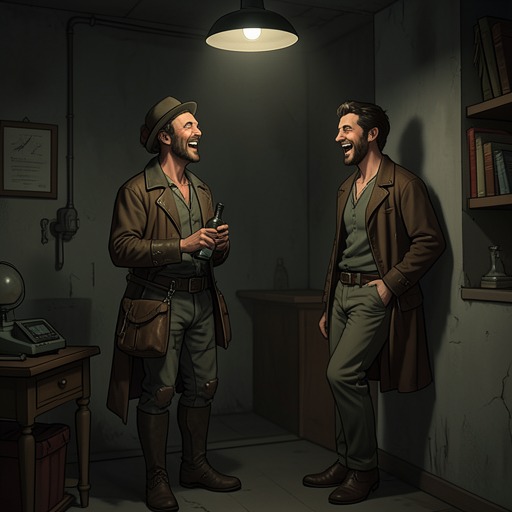
Jonas Taylor—Mac Mackreides
The TrenchJonas Taylor and Mac Mackreides share a candid, durable friendship in which loyalty takes the form of both practical intervention and uncomfortable truth-telling. When Jonas’s guilt and fear threaten to turn his pursuit of the Megalodon into a death wish, Mac does not simply comfort him: he physically removes him from a confrontation, insists that he confront his exhaustion, and later interprets his behavior through the knowledge of trauma he has gained from his own losses. Their bond is tested by Jonas’s refusal to be reassured, but Mac’s persistence keeps the friendship active at the very point Jonas tries to push his companions away.
Intervention Under Pressure
After Jonas’s heated exchange with Mike Maren, Mac takes hold of Jonas and leads him away from the confrontation. Richard Diefendorf helps escort him down two flights of stairs to the main deck, where they shelter beneath a Zodiac raft in heavy wind. The change of setting does not immediately calm Jonas: Mac tells him that his temper is being provoked, then recognizes that he is exhausted and needs sleep. When Jonas admits that he is afraid to sleep, Mac answers with confidence that Jonas knows what must be done and that the nightmares will end once he does it. He also urges him to let the fish expert pursue the capture, promising that the shark will eventually be brought within Jonas’s reach.
Jonas rejects that reassurance and tells Mac and Diefendorf to leave the boat. Mac’s response reveals the forceful side of their intimacy. He pushes back against Jonas, pins him against the A-frame, and gives him a choice between coming inside to get drunk or being knocked unconscious. The episode is not presented as a calm exchange between equals: Mac uses physical strength to stop his friend from driving everyone away while Jonas, exhausted and frightened, says he does not want them to die too. Mac answers with sarcasm about Jonas’s grand self-sacrifice, then leads him inside. The humor does not erase the danger in the moment; it is one of the means Mac uses to keep Jonas close and interrupt his spiral.
A Shared Knowledge of Guilt
Mac’s later conversation with Jonas makes clear that this intervention rests on personal recognition, not only loyalty. While they stow sound equipment in a compartment near the ship’s A-frame and look toward the Washington coastline, Mac asks why Jonas behaved as though his life did not matter. He identifies the pattern as survivor’s guilt and explains that he has experienced something similar himself. During a third tour of duty in Vietnam, he led his platoon into an ambush and lost more than half his men. He blamed himself and repeatedly relived the night in dreams.
Mac does not claim that the dreams vanished. He says they still return occasionally, but with less intensity, and that he no longer wakes screaming. By describing change as gradual rather than miraculous, he offers Jonas a concrete account of survival beyond the worst period. His personal history gives his advice weight, while also placing a limit on what he can promise: he understands the experience, but cannot instantly remove Jonas’s guilt. Jonas answers with irony about Mac’s time in psychiatric treatment, yet Mac continues to speak seriously, warning him not to discard his life simply because he cannot currently see a way forward.
The Shark, Terry, and Jonas’s Fixation
Mac’s empathy does not mean that he accepts Jonas’s account of the Megalodon without challenge. He sees that Jonas has declared war on an animal that is merely trying to survive, and argues that Jonas has attached the losses of the last eleven years to the creature. In Mac’s reading, killing the shark has become more than a mission: Jonas believes that its death will settle a much broader reckoning. Mac’s comparison of Jonas to Captain Ahab frames the pursuit as an obsession capable of consuming the hunter, even as Mac recognizes how deeply Jonas is committed to it.
The personal stakes sharpen when Jonas recalls begging Terry Taylor not to descend into the Trench. Mac tells him that Terry is expected back aboard the Goliath within days and stresses that the Megalodon is thousands of miles from the Trench. He treats the two dangers as coincidental, not connected, and predicts that Terry will be topside by the end of the week. Jonas cannot accept the reassurance as certainty. He acknowledges that he may not be thinking rationally, but says he cannot take the chance that the events are related; he wants the shark dead to remove the doubt. Mac agrees to that immediate objective and imagines Jonas and Terry returning to a shared future once the shark is dead.
Friendship as Friction and Support
The friendship between Jonas and Mac is defined by a repeated tension between Jonas’s impulse to withdraw and Mac’s insistence on staying involved. Mac offers care through action—removing Jonas from the argument, getting him inside, and placing a hand on his shoulder—as well as through frank interpretation of the guilt and obsession driving him. Jonas, in turn, does not simply accept Mac as an authority: he resists, jokes, and admits uncertainty. Their candor allows disagreement without ending the alliance.
Mac’s own history makes him a companion rather than a distant counselor. He has known blame, recurring nightmares, and the long work of living with loss, so his confidence in Jonas’s ability to find a way out comes from experience rather than abstract optimism. Still, his support has limits: he cannot persuade Jonas to abandon the hunt or prove that Terry is safe. He stays beside him while Jonas chooses to pursue the shark, combining practical solidarity with warnings about the cost of that fixation. Their relationship therefore offers no simple cure for Jonas’s trauma; it provides a persistent counterweight to the isolation and self-destruction that trauma encourages.