Jonas Taylor—Terry Taylor
The TrenchJonas Taylor—Terry Taylor is a marriage tested by loss, fear, and the consequences of Jonas’s choices. Its repair takes shape not through a simple explanation or a promise that danger has passed, but through a change in understanding: Terry recognizes the reality of the fear she had dismissed, while Jonas confronts the damage he believes he has done. Their reunion in the UNIS brings that change into the open, turning rescue into an act of renewed commitment even as danger continues around them.
Loss and the roots of the fracture
The couple’s estrangement is bound to a private loss that followed Jonas’s trial. He explains that the proceedings and their public coverage overwhelmed him with guilt over the people who had died during his attempt to capture a shark. At the time, Terry was pregnant with their first child. The baby died in the womb in the eighth month, shortly before the verdict. Jonas connects the night terrors that began immediately afterward to the grief and guilt he was carrying; a psychiatrist diagnosed post-traumatic stress disorder. Medication helped for a time, but the dreams later returned more intensely.
The account gives their marital conflict a history deeper than the immediate hazards of the expedition. Jonas’s terror has a specific origin and has persisted beyond the trial, but Terry had not understood its force. The difference between his lived experience and her earlier response becomes one of the relationship’s central wounds. His history also complicates his decisions: he recounts several failures, including the attempt to capture the Megalodon rather than kill it and his later failure to prevent its offspring from escaping. In retrospect, he says he should have drained the lagoon and drowned the shark two years earlier. His self-reproach is therefore tied both to the trial and to decisions he sees as renewed opportunities to avert danger that he failed to take.
Fear understood at a distance
Isolated aboard the Benthos and frightened of Benedict and Sergei, Terry repeatedly recalls Heath Williams’s warning that Benedict considers himself above the law and might kill her. On the verge of hyperventilating, she steadies herself by imagining the few days remaining until she can return home, embrace Jonas, apologize, and tell him that she understands what he has endured. The imagined reunion is practical as well as emotional: getting topside and going home become measures of how much longer she must withstand the present danger.
For the first time, Terry recognizes that Jonas lives with constant fear and that his mind is consumed by premonitions of violent death. What she had treated as paranoid delusions now becomes intelligible to her as an experience with real emotional power. Her isolation does not erase the harm between them, but it changes how she interprets it. She understands that she had been callous toward a fear she had not herself experienced, and she misses him. This turn matters because the movement toward repair begins before they are physically reunited: she is already preparing to acknowledge her part in the distance between them.
Jonas, meanwhile, remains caught in the expectation that his nightmare will come true. He tells Mac Mackreides that he believes both he and Terry will end up in the Trench, and that the creature will appear. When he erupts over having begged Terry not to go, Mac tries to separate the present situation from Jonas’s guilt: Terry is expected back aboard the Goliath within days, and the Megalodon is thousands of miles from the Trench. Jonas admits that he cannot think rationally and says he needs to kill the creature to remove all doubt. His fear is not merely a private symptom; it drives his judgment and keeps his marriage entangled with the dangers he is trying to control.
Rescue and recognition
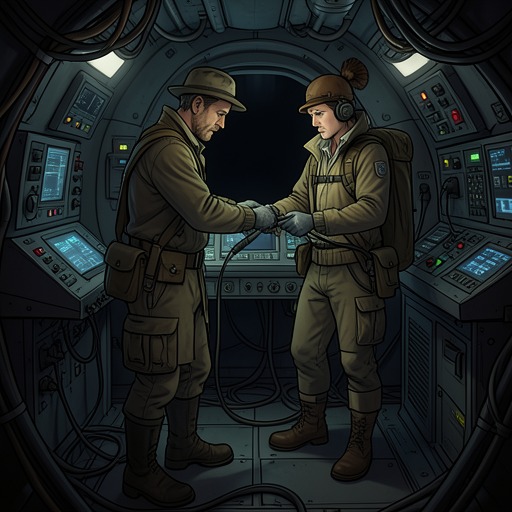
The decisive change comes when Jonas reaches Terry inside the UNIS. He lifts its lid, finds her unresponsive, pulls her out, and begins mouth-to-mouth resuscitation. When she recovers, his relief is immediate and uncontrollable: he trembles, smiles, and cries. Terry recognizes him, embraces him, and tells him she loves him. He answers that he loves her too. They hold each other for a long moment, temporarily unaware of their surroundings. The exchange gives their reconciliation a clear reciprocal form: Jonas’s rescue is met not simply with gratitude but with an embrace and an explicit declaration of love, which he returns.
Yet the scene does not make their repair equivalent to safety. A metallic screech sounds above them, interrupting their reunion. Later, Jonas describes the danger he expects as they approach the hydrothermal ceiling: in his dreams, Angel follows them upward and engulfs the pod. The threat remains present in the very conversation where he addresses the marriage. He apologizes for having ruined it; Terry responds that he risked his life to rescue her. Her answer does not deny the damage or offer a detailed accounting of it. Instead, she places his present action beside his confession, recognizing the commitment his rescue demonstrates.
A fragile renewal under continuing threat
Jonas tells Terry that he would rather die with her than live without her, then leans over and kisses her. The statement makes his attachment unmistakable, but its terms remain shadowed by the immediate danger and by the fatalistic language that has accompanied his nightmares. Their closeness is genuine; it is also formed under pressure, with no assurance that either will reach safety. Terry’s hand in his and her response to his apology make the scene a moment of mutual recognition, not proof that every conflict has been settled.
The relationship’s movement is therefore from misrecognition toward a guarded, embodied reconciliation. Terry learns to see Jonas’s fear from within her own experience of isolation and danger; Jonas, after repeatedly blaming himself for failures and imagining catastrophe, acts to bring her back and acknowledges the harm he believes he caused. Their words and gestures restore intimacy while the surrounding peril remains active. The reunion offers a second chance, but the threatened ascent and the returning Angel leave its outcome open: the marriage has turned toward one another again, without yet escaping the world that tested it.