Jonas Taylor's Post-Traumatic Stress and Survivor Guilt
The TrenchJonas Taylor's post-traumatic stress and survivor guilt link the deaths surrounding the shark-capture operation to a private family loss and to his later sense that he failed to prevent danger. The nightmares first followed the trial and the death of his and Terry Taylor's unborn child; when they return, Jonas reads them not only as symptoms of distress but as a belated demand to act. His account leaves a tension unresolved: he sees guilt as evidence that he should have done more, while Mac Mackreides warns that guilt and dreams can distort the future as well as recall the past.
Origins in the Trial and Family Loss
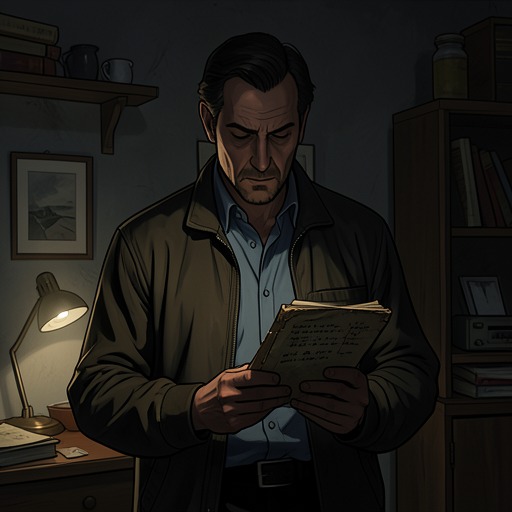
Jonas traces the beginning of his nightmares to a trial that began about two years earlier. He had to face, week after week, the surviving parents, spouses, and children of people who had died while he was trying to capture a shark. The trial’s repeated confrontation with those bereaved families made the consequences of the operation difficult for him to set aside. Celeste Singer calls the proceedings a sham and says the judge had railroaded him, but Jonas does not treat that judgment as enough to resolve his distress: even if the trial was unfair, he remembers being overwhelmed by the pressure and going home consumed by guilt.
The strain coincided with Terry Taylor's pregnancy with their first child. Jonas recalls that they had been excited, but that the trial and its media coverage took a toll on them. Just before the verdict, in the eighth month of pregnancy, the baby died in the womb. The chronology gives the loss a defining place in his account: Jonas says the night terrors began right afterward. The evidence does not present the child's death as something Jonas caused; rather, it shows how the loss followed a period in which he was already struggling under public accusation and responsibility for the deaths tied to the shark-capture effort.
Diagnosis and the Return of the Nightmares
A psychiatrist labels Jonas's condition post-traumatic stress disorder, connecting it to guilt that had emerged during the trial. Medication works for a time, giving the nightmares a period of relative quiet, but does not end their recurrence. When they return, Jonas describes them as worse than before. The sequence matters: the distress is not a single reaction confined to the courtroom, but something that persists beyond the trial, eases, and then resurfaces.
Jonas's explanation of the returning dreams changes their meaning without establishing that they are literally predictive. He believes that, as early as two years before the conversation, he knew the Megalodon's offspring was growing too large to control. In retrospect, he understands the nightmares as his subconscious urging him to act before the creature escaped. His certainty gives the dreams a practical and moral force: they seem to tell him that recognizing danger was not enough. Yet the account also preserves a gap between what he felt he knew then and what he believes the dreams mean now; this is Jonas's interpretation of his symptoms, not proof that the dreams foretold events.
Warning, Constraint, and Responsibility
Jonas says he did not simply ignore the danger. He warned Masao Tanaka that the creature might escape and argued that she should be permanently sealed in the lagoon. Masao agreed, but they lacked the funds to carry out the plan. Their inability to act therefore sits at the center of Jonas's guilt: he remembers recognizing a threat and proposing a response, yet the response remained beyond their means.
An injunction then closed the Tanaka Oceanographic Institute and froze its assets. Jonas recalls that the Institute could do little beyond paying attorneys and feeding the shark. He describes the sequence as if the people with power had wanted the organization to go bankrupt. The account presents that as his perception of the circumstances, rather than establishing anyone's hidden motive. It also complicates his self-blame: Jonas's sense of responsibility is intense, but the action he says was needed depended on funding and institutional capacity he and Masao did not have. His nightmares turn that constrained history into a personal demand that he should have prevented the danger all the same.
Mac Mackreides as Witness and Counterpoint
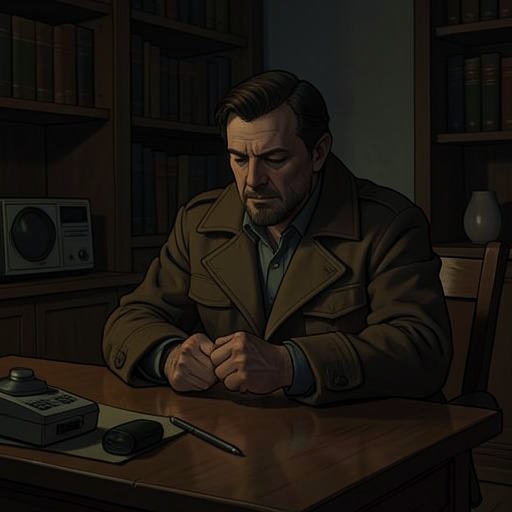
Mac recognizes Jonas's guilt through his own experience in war. During his third week in the jungle, he led his platoon into an ambush; more than half his men were lost, and he blamed himself. He says he repeatedly relived that night in dreams, though they later became less intense and he stopped waking in terror. His experience gives him grounds to recognize a resemblance in Jonas without claiming that their circumstances are identical.
Mac identifies Jonas's fixation on the creature as a way of assigning the losses of the past eleven years to a single target. At the same time, he distinguishes Jonas's anger from the animal's nature: the creature is trying to survive, not knowingly taking part in a conflict with him. The comparison challenges Jonas's understanding of his own pursuit. What feels to Jonas like a campaign against an enemy may also be an attempt to give grief and responsibility one object on which to settle.
Jonas responds that he knows how his life ends, a claim Mac meets with caution rather than confirmation. Because Mac has also dreamed of his death, he urges Jonas not to make a nightmare into a self-fulfilling prophecy and tells him not to throw his life away. The exchange leaves Jonas's belief in his foreseen ending in tension with Mac's account of recovery: Mac's dreams grew less powerful, while Jonas's have returned with greater force. In this episode, the condition is neither resolved nor treated as a reliable forecast. It is shown instead as a struggle over what guilt can tell Jonas, what it cannot prove, and whether he can act without surrendering his future to the dreams.