Jonas's prophetic nightmares
The TrenchJonas's prophetic nightmares are both an expression of trauma and a forecast that Jonas Taylor believes he should have acted on. They return him to the losses surrounding the Megalodon, then take the form of a descent into the Mariana Trench in which he cannot escape Angel. As their images begin to resemble events unfolding around him, Jonas treats them not as private distress alone but as evidence of a danger he had already recognized—and failed to stop.
Origin in Guilt and Bereavement
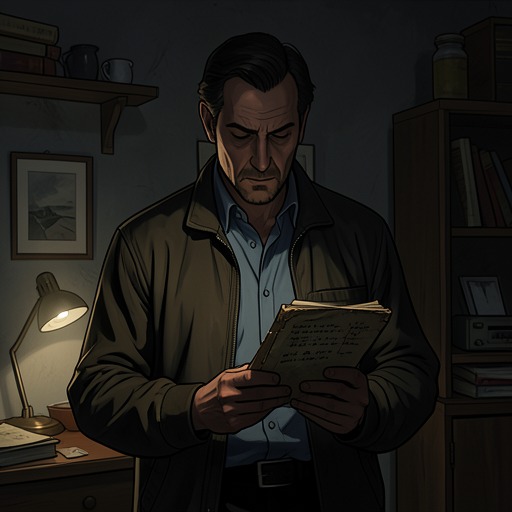
Jonas traces the nightmares to the trial that followed his attempt to capture a shark. For weeks, he had to face relatives of people who died in the operation. Although Celeste Singer calls the trial a sham and says the judge railroaded him, Jonas recalls the pressure as overwhelming: he stayed awake at night, consumed by guilt. The legal proceedings therefore form the first setting for the dreams, but their effects reach into his family life as well.
During the trial, Terry Taylor was pregnant with their first child. The pregnancy ended in the eighth month, shortly before the verdict. Jonas says the night terrors began immediately afterward. A psychiatrist diagnosed post-traumatic stress disorder, connecting the condition to guilt that had taken shape during the trial. Medication helped for a time; later, however, the dreams returned more intensely. The account places that recurrence beside a loss that Jonas had already associated with a period of public blame and private anguish, without suggesting that the nightmares simply disappeared once they were medically named.
From Recurrent Dream to Warning
When Celeste asks what is haunting him, Jonas initially describes the dreams through their effect on him: he wakes screaming, and their return is worse than before. He then gives them a second meaning. Looking back, he believes he knew two years earlier that the Megalodon's offspring was growing too large to control. In his account, the nightmares were his subconscious urging him to act before the animal escaped. This is Jonas's retrospective interpretation, not a claim that the dreams provide a clear or dependable solution; their warning matters because he thinks he recognized the danger and did not prevent it.
He explains that he did try to pass on the concern. He warned Masao Tanaka that the creature would eventually escape and that it should be permanently sealed in the lagoon. Masao agreed, but they lacked the money to act. A cease-and-desist order then closed the Institute and froze its assets, leaving them to pay attorneys and continue feeding the shark. The sequence complicates Jonas's self-accusation: he sees himself as having passed the responsibility onward, while the warning could not be converted into action under the financial and legal constraints he describes. In the dreams, that past failure returns as an urgent presentiment.
The Trench, Angel, and the Predicted Death
Jonas's most explicit death dream is set eleven years after he believes he cheated death aboard the Seacliff. In it, he descends in the deep-sea model of the Abyss Glider. Angel emerges from the darkness, and this time Jonas cannot escape. He describes the vision as having closure and becomes convinced that he is destined to die in the deep recesses of the Mariana Trench, where he thinks he should have died years earlier. The dream binds a remembered survival to an imagined ending: escape no longer appears to have settled the danger but to have deferred it.
The vision also acquires a more specific and painful form when Jonas confides in Mac. He says that he descends to the Mariana Trench in the Abyss Glider apparently searching for Terry Taylor, and that she dies with him after he finds her. When events seem to echo this sequence, he calls the nightmare a bizarre déjà vu and insists that both of them will end up in the Trench. He remembers begging Terry not to go. His alarm is therefore not only fear of his own death; it is also a prediction of a shared fate and a response to his inability to keep Terry from entering danger.
The arrival of an AG-2 makes the dream's machinery seem materially present. Jonas objects because he has told Celeste about the nightmares and now sees the deep-water sub aboard; he calls it his coffin. Celeste answers that he will not pilot it. The exchange does not establish that the dream is literally coming true, but it shows how an ordinary equipment decision becomes charged by the image Jonas already fears. The sub is not merely a vehicle in this moment: to him, it appears to be the vessel that could carry him toward the death he has imagined.
Fear, Judgment, and Risk
The nightmares unfold in a story where fear is repeatedly argued over rather than treated as a simple measure of competence. During an earlier dispute about operating the Proteus, the team leader accuses Captain Leace of being scared. Leace answers that fear is appropriate at a depth of thirty-five thousand feet, where a hull breach could leave no time for ordinary emergency procedures. The exchange gives Jonas's dread a practical counterpart: the abyss presents hazards that confident schedules and expertise cannot make controllable.
Other disagreements sharpen the distinction between calculating a threat and understanding how it may change. Michael Maren reads the SOSUS data as showing the Megalodon less than two miles ahead, moving north at three knots, and estimates that it will take ninety-four minutes to reach the bay. Jonas counters that Angel may accelerate as soon as she detects the calf, reaching sixty-eight miles an hour; he also objects to confining a seventy-two-foot animal that has spent its life in captivity. The disagreement does not prove that every fear Jonas has is correct. It does show why he distrusts a plan built on a static estimate of speed and position: to him, danger is shaped by an animal's response, not just its present location.
A related dispute aboard the expedition concerns the boundary between acceptable risk and foolhardiness. Benedict argues that the mission's purpose justifies deaths and invokes the public good, while Captain Hoppe protests that sending the Prometheus too far ahead of the Benthos endangers the crew. Set beside those arguments, Jonas's dreams give risk an intimate scale. The cost is no longer an abstract number of casualties or an operational timetable; it is a feared descent in which Terry is beside him and neither returns.
Prophecy and Uncertainty
Mac directly warns Jonas against making the nightmares into a self-fulfilling prophecy. Jonas denies that he is trying to do so, but says he has seen how his life ends. That exchange leaves the dreams suspended between warning and fatalism. Jonas interprets them as a call to act, yet their apparent certainty also tempts him to regard death as already settled. Their significance comes from this contradiction: the dreams make him more alert to danger while threatening to persuade him that resistance is futile.
The narrative does not reduce the nightmares to either a supernatural prediction or a symptom that can be dismissed. It grounds their return in an explicit history of guilt, the death of Jonas and Terry's child, and a diagnosis of post-traumatic stress disorder; it also connects their imagery to an earlier warning about the Megalodon's growth and to Jonas's present fear for Terry. His dream of the Trench gathers these strands into one image of delayed consequence. Whether Jonas is foreseeing events or reading danger through trauma, the visions force him to confront what he believes he failed to do—and what he may still be able to prevent.