Kamchatka Trench
The TrenchThe Kamchatka Trench is a crucial link in the undersea route Jonas Taylor proposes for the female Megalodon’s journey across the North Pacific. More than a geographic landmark, it gives his account of the predator’s movement a physical structure: a trench system that may guide a shark toward the Kuril and Japanese trenches, while carrying it into the path of migrating whales.
Geographic Setting and Route
Jonas’s explanation treats the Kamchatka Trench as part of a connected chain of deep-sea gorges. He believes the shark bypassed the Bering Sea and continued southwest by following seismic vibrations from the Aleutian Trench. From there, the proposed route crosses the North Pacific to the Kamchatka and Kuril trenches, continues past the Kuril Islands, and leads toward the Japanese Trench and ultimately the Mariana Trench, identified as the species’ home for more than a million years.
The route is presented as a hypothesis grounded in the sharks’ sensory abilities. Jonas explains that they can use the Earth’s magnetic field and seismic vibrations along fault lines to orient themselves over long distances. He had previously thought the female was following whale migrations, but now sees the trench system as a possible navigational path. Mac captures the implication by likening it to an underwater highway; Captain Morgan remains unconvinced that seismic guidance, rather than cetacean migration, explains the shark’s movements.
The Shark’s Passage
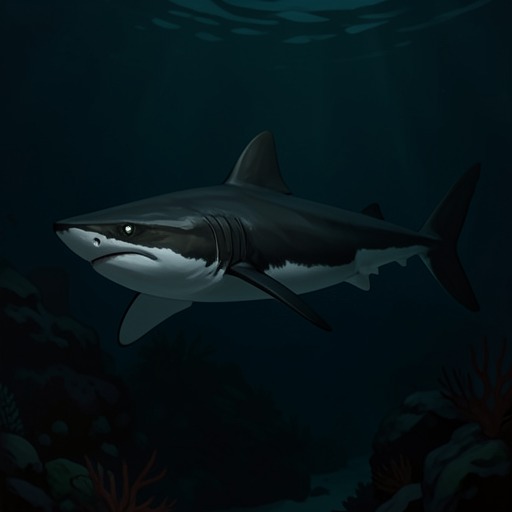
A later account follows the female as she moves southwest along the Asian coast in the southerly flow of the Anadyr current. Having crossed the North Pacific by using the Aleutian Trench as a bearing, she follows the Kamchatka Trench southwest and passes Cape Lopatka. The narration turns the geographic theory into a concrete journey: the trench is not merely a line on Jonas’s map but part of the route the predator takes through the ocean.
Near Cape Lopatka, the shark encounters a thousand whales migrating north toward their summer feeding grounds in the Sea of Okhotsk. The whales panic and establish an alternative route to give the predator a wide berth, but not before she kills and feeds on a fin whale and her calf. The encounter shows how a deep-sea corridor can connect long-distance movement to immediate predation, disrupting the migration of animals at the surface.
Narrative Significance
The Kamchatka Trench links scientific interpretation with action. Jonas’s revised theory gives a possible pattern to a journey that first seemed explicable as whale-following; the subsequent account of the shark’s passage supplies a vivid instance of that pattern, while the competing explanation voiced by Captain Morgan leaves some uncertainty in place. The trench route therefore functions as both a proposed navigational system and a path through which the predator’s presence alters the behavior and safety of other animals.