Kronosaurus
The TrenchKronosaurus is a short-necked marine reptile adapted to deep water, and its appearance overturns the assumption that the Mesozoic predator belongs only to the distant past. In the Mariana Trench it survives as a fast, social hunter, breathing through gills and drawing warmth from hydrothermal vents. Its encounters with the crew of the Benthos bring that ancient life into direct conflict with human technology; the later birth of Megalodon pups reveals that the conflict belongs to a larger, continuing food chain, not simply to a monster story with a single quarry.
Identity and Fossil Evidence
Heath first introduces the animal through a massive fossil specimen laid across four steel tables under surgical lights. The grayish-black section, more than ten feet long and eight feet wide, extends from the middle of the jaw to the forelimb girdle and upper rib cage. Its crushed skull nevertheless preserves evidence of a formidable predator: Heath describes a flat-topped head, powerful jaws with twenty to twenty-five teeth in each jaw, and fragments of teeth about four inches long. The torso and paired, elongated flippers suggest a streamlined swimmer built for pursuit, while the large limb girdles recovered from other fossils support the inference that these reptiles could move rapidly through the sea.
The fossil changes the meaning of the animal’s apparent extinction. Heath dates the specimen to less than two thousand years before the present, rather than to the Mesozoic seas in which its kind was thought to have flourished. He also identifies grooves beside the crushed rib cage as apparent gill slits. In his account, this is a marine reptile that evolved over tens of millions of years to inhabit the unusual conditions of the Mariana Trench: an ancient body plan modified for a deep-water environment. The evidence is damaged and some features are difficult to read, but the surviving anatomy joins fossil history to a living, breathing population.
A Living Deep-Sea Predator
The living animals make the fossil’s proportions immediate and dangerous. When the water fills the Benthos hangar, a colossal brown head emerges from the darkness. Its flat, crocodilelike jaws open around rows of pointed teeth; the roughly forty-foot reptile takes Sergei’s remains in one bite and swallows as it turns upside down. Luminous scarlet eyes search the hangar for more food. The scene presents the creature not as a relic to be studied but as a predator entering the ship’s enclosed human space, where a dead body becomes prey and the open hangar leads back to the abyss.
Kronosaurus also hunts smaller animals with startling speed. When Benedict prevents Terry from fleeing, she sees one engulf a gulper eel in two quick snaps. The creature turns gracefully away, striking the LEXAN glass with one enormous paddlelike limb as it disappears. Benedict identifies six animals circling the Benthos. Their presence around the vessel makes the earlier image of one sudden attacker part of a sustained encirclement: the ship is inside the territory of a group, not facing an isolated visitor.
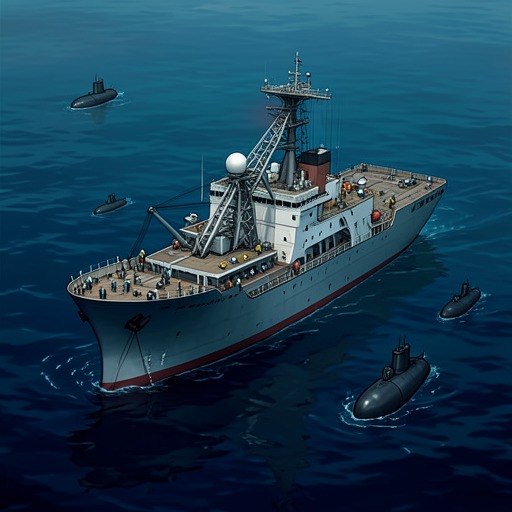
The historical relationship between Kronosaurus and Megalodon is described as a long contest for predatory dominance. Benedict says the short-necked pliosaurs ruled the Mesozoic seas until Megalodon evolved seventy million years ago. In the present, the animals’ coordinated behavior remains consequential. Jonas is told that the Benthos has been attacked by a pack of Kronosaurus, and that the ship is stranded on the bottom. The proposed rescue plan uses powerful underwater lights mounted on the Prometheus to keep the reptiles away while the remaining crew are evacuated. The lights offer temporary protection, not mastery of the surrounding sea.
Pack Behavior and Adaptation
The narrative later follows a family moving above the warm seafloor. A forty-nine-foot, twenty-five-ton adult female leads; she is nearly one-third larger than her mate and twice the size of her surviving female offspring. The smaller animals travel on either side of her pelvic girdle in a close triangular arrangement. Their formation conserves energy: the adult’s body creates a channel of water that draws the others forward. It also makes the group appear larger to its voracious enemy, Megalodon. Their cooperation is thus both efficient movement and a defensive answer to predation.
Their route through the gorge also explains how a cold-blooded reptile can live in the abyss. The animals move in and out of hydrothermal vents, using superheated water to maintain body temperature. Their ancestors depended on the sun’s warmth; the surviving genus instead draws heat from the deep seafloor. Gills allow them to breathe underwater, completing the adaptations Heath had inferred from the fossil. The vents are not merely scenery or a source of danger: they are part of the conditions that make this population’s continued existence possible.
Encounters and Reversals
During Jonas’s attempt to reach the Benthos, the pack’s behavior turns the rescue approach into a series of reversals. After one Kronosaurus is stunned, a larger animal closes in from behind, then veers away with its offspring. The radar blips move east, but a different, much larger object approaches from the south. The apparent retreat offers only a brief reprieve. Two blips reappear, and the creatures race upward from the seafloor, cutting Jonas off from the stranded ship and forcing him to turn back toward the Prometheus.
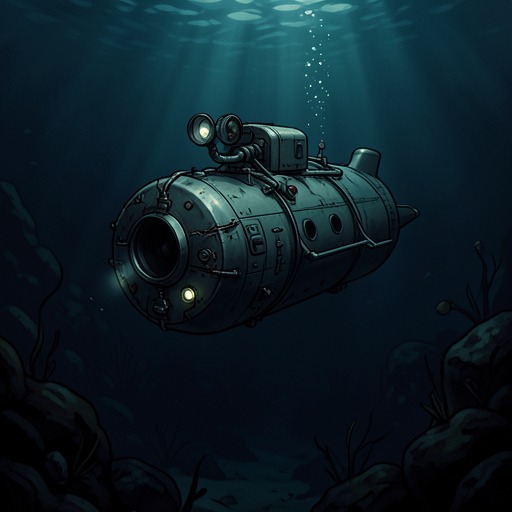
The adult then appears in the Abyss Glider-2’s headlights and snaps at its tail fin. The animals work together to circle the sub and keep it between them. Jonas climbs vertically toward the protective lights of the Prometheus, using the vessel as a refuge from the surrounding dark. Later, he draws an approaching animal toward the hangar and rolls the sub inside. Before the doors close, a smaller Kronosaurus darts into the chamber and crashes sideways into the craft, overturning it and smashing a row of UNIS robots. The animal is wedged lengthwise in the enclosure, straining toward its prey as the door seals. The maneuver saves Jonas from an immediate open-water attack but brings the danger inside the ship’s machinery and confines both predator and prey in a cramped space.
In the LEXAN escape pod, the conflict reaches a further reversal. As the face of Megalodon rises from the mist, Jonas and Terry see an adult Kronosaurus charge the pod instead. Its jaws close over the cylinder, grinding it between tongue and palate while the two occupants cling to one another. The rivalry between the predators does not function as a reliable rescue: the animal that may threaten Megalodon can also mistake the pod for prey.
Birth and the Unstable Food Chain
The account of Megalodon’s newborns extends the struggle beyond the ship. A young hunter accelerates past its parent and disappears into a dark gorge; a second male pup, slightly smaller at nine feet, follows north. The exhausted mother pursues the offspring she has just borne, but the pups register her vibrations and flee among black smokers and tube worms, widening the distance between them. Their survival depends on avoiding both their insatiable mother and the packs of Kronosaurus. Birth does not provide safety or protection: it begins another contest for survival within the same ecosystem.
Unable to catch the faster pups, the female slows and struggles to breathe in oxygen-poor water. The shallows have not erased the limits imposed by her species’ adaptation to the warm gorge. Angel resumes a southerly course, homing in on a young Kronosaurus. The narration imagines that Megalodon might one day kill the last of the pliosaurs, ending the abyssal food chain that has sustained its kind for more than one hundred thousand years. If that happens, Megalodon would be driven back toward the surface in search of food. The possibility gives Kronosaurus a significance beyond its attacks on the crew: it is prey as well as predator, and the survival of its population helps keep the deep-sea system that sustains Megalodon intact.