Mariana Trench
The TrenchThe Mariana Trench is the deepest, least explored setting in Deep Pressures and the place where human ambition repeatedly meets what lies beyond its control. At 12 degrees north latitude and 144 degrees east longitude, it gives the novel’s explorations a specific geographic anchor; narratively, it is at once a workplace, a prison, a repository of concealed value, and the habitat of creatures presumed lost to prehistory. The dangers there are not confined to depth or pressure. The Trench holds the memory of an earlier catastrophe and the possibility that its survivors, or other deep-adapted animals, remain out of sight.
Setting and Physical Geography
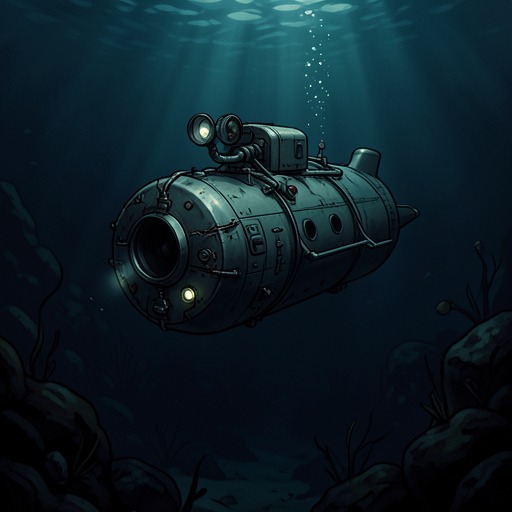
The novel identifies the Mariana Trench as nearly seven miles deep, the deepest and most unexplored location on the planet. Its darkness and remoteness shape the conditions of every descent: even experienced submariners must work inside vessels where drowning is an accident away. For the crews aboard the Benthos and its submersibles, the abyss is not a blank backdrop but a terrain to be mapped, sampled, and navigated under pressure.
A computerized bathymetric map shows the Trench as a long, winding gorge east of an arcing volcanic island chain. A rising shelf divides its northern and southern halves, separating the deeper stretches by about thirty miles. That divide gives the setting a readable physical structure while emphasizing how much remains difficult to access. The expedition’s work proceeds through repeated descents to the seafloor, where crews collect material and assess which terrains can support the next UNIS robots.
The Trench’s name also gathers meanings from the people who enter it. For Jonas Taylor, its darkness marks the place where an encounter changed his life. For Terry Taylor, it becomes the setting of a mission she did not want her father to discover she had joined. For Geo-Tech, it is both an operational challenge and a source of resources worth keeping secret. Those views overlap in the same confined environment, where exploration can become exposure to danger or captivity.
Earlier Encounters and Their Aftermath
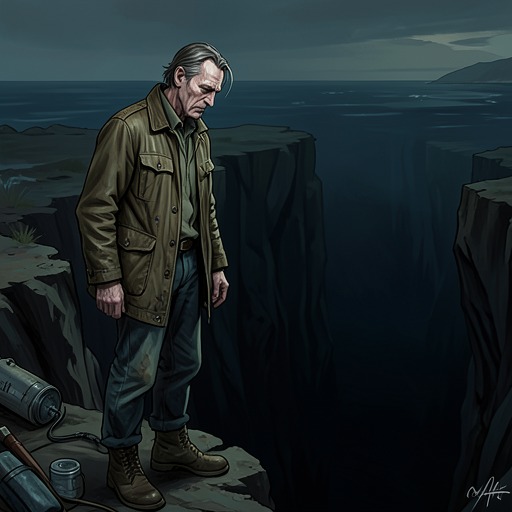
Eleven years before the later expedition, Jonas piloted the Navy’s three-man Seacliff on a top-secret dive nearly seven miles down. Looking into the black water, he saw a white glow resolve into a sixty-foot Megalodon rising toward the sub. Panic drove him to jettison the vessel’s ballast and race upward; the rapid ascent damaged its pressurization system, and both scientists aboard died. The encounter ended Jonas’s career as an argonaut, or so he believed at the time.
The Trench remained central to Jonas’s life after the disaster. For seven years, he pursued evidence that the creature had existed, returning to school and earning advanced degrees in paleobiology. His theory was that Megalodons had migrated into the warmer abyssal waters to escape the surface cooling associated with the last ice age. Colleagues dismissed his research, but the novel later establishes that the danger he had tried to document was real: four years before the present expedition, human intervention brought a Megalodon up from this very Trench. The albino predator killed at least a dozen people before it was destroyed, while its surviving offspring were captured. The earlier emergence makes every later descent carry a question the expedition cannot answer with technical precautions alone: whether more creatures remain below.
The Expedition and Its Risks
The later mission gives the Trench a second, active role as an environment under investigation. When the submersibles arrive late, Benedict Singer changes the deployment schedule: the Epimetheus is sent down first with supplies and a partial replacement crew, and the Prometheus is to follow after it returns. The planned week-long mission includes deploying at least three UNIS robots. The immediate work is systematic rather than spectacular: for four hours, the Prometheus travels through darkness, stopping about every kilometer to collect sediment and rock. Geologists aboard the Benthos are to examine each sample, helping map the terrain and identify suitable locations for future robots.
But the machinery and procedure do not make the expedition safe. Terry enters the Prometheus through the Benthos’s pressurized docking chamber, and Benedict guides her to a computer station with a reinforced six-inch window. The cramped vessel is a platform for research and, for Terry, part of a dangerous situation shaped by Benedict’s control. Later, after the Epimetheus docks, he sends it back into the Trench while keeping the Benthos close. Terry, locked in her cabin, concludes that the UNIS deployments may be a cover for Benedict’s own quest. Her suspicion turns the mapped landscape into a field of concealed purposes: what the crew calls scientific work may serve aims it has not been told.
Deep Life and Concealed Resources
The Trench’s biological history also unsettles the boundary between extinction and survival. After the Prometheus is attacked, an examination of damaged remains leads to the identification of a prehistoric marine reptile adapted to deep water. Its crushed rib cage appears to bear grooves consistent with gill slits. The evidence is presented as a sign that this species developed adaptations for the Mariana Trench’s unusual conditions over tens of millions of years; it inhabited those waters less than two thousand years ago. The prospect of Kronosaurs makes the abyss not merely a refuge for a surviving shark but an ecosystem where animals thought extinct may have persisted in altered forms.
The geological samples reveal another reason the Trench matters. Benedict explains that nodules collected by Prestis and Shaffer on an earlier secret dive contained a mixture of helium-3 and deuterium compatible with a long-burning fusion reaction. Their Seacliff used a suction device to retrieve the nodules from a precise site the two divers called Devil’s Purgatory. Benedict suspects the vacuum pump’s vibrations attracted the Megalodon that attacked them. The Navy confiscated the half-dozen nodules Prestis managed to collect without recognizing their value; years later, Benedict obtained some and tested them in his own laboratory, uncovering their properties.
Narrative Significance
These strands make the Mariana Trench more than a remote destination. The same depths that preserve animals outside ordinary expectations also contain a resource with the power to redirect human enterprise. Extraction and discovery are inseparable from risk: the suction apparatus used to gather valuable nodules may have drawn a predator to the Seacliff, while the later search for geological knowledge takes place amid attacks and hidden agendas. The Trench offers neither uncomplicated scientific progress nor a passive storehouse of wealth.
Its recurring importance also gives the novel’s explorations a structure of return. Jonas’s first descent ends in death and professional loss; later missions revisit the same abyss under new institutional and personal pressures. The place that once supplied a sighting dismissed as fantasy becomes the setting where evidence of deep-adapted life and concealed fusion fuel can no longer be separated from immediate danger. By bringing memory, research, captivity, and extraction together beneath the surface, the Mariana Trench stands at the center of the story’s conflict over what humans can discover there—and what discovery may awaken.