Mesozoic Era
The TrenchThe Mesozoic Era appears in the novel as the vanished age of powerful marine reptiles and as the deep past that may explain life in the Mariana Trench. Its ending brings environmental upheaval and extinction, while Heath’s account proposes that the Trench’s hydrothermal warmth allowed some reptiles to survive and adapt to its depths.
Marine Life in the Mesozoic
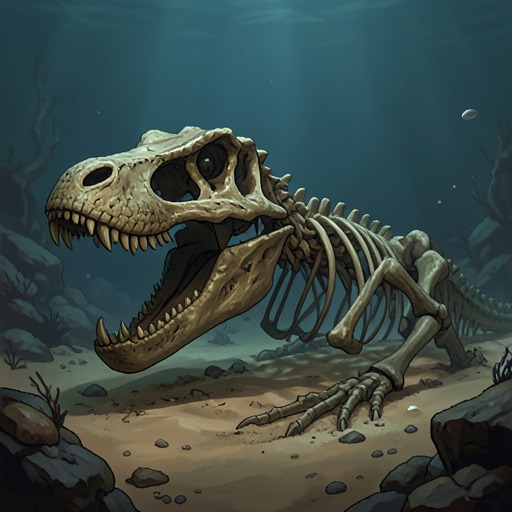
Heath describes the Mesozoic seas as an ecosystem in which Kronosaurus stood at the top of the food chain. In his reconstruction, around one hundred million years ago the waters stretching from the Mariana Islands toward the Australian landmass were warm and tropical, filled with prehistoric fish and reptiles. The scale of this lost world is also suggested by a fossil skull presented to Benedict: identified as belonging to a short-necked, carnivorous pliosaur, it is more than ten feet long and bears fragments of four-inch teeth. The specimen makes the age’s marine predators tangible, not merely names in an account of prehistory.
Cooling and Extinction
Heath places a major rupture about sixty-five million years ago, when an asteroid collision set off mass extinctions. Sea levels fell, and both air and ocean temperatures cooled. Dinosaurs disappeared worldwide at the end of the Mesozoic, while the extinction of ancient marine reptiles was more gradual, linked in Heath’s explanation to the steady decline in sea temperatures. Reptiles depended on external warmth, so the changing climate threatened animals whose bodies had been sustained by the sun-heated seas.
The Trench as a Possible Refuge
Against that history of cooling, Heath advances a theory about survival in the Mariana Trench. He argues that some Kronosaurus may have sought its warmer depths, where water heated by hydrothermal vents could act as a natural furnace. The vents also provide the basis for a broader change in scientific understanding: life in the abyss can draw energy from chemicals through chemosynthesis rather than depending on sunlight. Heath’s account further describes a prehistoric marine reptile that adapted to deep water by growing gills over tens of millions of years, apparently in response to the Trench’s distinctive conditions. These claims are offered as an explanation for the creatures encountered in the story, not as a settled account of the Mesozoic past. The era therefore serves both as an ecological history of extinction and as the remote setting for Heath’s proposed continuity between prehistoric predators and life in the abyss.