Nature cannot be driven away
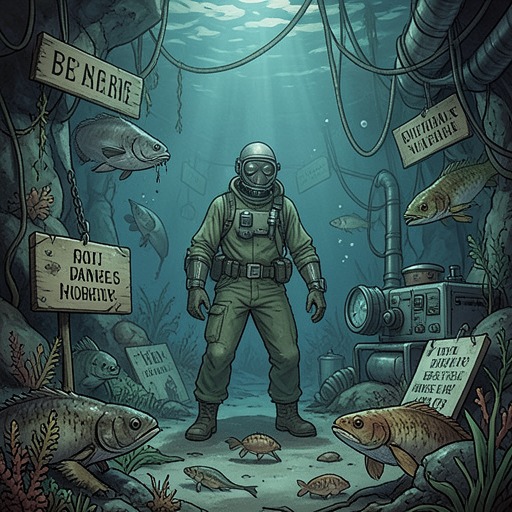
The TrenchNature cannot be driven away is both Benedict’s spoken reflection after a catastrophe and a pattern enacted by the novel’s recurring reversals. Human beings try to exploit and manage the deep through engineered vessels, lights, and carefully planned routes; the animals and pressures of the trench repeatedly make those plans precarious. The principle does not present nature as a passive backdrop. Its forces alter the course of events, damage human technology, and make the consequences of extraction impossible to contain.
The Maxim and the Epimetheus Disaster
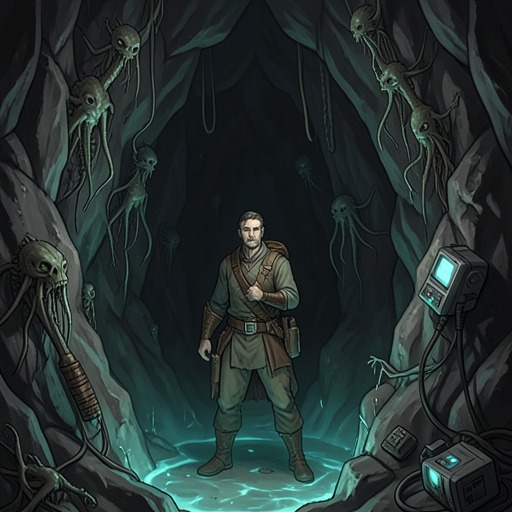
A fifty-thousand-pound female Kronosaurus drives its skull into the belly of the Epimetheus, compromising the submarine’s titanium hull. Under the pressure of sixteen thousand pounds per square inch, the vessel implodes inside the sealed docking-station vault. The ten-foot-thick titanium surrounding the chamber keeps the Benthos from suffering the same fate, but it cannot prevent the catastrophe within the vault. Human engineering contains the immediate damage only imperfectly: the surrounding ship survives, while the people and equipment inside the chamber do not.
Terry escapes the vault as the Benthos shudders around her. When the water in the chamber settles enough for her to see the wreckage, she turns away and flees with the others. Benedict alone remains, looking into the ruined chamber. He whispers the Latin maxim Naturam expellas furca, tamen usque recurret, then gives its meaning: “You may drive nature out with a pitchfork, but she will keep coming back.” He wipes a tear from his eye and closes his eyes before adding, “C'est la guerre.” The sequence makes the maxim more than a detached observation: Benedict speaks it in the immediate aftermath of an event in which a living predator and the pressure of the deep have overwhelmed a carefully constructed human enclosure.
Human Plans to Manage the Deep
The maxim recurs in the Benthos crew’s efforts to protect the Prometheus and continue collecting manganese nodules. Benedict says that the recovered material could supply power to every industrial nation for several years, but insists that it is not enough: his group must obtain more before the Americans discover their secret and seal off the area. Resource extraction is therefore not incidental to the danger. The crew’s intention to keep working in the trench shapes the measures they take to control the creatures and the route of the Prometheus.
Captain Prokovich identifies the immediate obstacle: the creatures are still circling, and the blood of the crew has kept them in the area. Benedict answers with a plan rather than abandoning the operation. High-powered lights are being installed along the Prometheus to deter the pliosaurs, while the Benthos will remain only fifty meters above the hydrothermal layer, where the creatures do not venture. It will escort the Prometheus down to the seafloor and back to the colder layer as the sub transports nodules to the Goliath. These precautions show an attempt to make extraction possible by adjusting equipment and position. They do not remove the predators from the situation; the plan depends on predicting their behavior and holding them at a distance.
The Benthos Attacked
As the Benthos rises from the seafloor, three Kronosaurs circle its underside. The ship’s hydraulic rams, forcing seawater out of its lower catches, draw their attention. Its rows of pressurized tanks are especially vulnerable: the animals appear to mistake the pontoons for the Epimetheus, which had been a source of food. They begin biting the titanium containers. The sequence links the earlier loss of the Epimetheus to the new danger, showing how one encounter shapes the predators’ response to another vessel.
Benedict watches an enormous flat head appear on a monitor and strike a gasoline tank. The tank’s damage exposes a weakness under trench pressure; it ruptures and implodes, jolting the Benthos sideways and cutting its lights. Emergency systems restore red lighting, but the ship has stopped rising and lists ten degrees to port. The crew reports that ballast tanks B-four through B-eight are gone and that gasoline is escaping from tanks G-five, G-eight, and G-nine. Another explosion follows. The ship then begins to fall back toward the seafloor. The reversal is decisive: machinery intended to lift and position the Benthos cannot sustain its course once the predators’ attack has compromised the tanks.
Meaning and Recurrence
Across these episodes, the maxim gathers force through repetition rather than argument. At the vault, the pressure of the sea and the strike of the Kronosaurus defeat the security of a sealed chamber. Later, the effort to protect an extraction route with lights, buoyancy systems, and a carefully chosen depth is disrupted by animals responding to sound, blood, and the appearance of the tanks. Nature acts through distinct material forces—predator behavior, water pressure, and the failure of damaged equipment—and each changes what the human characters can do next.
The contrast is not simply between nature and technology, since the Benthos’s armor and backup systems do prevent some immediate failures from becoming total ones. Rather, the novel presents control as provisional: a barrier can protect the larger ship while a vault is destroyed, and emergency power can restore light without restoring ascent. Benedict’s maxim names that limit at the same moment the story demonstrates it. The attempt to turn the deep into a manageable source of energy continues, but the creatures and conditions of that environment remain active participants in the outcome.