Naval mission coordinate secrecy rule
The TrenchThe Naval mission coordinate secrecy rule is the boundary Jonas Taylor and Heath Williams maintain around the location of a classified United States Navy deep-sea mission. The novel gives no formal written wording for the rule; instead, it makes the obligation legible through refusals to disclose coordinates, even when the request comes from someone close and the information might offer a warning. In the case of Devil's Purgatory, secrecy protects a location tied to a dangerous encounter and to a mission whose real purpose Jonas himself never learned.
The Classified Mission and Its Location
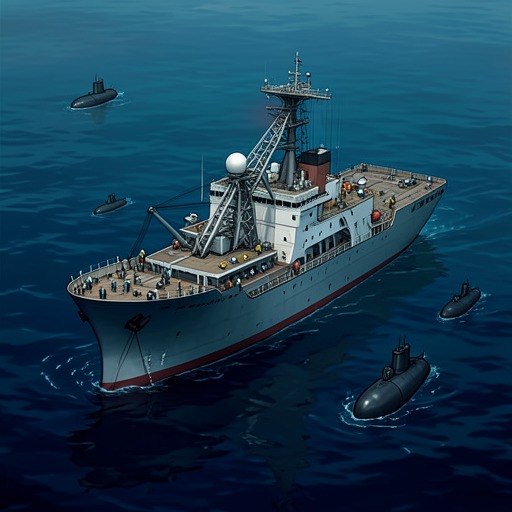
Heath tells Terry Taylor that he and Jonas worked on a deep-sea project for the United States Navy about eleven years earlier. The mission took place in the Mariana Trench, and its classified status has endured: Heath says Jonas still does not know what the operation was really about. He identifies Shaffer and Prestis, two colleagues who died when Jonas panicked in the abyss, as people connected to that earlier mission. The disclosure therefore establishes more than a protected set of coordinates. It places the rule within a history of secrecy, professional danger, and deaths whose circumstances remain bound to a mission Jonas cannot fully understand.
When Jonas later discusses the first time he saw one of the creatures, he dates the encounter to eleven years earlier, when he was piloting the Seacliff. The remote site had been nicknamed Devil's Purgatory. That name gives the hidden location an unusually vivid presence in the conversation, but it does not make its coordinates public: Jonas says he knows them and cannot discuss them because the mission was classified. The place can be named, remembered, and feared while its precise position remains inaccessible.
Celeste's Request and Jonas's Refusal
Celeste asks Jonas for the exact coordinates after hearing about Devil's Purgatory. Her concern is directed toward Benedict Singer and the Benthos crew, whom she describes as her family and all she has left. She wonders whether the Benthos might be exploring the same area of the Trench and argues that another Megalodon could be more likely to appear there. Her request is therefore framed as a warning meant to protect people, not as curiosity about military information for its own sake.
Jonas answers that there is no reason to think the area is more dangerous than another part of the Trench, but he does not treat that assessment as permission to reveal its location. He has already told Celeste that he cannot give out the coordinates; when she promises not to tell anyone and asks whether he trusts her, he separates personal trust from official secrecy. The restriction applies even when the person asking is trusted. He reinforces the point by saying that he could not disclose the coordinates to Masao Tanaka, whom he regards as a father figure. That comparison makes the rule's force concrete: affection and loyalty do not create an exception.
The refusal has an immediate interpersonal cost. Celeste slams down her fork and tells Jonas to forget she asked; he tries to calm her. The scene leaves the practical danger unresolved. Jonas does not provide a location that Celeste could use to warn the Benthos, and the reader is not told that she receives the coordinates by any other means. The rule thus operates not as an abstract statement about military procedure but as a choice that closes off one proposed route to protection.
Secrecy Amid Suspicion and Confinement
The coordinate restriction sits within a broader story of withheld information, but it should not be confused with the coercive control Benedict exercises aboard the Benthos. Terry becomes anxious among the crew, suspects that Benedict has brought her into the abyss for a hidden purpose, and concludes that he intends to keep her captive. Her suspicion follows her intrusion into the Goliath's lab, where she has encountered something important to Benedict without understanding its significance. Her experience shows how secrecy aboard the expedition can make information itself a source of vulnerability; it does not establish that Benedict's actions are an application of the Navy's coordinate rule.
The physical organization of the vessel gives that wider secrecy a material setting. In the hangar, Terry finds a control room enclosed in titanium and LEXAN glass, two large inlets beneath the floor, and an imposing titanium door. Elsewhere, she finds that a steel security door requires personal identification, and later tells Heath that Benedict is keeping her aboard like a prisoner. These barriers concern access to spaces and Terry's freedom of movement, rather than the disclosure of Devil's Purgatory's coordinates. Their contrast clarifies the rule's narrower operation: Jonas withholds information because the mission is classified, while Terry's confinement reflects Benedict's control over a person.
Scope and Significance
The novel presents the rule through two related refusals. Heath describes the mission as classified and says he cannot discuss the exact coordinates; Jonas repeats that boundary when Celeste presses him to share what he knows. Neither account supplies a broader code, a penalty for disclosure, or a named authority that would enforce it. The evidence supports a specific obligation around this mission's location, not a complete account of United States Navy information policy.
That narrow boundary nevertheless shapes the story's choices. Devil's Purgatory is both the site of Jonas's earlier encounter and a possible danger to the Benthos, yet the coordinates remain withheld when Celeste seeks them for protective reasons. Jonas's answer preserves the distinction between trust and authorization, while leaving the consequences of secrecy unsettled. The location becomes a point where classified history, present fear, and personal loyalty meet—and where the rule's effectiveness is measured by what Jonas will not say.