Power struggle to monopolize fusion energy
The TrenchThe power struggle to monopolize fusion energy is the political and scientific conflict driving the secret operation in the Mariana Trench: Benedict Singer seeks to control nodules containing a fuel source that could sustain fusion, while governments and intelligence services try to prevent his coalition from gaining that advantage. The contest turns on more than who can reach the seabed. It also depends on who controls the evidence, the cover story, and the legal interpretation of an expedition presented as scientific research.
The fuel source and its discovery
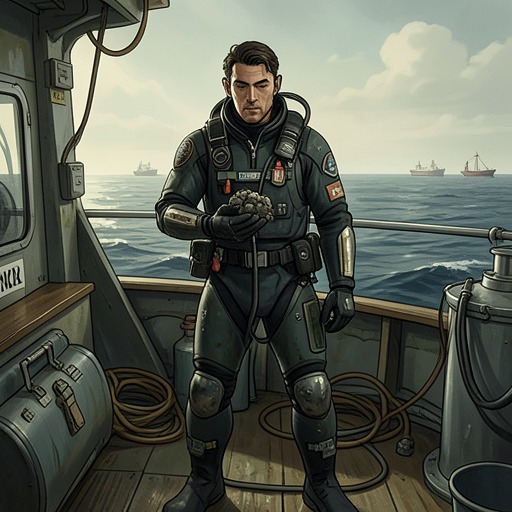
The secret begins with manganese nodules collected during an earlier dive by Prestis and Shaffer. Their Seacliff carried a long suction device to gather material from the seafloor in a remote part of the Mariana Trench. The site became known as Devil's Purgatory. Singer later obtained several nodules and tested them in his own laboratory. The tests revealed inert gases and, more importantly, a mixture of helium-3 and deuterium that could sustain a long-burning fusion reaction.
The historical account links that discovery to danger as well as opportunity. Singer suspects the vibrations from the Seacliff's vacuum pump attracted the Megalodon that attacked the submersible. The United States Navy confiscated the collected nodules but did not understand their value at the time. Only after Singer obtained samples and examined them did the rocks become the key to a new energy source—and the object of a far larger contest.
The fuel matters because it addresses a longstanding technical obstacle to fusion. Scientists had been trying to contain charged tritium or deuterium plasma while its atoms fused into helium. Singer's fuel, when used in his tokamak reactor, stabilized within shifting magnetic fields and produced sustained energy. The account places his discovery roughly thirty years ahead of the International Thermonuclear Experimental Reactor project being pursued by the United States, Russia, Japan, and the European Union. What looks like an obscure seabed resource therefore threatens to reorder the balance of scientific and political power.
Singer's mining operation and its cover
Singer presents the Benthos's work as an expedition involving the deployment of UNIS systems, but Terry identifies the deeper purpose: the deployment provides cover for mining nodules in an area protected by Exclusive Economic Zone laws. Singer confirms that his partners are a small coalition of Arab investors supplying Geo-Tech Industries with personnel and funds. He argues that the restrictions imposed by national law would prevent him from freely pursuing the new resource, and describes himself as an explorer seeking access to new frontiers. His stated preference for freedom from legal and legislative constraints makes the conflict explicit: scientific ambition is bound to an attempt to evade the rules governing access to the seabed.
The operational plan is concrete. Singer tells Terry that the Benthos is expected to reach Devil's Purgatory within forty-eight hours, where the Prometheus and Epimetheus will work together to clear the seafloor of nodules. The Tanaka Institute's participation helps the Benthos ascend without Japan knowing the expedition's actual purpose. The research and engineering apparatus is thus not separate from the concealment; it enables and legitimizes it.
A separate intelligence account traces the financing and planning behind the vessels. Israeli intelligence learned of a secret meeting in Sudan between Singer and a group of Islamic terrorists. Six months later, construction began on the Benthos, Prometheus, and Epimetheus, funded through money discreetly channeled into Geo-Tech by Osama bin Laden's organization. The National Security Agency later intercepted a communication identifying the meeting's purpose: Singer had found a fuel source capable of sustaining fusion energy. These details recast the fleet from an ambitious deep-sea research project into infrastructure assembled to reach and control the source.
Surveillance, evidence, and the competing account
The geography of the operation helps Singer evade scrutiny. The Benthos can descend too deep for satellite detection; sonar reconnaissance is difficult, its engines give off little signature, and its thick titanium hull makes a direct attack difficult even if its position is found. Intelligence officials feared that Geo-Tech could take the vessel into international waters and enter the Mariana Trench undetected. Their account says Singer instead sought a scientific expedition that would give him legitimate access to the trench and allow the Goliath to shadow the Benthos at the surface as a safety measure.
The Proteus accident becomes a struggle over how the available evidence is read. During sonar monitoring, an unidentified object appears on a display at a range of twenty thousand yards from the Benthos, and its acoustic signature then disappears. A technician identifies the recording's forty-two-hertz signal as belonging to the Proteus and notes that the sonargram was made shortly before the submersible imploded. Later, Terry's report to JAMSTEC states that the data show no other vessels or predatory life-forms before the Proteus lost hull integrity, and attributes the accident to piloting error, possibly after a bow plane struck a black smoker. It also says Geo-Tech has begun restitution to the four victims' families and requests that the UNIS deployment continue.
That report conflicts with Terry's later accusation that people aboard both the Goliath and Benthos knew creatures had attacked the Proteus and that the sonar records had been altered to make the accident appear clean. The evidence presented therefore gives the report two roles: it is an official explanation that preserves the research deployment, and it becomes an object of suspicion when Terry challenges the reliability of the records behind it. The mining plan depends not only on access to the nodules but also on keeping the expedition's true purpose—and the risks surrounding it—out of institutional view.
Countermeasures and unresolved stakes
The opposing effort also targets the nodules directly. Analysis of remaining samples from the Seacliff dive reveals gases trapped in the rocks, confirming the connection between the seabed material and fusion fuel. Intelligence officials begin preparing their own remote submersible robots to mine from the known location, hoping to avoid a direct confrontation with Singer, who retains substantial financial and political power. They also plan to use a JAMSTEC investigation of the Proteus accident to force him out of the trench before he can locate the deposit.
That plan is undermined by the same information and reporting on which it relies. Terry sends JAMSTEC a positive account of Geo-Tech's activities, while Jonas unknowingly tells Celeste Singer the secret location of the dive site. The Benthos is consequently already on its way to collect the nodules. Officials then depend on Mossad operatives aboard the Goliath: once Singer has located and loaded the material, the United States Navy intends to confiscate it under EEZ law. They also worry that Terry and an agent still aboard the Benthos may be used as hostages if they are not removed before the Navy arrives.
The conflict remains unsettled in these disclosures. Singer's operation has the vessels, funding, a concealed destination, and a significant head start; the opposing governments have intelligence, a legal basis for seizure, and a competing plan to mine the site. Neither side's claim to the fuel is simply a matter of scientific discovery. The struggle exposes how technical breakthroughs can be converted into strategic leverage, while surveillance limits, corporate secrecy, disputed records, and law determine who can act on the discovery—and who can plausibly deny what is happening.