Predatory Rivalry Between Megalodons and Kronosaurs
The TrenchThe Predatory Rivalry Between Megalodons and Kronosaurs is both a prehistoric predator-prey relationship and a continuing force in the Mariana Trench. Fossil evidence identifies Megalodon as the natural enemy of Kronosaurus, while the animals’ modern descendants or surviving populations make that history newly consequential for the crew of the Benthos. The relationship reverses the expected order of danger: Megalodon once hunted Kronosaurus, but in the trench, Kronosaurs gather around a human vessel whose size and movement resemble familiar prey.
Ecological and Historical Setting
The rivalry crosses a substantial span of time. Heath Williams explains that Kronosaurs had been proliferating in the Mariana Trench for tens of millions of years before Megalodon first sought refuge there. Megalodons evolved later in the Cretaceous, yet the account describes them as larger, more formidable predators, better able to manage changes in water temperature. The chronology therefore places the two animals in an unequal but overlapping relationship: Kronosaurs had long occupied the trench environment, but the arrival of Megalodon introduced a predator capable of killing them.
Megalodon’s continued survival is presented through fossil records of its teeth, which indicate that the sharks thrived in oceans around the world until the Last Ice Age. Jonas Taylor’s theory, as Heath recounts it, proposes that Megalodons escaped extinction after that period by inhabiting the warm bottom layers of the Mariana Trench. Heath had questioned whether such enormous sharks could endure in the abyss with so little food. His revised understanding is that the premise was wrong: the trench held an abundant population of Kronosaurs long before Megalodon entered it.
Fossil Evidence and the Predator-Prey Relationship
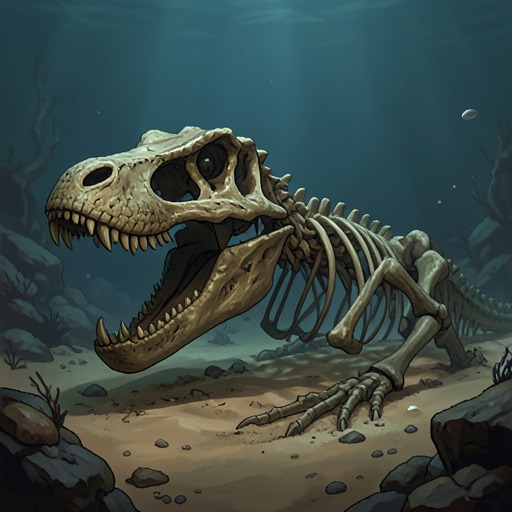
The rivalry becomes concrete when Heath examines a Kronosaurus fossil. A row of holes along its rib cage marks the animal as the victim of an attack, and Heath identifies the wounds as Megalodon bite marks. His explanation connects those traces to the shark’s ability to seize the Kronosaurus around its head and upper torso. The fossil thus offers physical evidence for a relationship that might otherwise seem improbable across such different periods of evolution: Megalodon was not merely a possible competitor but a predator that could kill Kronosaurus.
For Heath, the fossil also helps resolve the question of how the trench’s large predators could coexist. The Kronosaurs’ apparent abundance had provided Megalodon with a substantial food source, overturning the assumption that the abyss offered too little prey. The fossil is therefore evidence of more than an individual animal’s death: read alongside the trench population history, it reveals an established food relationship that could sustain Megalodon in isolation.
Hunting, Packs, and Reversal
Heath proposes that Kronosaurs now hunt in packs as a defense against Megalodon attacks. The evidence does not present this explanation as proven behavior; it is his inference from the bite marks and the threat posed by the shark. Even so, it gives the animals’ collective behavior a specific ecological logic. Their grouping may answer not simply the demands of hunting but the danger of being hunted by a larger and better-adapted predator.
That interpretation also clarifies the reversal at the center of the rivalry. Megalodon’s arrival made the long-established trench inhabitants potential prey, changing who occupied the position of hunter. Later, when Heath assesses the threat to the mission, the Kronosaurs themselves are the immediate danger. The old predator-prey hierarchy remains part of the explanation, but it does not make the Kronosaurs harmless: they are large enough to attack the Prometheus, and their behavior continues to put the crew at risk.
The Benthos and the Present Danger
Heath’s practical response is to keep the Benthos close, even if doing so delays the mission. He reasons that the Kronosaurs are nearly as large as the Prometheus and will continue to attack it, whereas even four of them are no match for the Benthos, the largest moving object in the trench. The advice translates ecological scale into a survival strategy: the same size difference that enabled Megalodon to prey on Kronosaurus now makes the Benthos a comparatively safer presence for the expedition.
The danger does not end when the vessel rises from the seafloor. Three Kronosaurs circle the Benthos’s undercarriage as it ascends, drawn by the taste of blood and by the noise of hydraulic rams forcing seawater from catches along the lower levels. Their attention shifts to the pressurized titanium ballast tanks. In the predators’ nocturnal vision, the containers resemble the size and shape of the Epimetheus, a life-form that had been a plentiful food source. They begin biting the tanks, creating a new problem for the crew and showing how the animals’ established feeding responses can turn the vessel’s machinery into a target.
The Hydrothermal Boundary and Significance
The Kronosaurs’ habitat has a defined ecological limit. After the ascent carries the vessel above the hydrothermal layer, Benedict Singer says the predators cannot follow: the vents support the abyss’s chemosynthetic food chain, and without them that chain would die. The layer is therefore both a life-support system for the trench ecosystem and a boundary that temporarily separates the ship from its pursuers. It does not erase the danger below; it explains why the animals’ pursuit stops at that point.
Across the fossil, Heath’s warning, and the attack on the ballast tanks, the rivalry is presented as an active ecological history rather than a closed prehistoric episode. Megalodon’s predation helps explain the Kronosaurs’ possible pack behavior, while their abundance explains how Megalodon could have survived in the trench. In the present, the predators’ appetite and habitat constraints shape the crew’s route and choices. The human expedition does not stand outside this food web: its machines can resemble prey, its movements can attract attention, and its safest course depends on understanding the animals’ place within the trench.