Prometheus
The TrenchPrometheus is a white, red-trimmed deep-sea submersible whose missions connect the surface vessel Goliath with Benthos and the Mariana Trench. Designed for close observation and hands-on work on the seafloor, it serves in turn as a crew shuttle, a research craft, and a means of recovering UNIS equipment. Its spherical observation pod offers an extraordinary view of the abyss, but also becomes the point at which the sub’s machinery and a Megalodon meet with catastrophic force.
Design and equipment
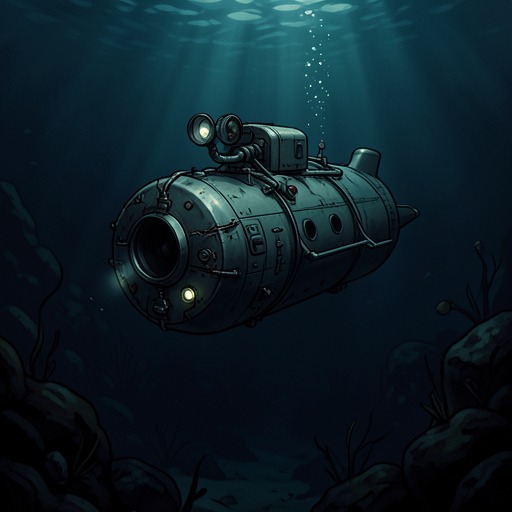
Prometheus is the sister vessel of Epimetheus. Both are cigar-shaped, sixty-eight feet long, sixteen feet across at the beam, and fitted with five-foot conning towers. Their white hulls have red trim. Although their dorsal surfaces appear relatively barren, their undersides carry an array of equipment organized around an eight-foot spherical observation pod. From inside that pod, one operator can control two robotic arms, cameras, lights, and a vacuum hose for gathering samples from the seabed.
The pod is suspended beneath the hull, rather than incorporated into the main cabin. Its single seat and small, angled porthole place the operator close to the work below, while the mechanical arms extend the sub’s reach beyond its own hull. That arrangement makes the vessel useful for both exploration and manipulation: it can investigate the seafloor, prepare a burrow for a UNIS system, and grasp equipment for retrieval. Its design is not merely a way to descend; it gives the crew a working interface with an environment they cannot enter directly.
Prometheus is launched from a hydraulic platform at Goliath’s stern. A steel frame and winch raise it above the deck and swing it out over the sea before release. Its docking procedure reverses that transition at Benthos: the sub enters an assembly beneath the larger vessel, whose hydraulic arms lift it into position. A pressurized sleeve seals around the conning tower, after which the connecting compartment is repressurized. The repeated passage between open water and Benthos’s sealed interior is central to the sub’s function as a link between the surface operation and the abyssal station.
Deployment and work at depth
The late arrival of the two submersibles forces Benedict Singer to alter the mission schedule. Since Benthos’s air purifiers and scrubbers must be replaced before carbon dioxide levels become too high, Epimetheus is assigned to descend immediately with supplies and part of a replacement crew, then return to the surface two days later with the A team. Benedict Singer and the remaining B team are to follow aboard Prometheus. Their planned week-long abyssal mission includes deploying at least three UNIS robots. The name inscribed beneath the sub’s name is Resurgam, meaning that it will rise again, a fitting promise for a vehicle whose work depends on repeated descents and returns.
Terry Taylor’s first descent aboard Prometheus begins as a rare opportunity rather than an assigned technical duty. Benedict Singer welcomes her into the four-person crew’s vessel, leads her through its narrow interior, and offers her the observation pod as the best seat for her first dive. He tells her she can use the computer’s guest program for a guided tour of Benthos, but warns her not to touch anything else. From the pod, Terry watches the launch: the winch carries the sub over Goliath, the vessel swings out above the sea, and divers check its equipment and weight plates after it enters the water. Prometheus then begins a six-hour descent into the unknown.
At the bottom of that journey, the sub docks beneath Benthos. Terry watches its bow slide into the docking assembly; the arms raise it into place as the sleeve seals around the conning tower and the compartment is repressurized. She and Benedict Singer then leave the spherical pod and enter G deck. The sequence makes Prometheus a threshold as much as a vehicle: its arrival carries a visitor from the open ocean into Benthos, while the elaborate seal and pressure change mark how sharply separated those environments are.
On a later mission, Terry returns to Prometheus with Benedict Singer. She is seated at a computer station beside a six-inch reinforced LEXAN window because Ivan Kron, the robotics expert, needs the observation pod to operate the mechanical arms and prepare a burrow for the next UNIS system. During work below, Benedict Singer orders the captain to take the sub back to Benthos. A heavy object—estimated by the captain to weigh more than five hundred pounds—makes the vessel drop and roll to port; releasing ballast rights it. The incident shows the sub’s vulnerability to the weight and movement of the objects it handles, even as its ballast system gives the crew a means of correcting the imbalance.
Prometheus also figures in Terry’s escape from the flooded hangar. After she wounds Sergei and takes his hunting knife, she orders the hangar doors opened. Its lights illuminate the flooded chamber, and its mechanical arms latch onto a UNIS robot. Terry reports that the robot has been secured and requests that the doors be closed and the hangar depressurized. The sub’s scientific equipment thus becomes part of a dangerous, improvised escape: its arms can recover the robot, but the operation depends on Terry gaining control of the hangar systems and holding Sergei at bay.
Damage, repair, and renewed descent
Prometheus continues to shuttle between Benthos and the abyss. From an observation deck, a captain watches its lights approach through dense clouds of rising smoke before it disappears beneath Benthos and docks with a metallic ring. In another descent, it carries Ivan Kron and Terry Taylor on a mission to work with the UNIS system. Such appearances underline the routine the operation is trying to establish: launch, descend, dock, work, and return. But the routine is repeatedly interrupted by threats in the water.
After an attack tears the screw from Prometheus’s drive shaft, Captain Hoppe says there is nothing left to repair in the immediate situation. Benedict Singer orders the crew and sub exchanges to take place twelve hours ahead of schedule and directs Epimetheus to descend within the hour. Captain Warren and his crew are told to let Prometheus drift free from Benthos’s docking bay, wait until the larger vessel clears, then drop ballast and free-float to the surface for repairs. The disabled sub cannot make its own way up; its return now depends on procedure, timing, and the clearance of the docking bay.
Prometheus is subsequently repaired, fitted with two arrays of additional exterior lights, and prepared for another descent. The lights are intended to help keep the creatures away while the crew rescues those remaining aboard Benthos, which is stranded on the bottom. When Jonas Taylor arrives at Goliath, he sees men mounting the lights along Prometheus’s hull on the stern’s hydraulic platform. The new equipment is a practical answer to the dangers encountered on earlier dives, but its necessity also records how the rescue plan has changed: the sub is no longer simply carrying a research team to its work site; it is being outfitted to approach a stranded vessel among predators.
The renewed mission takes Prometheus down toward the hydrothermal layer, where its captain switches on the powerful lights. Their beams reveal a fast-moving current of muddied water as the sub moves through abyssal clouds into Devil’s Purgatory. At the same time, Prometheus carries an extraordinary cargo: Celeste Singer enters the packed interior while men stand atop buckets holding tons of manganese nodules. The scene brings together the operation’s rescue and extraction purposes. The sub is equipped to negotiate a dangerous descent, yet it is also carrying the material whose value gives Benedict Singer’s activity its larger stakes.
Final encounter and significance
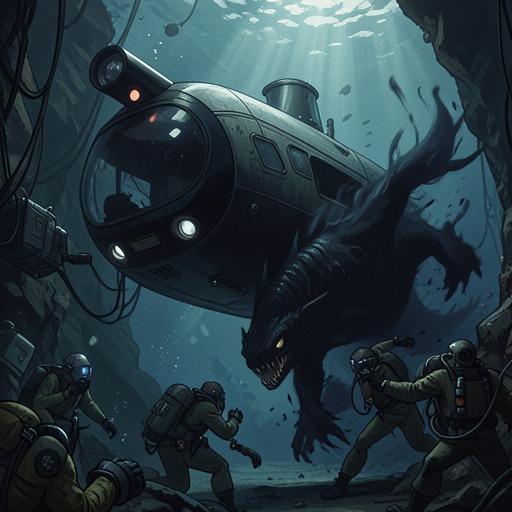
During the final pursuit, Jonas Taylor turns back toward the bottom as the Megalodon closes on Prometheus. Celeste Singer watches from a porthole as the animal rises out of the debris-filled current. It opens its jaws around the circumference of the spherical observation pod beneath the hull. The pod that once gave an operator an intimate view of the seabed now becomes the creature’s point of contact with the sub: a structure designed to extend human observation and control is seized by a force that cannot be managed through its robotic arms or lights.
The Megalodon’s added mass halts Prometheus’s ascent. As the animal twists its head, the sub’s power grid overloads in a shower of sparks, and a titanium plate begins to loosen. The vessel’s material strength, propulsion, electrical systems, and new exterior lights have all been brought into play across its missions, but none can make the final confrontation safe. In an explosion of light, Celeste Singer’s pain ends. The narrative does not treat Prometheus as a neutral container for this outcome: its suspended pod, strained hull, and failing power grid shape the encounter and turn a rescue vehicle into the site of a fatal reversal.
Prometheus’s course therefore compresses the central contradiction of the deep-sea expedition. It is a remarkable instrument for reaching, seeing, and working in a remote environment, and its repeated launches make the abyss seem technically accessible. Yet its machinery remains exposed to weight, damage, pressure, and animals whose scale overwhelms the human plan. The promise of Resurgam—of rising again—rings differently after the sub’s ascent is stopped by the Megalodon. Across its deployments, Prometheus carries people and equipment downward, brings scientific work within reach, and returns crews toward safety; its final encounter shows the limit of that promise when the ocean’s living force takes hold of the vessel itself.