Proteus abyss disaster
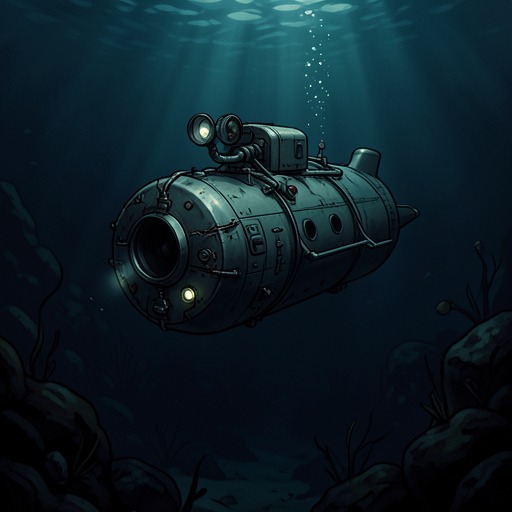
The TrenchThe Proteus abyss disaster is the catastrophic loss of a submersible in the Mariana Trench, where three unidentified objects approach during seabed work and the Proteus is struck, suffers damage to its hull, and implodes. Four people die. The sequence makes the disaster a collision between a vulnerable vehicle and an overwhelming external threat, while its aftermath leaves the cause unresolved: a reported hull breach is later recast by Celeste as probable pilot error.
Seabed Work and the Warning
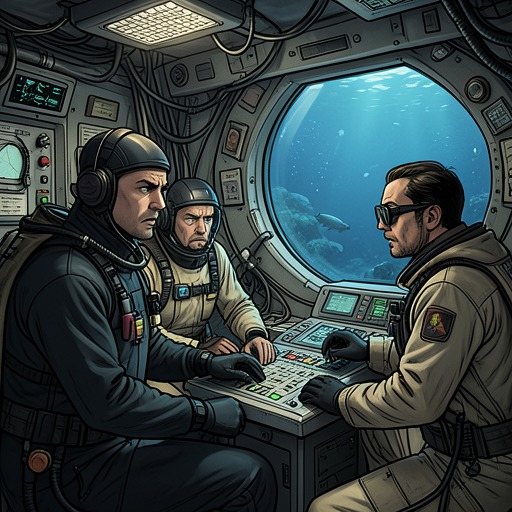
The Proteus is operating on the trench floor while its robotic arms work near a cluster of tubeworms. The arms stir clouds of mud as the crew continues its task. The danger first registers not as a visible attacker but as a change on the instruments: loud sonar warnings draw the pilot’s attention to a printout and screen, where a tight cluster of large objects has appeared. The others are still working and do not initially look up, making the warning a sudden break in the routine of the operation.
The sonar report gives the approach a precise, alarming shape. Three objects are bearing two-one-five, 7.4 kilometers away, moving at fifteen knots and closing directly on the Proteus. The crew attempts to contact the surface but receives no response. With no reply from above, the people aboard understand that they must face the approaching threat without immediate outside assistance. The report establishes the objects’ number, direction, distance, and speed, but does not identify them; the crew knows that something is coming before it knows what it is.
Impacts and Loss of Hull Integrity
As the objects draw near, the captain whispers that they have arrived. For a long moment, the only sound is the Proteus’s propeller. Then a sudden jolt pitches the submersible to starboard and throws Barry against his console. The pilot struggles with the navigational controls and reports that the Proteus is not responding properly. When Ellis asks what it hit, Barry says that the Proteus has been hit rather than having collided with something under its own control. The distinction shifts the scene from a possible navigation error toward an assault from outside.
The crew tries to shake the attacker. The pilot swings the submersible hard to port and then back to starboard, but the maneuver does not restore control. Linda warns that a plate is loosening. Grinding metal follows along the hull; the pilot touches a titanium rivet in the plate overhead, finds moisture, and recognizes it as seawater. He hopes to see the Benthos through the viewport, but the breach is already tangible inside the cabin. The captain reports that the tail fin is being torn loose, adding damage to the vehicle’s ability to maneuver to the warnings about the hull itself.
A further warning confirms that the plates are losing integrity. Arie Levy begins to call attention to a third creature, but a tremendous blow to the bow interrupts him, throwing Linda and Ellis to the floor and pitching Barry over the navigation console. The sequence has escalated from sonar contacts to repeated attacks on different parts of the submersible: its handling is compromised, a plate is loosening, seawater is present, the tail fin is threatened, and the bow is struck. The crew receives no demonstrated opportunity to stabilize the craft before the next impact.
The Crew’s Last Moments and the Reported Outcome
The bow strike leaves the danger close enough to be seen: a luminous crimson eye peers through the viewport. Arie presses his palm against the reverberating titanium plate and thinks of the information he has struggled to acquire but has not been able to report. He also thinks of his wife and children, whom he has forsaken in the line of duty. His thoughts place the mission’s unfinished work beside the personal cost of remaining aboard; the account does not say that he succeeds in sending the information or in escaping.
The disaster’s outcome is reported afterward. Jonas hears from Benedict Singer that the Proteus imploded in the Trench and that four people died. The message gives the loss its definitive scale without identifying the dead in that conversation. The earlier scenes have shown damage accumulating aboard the submersible; the report compresses that crisis into its final consequence, the implosion and the deaths. For Jonas, the news is immediately devastating, and Benedict’s next request is for him to meet about the Goliath.
Competing Explanations and Narrative Significance
In a later conversation with Masao, Benedict describes the Proteus disaster as a tragedy in which four valued personnel and friends were lost, including the project manager. He says the last word received was the pilot’s report of a hull breach. That account is consistent with the crew’s earlier report of seawater and failing plates, but it does not disclose what caused the breach. Celeste, Benedict adds, believes pilot error is more likely than a malfunction. Her explanation is presented as a belief, not as a confirmed finding; the narrative therefore preserves a gap between the crew’s experience of being struck and the post-disaster attribution of responsibility.
That gap matters because the scenes aboard the Proteus give the reader a specific chain of external impacts and worsening structural damage, while the later account offers no investigation or resolution that reconciles those events with Celeste’s suspicion. The disaster is not established as a simple mechanical malfunction, nor is the identity of the attackers settled in the report. Its uncertainty becomes part of its consequence: Jonas receives news of four deaths alongside a demand connected to the Goliath, while Masao hears an account that may redirect attention toward the pilot.
Elsewhere, the novel returns to the vulnerability of submersibles under pressure, though those later incidents are distinct from the Proteus disaster. The Prometheus is jolted sideways during work with its sediment-sampling equipment; a Kronosaurus strikes the Epimetheus; and the Benthos’s titanium plates buckle before level B implodes under 1,160 atmospheres of pressure. These episodes do not explain what happened to the Proteus. In the broader narrative, however, they place its loss within a recurring world in which deep-sea machinery can be abruptly overwhelmed, and in which a warning, a damaged hull, or an attempted response may arrive too late to prevent catastrophe.