Sea World
The TrenchSea World is the Seattle animal-care facility at the center of Tootie’s rescue and attempted return to the wild. Its staff nurse the gray whale calf, outfit her with radio transmitters, and later mobilize to retrieve her when the escaped Megalodon puts her in danger. The facility’s work is presented as both a conservation effort and a public campaign: the same rescue that gives Tootie a chance to join migrating whales also becomes a spectacle shaped by cameras, crowds, and a corporate sponsor.
Facility and rescue work
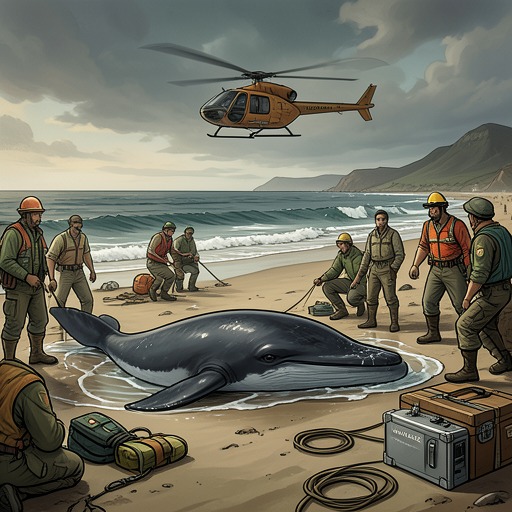
Fourteen months before Tootie’s release, the calf was found stranded about fifteen miles south of Ocean Park. She was in poor condition and probably less than a month old. Lifeguards and bathers placed her in a U-haul and drove her to Sea World’s facility in Seattle. The account establishes the facility through this act of emergency care rather than a detailed description of its grounds: it is the destination where the stranded calf receives sustained attention from animal-care staff.
Pete Soderblom, Sea World’s animal-care supervisor, becomes the public representative of that work. At Bruceport Park, he and zoologist Andrew Furman prepare Tootie for release in an eighteen-wheeler’s cargo container. Furman attaches the first of two radio transmitters to the thirty-one-foot calf, then described as weighing nineteen thousand pounds. Soderblom’s affectionate attention to Tootie’s snout sits beside the practical demands of the operation: the staff must transport her, monitor her, and coordinate a release before the migrating gray whales move north.
The decision to release Tootie rests on a judgment about her readiness and the season. Soderblom explains that the team believes she is strong enough and that thousands of gray whales will soon be traveling up the Pacific coast to feed in the Bering Sea. Joining a pod could help her learn to feed and avoid killer whales. The transmitters are intended to let Sea World follow her movements over the following months, extending the facility’s care beyond the point at which she leaves its custody.
Publicity and institutional image
Sea World’s work is accompanied by conspicuous publicity. At the release, roughly two dozen news vans wait near the dock. Soderblom asks that the Sea World Rescue banner appear on camera, while shirts made for the event carry Tootie’s picture and a plea to save whales on the front and Sea World’s logo on the back. The first two hundred attendees are to receive them. The staging makes the release an event for public consumption as well as a transition in the calf’s life.
That publicity is tied to the sponsor Anheuser-Busch. Soderblom acknowledges that the company is promoting a back-to-nature campaign and wants Tootie to become a recognizable mascot. The branding introduces an awkward commercial edge to the rescue: Tootie is treated as an animal whose survival matters, but also as the face of a campaign whose success depends on visibility. The novel does not erase the care behind the promotion; instead, it places affectionate attention, animal monitoring, cameras, banners, and sponsor expectations in the same frame.
Sea World’s auditorium becomes another stage for this public identity. When news of the escaped Megalodon draws a crowd, Soderblom watches from behind the backstage curtains as the gathering outside grows into what he sees as a media feeding frenzy. Furman brings him a newspaper reporting both the shark’s presence near Leadbetter Point and Tootie’s location in Grays Harbor. The scene shifts the facility from a site associated with rescue and release to a communications center suddenly forced to respond to a crisis involving the animal it had sent back into the wild.
Tracking Tootie and the Grays Harbor crisis
The radio transmitters make Sea World’s continued involvement possible, but they cannot remove the danger. A newspaper report says Tootie appears to have abandoned her northward migration and is feeding in Grays Harbor, less than twenty-five miles from where the Megalodon was last sighted. Sea World biologists confirm her position through the transmitter. The report turns the monitoring system into a warning: information gathered to follow her progress now places her near a predator that could reach the harbor within hours.
Furman tells Soderblom that Jonas Taylor, tracking the Megalodon aboard the William Beebe, believes the shark could enter Grays Harbor within three hours. Furman describes the risk plainly: the animal could enter the bay and kill the calf. Soderblom’s first concern includes the public-relations consequences, especially because the sponsor objects to the prospect of its whale campaign becoming associated with a calf eaten by a giant shark. But the response he proposes is not merely publicity management. He directs that the cargo container and harness be sent to Westport Marina and that staff obtain a fishing trawler with nets, locate Tootie, and move her into shallow water before the shark reaches her.
The plan also links her rescue to the attempted capture of the Megalodon. Soderblom suggests using gill nets to close the bay’s exit if the shark enters, while recovering Tootie from the water. The proposal makes the danger to the calf part of a larger operation, and exposes the disturbing possibility that her proximity to the shark could function as bait. His proposed outcome is that Tootie be safe in the cargo truck while the shark is captured; if circumstances require it, Sea World will transport her back to the facility. Thus the earlier release does not end the institution’s responsibility in the narrative. It creates a new obligation to bring the animal back within reach when the wild proves perilous.
Narrative significance
Sea World connects rescue, release, surveillance, and recapture into a single, unfinished cycle. The facility gives Tootie a chance to live beyond human care, but the radio transmitters keep her movements legible to the people who may need to intervene. That technology serves both welfare and plot: her location is traceable, yet knowing where she is also reveals how close the threat has come.
The institution’s significance lies in this tension between care and control. Sea World releases Tootie in the hope that she can join a whale pod, while its staff remain prepared to retrieve her; it presents the operation as conservation while using it to build a branded public image. When the Megalodon enters the picture, those motives converge in a high-stakes response. The facility is not simply a backdrop for Tootie’s story but the human organization that first saves her, watches her departure, and then tries to protect her again.