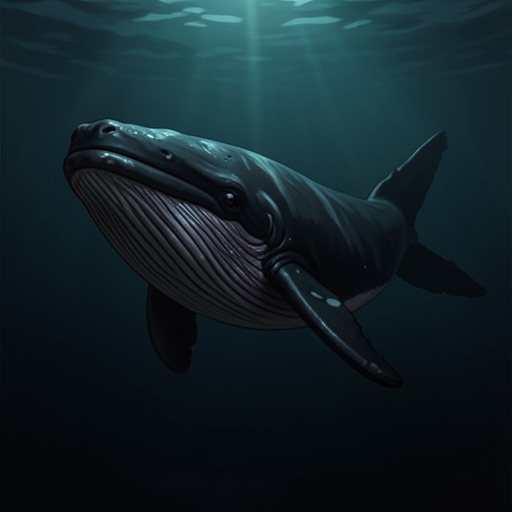
Sperm whale
The TrenchThe sperm whale is portrayed as a powerful, intelligent deep-ocean hunter whose immense size and echolocation make it difficult to track, but whose mammalian need to breathe leaves it exposed. In the episode of the bull nicknamed Mad Max, those strengths and limitations converge: the whale detects the Megalodon, faces it with a dangerous defensive charge, and is ultimately killed when it must approach the surface. Its death makes the expedition’s scientific account of the species inseparable from the brutal reality of observing a predator at work.
Identity and Natural History
Bruce’s documentary narration describes the male sperm whale as reaching sixty feet in length and weighing as much as forty-five tons. He presents the bull as an exceptionally formidable predator, while placing human exploitation in the same account: nineteenth-century whalers hunted sperm whales for the large quantities of oil they yielded. The reference to Herman Melville’s Moby Dick connects the animal’s history of resisting whalers with its place in cultural imagination, but the scene that follows gives that reputation a present-tense, physical form.
The narration distinguishes the larger, more aggressive bulls from females and says that bulls usually travel alone. Their deep descents make them elusive in the open ocean. Unlike baleen whales, sperm whales belong to the toothed whales and use echolocation: pulses of sound allow them to locate objects in their environment. For the researchers aboard the Cachalot, this ability is both a feature of the animal’s biology and the means by which they can study it. Underwater microphones mounted in the boat’s keel pick up the whale’s vocalizations, allowing sound engineer Janis Henkel to estimate its location within a five-mile radius.
Tracking Mad Max
The Cachalot’s expedition has tracked the enormous bull for four days in the Western Pacific, about twenty-one miles southwest of the Kamchatka Peninsula. To reduce disturbance, the twenty-eight-foot research vessel remains under sail and makes as little noise as possible. Its captain turns the boat into the wind, drops sail, and lets it drift in five-foot seas. On deck, the rising three-quarter Moon briefly illuminates the vessel; inside, Henkel listens through headphones while avoiding the Discovery camera aimed toward her.
Henkel tells Bruce that her calculations place Mad Max in eight hundred feet of water, hovering vertically beneath the boat. If the whale’s pattern holds, she expects it to rest for at least three more hours before continuing north. The estimate gives the crew a useful picture of the animal’s movements, but the narration complicates the ordinary meaning of rest: although the bull is motionless and silent in the pitch-dark water, it never fully sleeps, because part of its brain remains alert. When something approaches, the resting animal opens its eyes, slaps its fluke, and levels itself out.
The Encounter with the Megalodon
The bull locates the approaching Megalodon with its sonar-like clicks and circles while awaiting the challenger. It holds its defensive pattern until the shark comes within several hundred yards, then surges forward, beating its muscular fluke and attempting to ram with its massive head. The shark banks away. The whale gives chase but cannot catch its quicker opponent, so it returns to its defensive position rather than abandoning the protection that its size provides.
The balance of power is precarious. The animals are described as evenly matched in size, but the Megalodon is faster, and a direct attack on the bull carries the danger of a crushing blow to the head or a strike from its powerful fluke. The whale’s major disadvantage is not a lack of force: as a mammal, it has to reach the surface for air. As it circles upward to breathe, the shark attacks from below and clamps its jaws onto the whale’s small, rounded pectoral fin. Mad Max bucks as serrated teeth sink into the appendage, but the hold leaves the whale badly injured.
At the surface, the bull’s suffering becomes visible to the people on the Cachalot. Its lower jaw is mangled and dislocated, and dark waves wash whale oil and blood over the boat’s transom. Bruce accelerates away from the thrashing animal. When Mad Max turns belly-up, the Megalodon disappears briefly before returning from below and burying its teeth in the whale’s back. The bull’s tail lashes across the surface in its final spasms. The shark continues attacking the bleeding body for twenty minutes, while the current carries the sailboat farther from the scene.
Death and Narrative Significance
The crew huddles together on deck, horrified by the attack and by their own exposure to it. Norton alone looks away from the whale long enough to check that the cameraman is still filming. That detail sharpens the difference between witnessing and recording: the crew confronts the animal’s destruction as an immediate danger, while the camera continues to turn it into footage. The researchers’ quiet method of tracking a solitary bull has brought them close to an event they cannot control or interrupt.
Mad Max’s death also reveals how the sperm whale’s impressive adaptations meet their limits. Echolocation finds the threat; the massive head and fluke can deter an attack; and the bull’s defensive circling buys time. None of these can remove the need to surface for air. The encounter therefore presents the whale as more than a measurement or a target of scientific observation: it acts, detects, defends itself, and struggles to survive, even as the human observers watch from a small vessel and the faster predator takes advantage of its vulnerability.