Survivor's guilt
The TrenchSurvivor’s guilt is the burden Jonas Taylor places on himself for deaths connected to the Megalodon and for decisions he believes allowed further danger to grow. It first emerges as night terrors after the lawsuit over the creature’s victims and the death of his and Terry Taylor’s unborn child; later, Mac Mackreides names the pattern directly. The concept joins grief to responsibility, but the story leaves room to question Jonas’s harsh verdict on himself: some of the failures he counts as personal were intensified by legal and financial forces beyond his control.
The Trial and the Beginning of the Nightmares
Jonas traces his nightmares to the trial that followed the opening of the Tanaka lagoon. Eight months after the attraction began operating, Jonas and the Tanaka Institute became defendants in a $200-million class-action lawsuit brought by relatives of people killed by the Megalodon. The trial continued for eighteen months and repeatedly placed Jonas before the surviving parents, spouses, and children of the dead. Its central question was not merely whether the creature was dangerous, but why he had risked so much to capture and study it rather than destroy it. For Jonas, the courtroom made the consequences of his choice impossible to keep abstract: each proceeding returned him to the people who had lost someone while he pursued the shark.
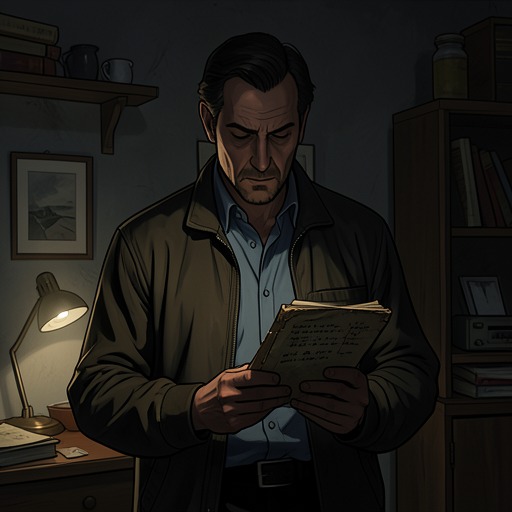
Terry Taylor was four months pregnant when the trial began. Jonas recalls the strain of the proceedings and media attention, and says that the couple’s first child died in the womb during the eighth month of pregnancy, shortly before the verdict. His account links this family loss to the period of mounting pressure, but he does not present it as a simple legal consequence or as proof of a single person’s fault. What he does make clear is the timing: the night terrors began immediately after the loss. A psychiatrist later labeled his condition post-traumatic stress disorder, with guilt from the trial as its basis. Medication helped for a time; then the dreams returned more intensely.
That sequence gives the guilt its belated force. The legal proceedings made Jonas repeatedly face the human cost of the Megalodon’s victims, while his private grief arrived within the same stretch of time. The dreams persisted beyond the trial and, in their return, seemed to Jonas to carry a warning about what he had not done. They are at once symptoms of past suffering and a form through which he tries to interpret a danger still unfolding.
Responsibility, Choice, and Constraint
Jonas’s self-accusation gathers around three decisions. He counts the Seacliff disaster as his first failure, his attempt to capture the Megalodon instead of killing it as his second, and the escape of its offspring as his third. The list turns distinct events into a single moral sequence: in each, he believes that he had a chance to prevent loss and failed to take it. He even wonders whether the lagoon should have been drained two years earlier, drowning the Megalodon rather than leaving it alive.
The story also supplies circumstances that resist his view of himself as simply unwilling to act. Jonas says he realized two years earlier that the Megalodon’s offspring was growing too large to control. He warned Masao Tanaka that the creature might escape and argued that it should be permanently sealed in the lagoon. Masao agreed, but the Tanaka Institute lacked the funds. A judge then issued a cease-and-desist order, shut the Institute down, and froze its assets. Jonas describes the resulting position as one in which the Institute could pay attorneys and feed the shark, but could not carry out the measure he believed necessary. His retrospective regret remains real, yet the account sets it against financial and legal restrictions that had narrowed his choices.
This tension is central to the concept. Jonas does not deny that institutions and circumstances constrained him; instead, he makes their failures part of his own indictment, treating the decision to pass the warning to Masao as another way of failing to act. His guilt therefore exceeds a straightforward question of fault. It folds grief, hindsight, and fear of future harm together, so that an attempted warning can feel to him like an inadequate substitute for prevention.
Mac Mackreides’ Recognition
Mac Mackreides sees the danger in Jonas’s readiness to risk his life. After Jonas has gone into danger with little concern for his own survival, Mac identifies what he recognizes as survivor’s guilt. He speaks from experience rather than from clinical authority: during his military service in Vietnam, he led his platoon into an ambush in the jungle, where more than half the men were lost. He blamed himself and repeatedly relived the event in dreams. Although the dreams still return occasionally, Mac says they have become less intense and no longer wake him screaming.
The comparison does not make the two men’s losses interchangeable. It gives Mac a way to recognize Jonas’s self-destructive response without dismissing it. He sees Jonas’s pursuit of the creature as more than a practical mission: Jonas has, in Mac’s view, declared war on an animal that is only trying to survive and has loaded the Megalodon with blame for the losses of the previous eleven years. Mac’s diagnosis thus identifies both the emotional wound and the way it is being redirected toward the shark.
Mac’s response is protective as well as interpretive. He cautions Jonas not to throw his life away and tells him that a nightmare about dying should not be made into a prophecy that determines his actions. Jonas says he has already seen how his life ends, but Mac treats that certainty as part of the danger, not as evidence of fate. The exchange offers an alternative to Jonas’s private logic: surviving does not require him to seek punishment or to prove his remorse through another dangerous act.
Meaning and Narrative Role
Survivor’s guilt connects the novel’s public accounting of death with Jonas’s private accounting of himself. The lawsuit gives grief a formal setting, with relatives’ losses set against the scientific rationale for capturing the Megalodon. Jonas’s nightmares carry that confrontation into his life beyond the courtroom. His later fear that the offspring will escape then gives the dreams a forward-looking meaning: he interprets them as his subconscious urging him to act before another disaster occurs. The past returns not only as memory, but as pressure to decide what responsibility requires now.
The story nevertheless distinguishes responsibility from omnipotence. Jonas’s decisions matter, especially his choice to capture rather than kill the Megalodon and his failure to secure the lagoon against the growing offspring. But his own account also records a warning made, an agreement from Masao, a lack of funds, and a court order that froze the Institute’s assets. Mac’s intervention adds another complication: the guilt may be distorting Jonas’s judgment by making every loss proof of personal failure and every nightmare a forecast. The concept therefore explains both his determination to confront the creature and the peril in that determination. His remorse may sharpen his attention to danger, yet it can also turn survival into something he feels he does not deserve.