The moral cost of exploration
The TrenchThe moral cost of exploration in the novel lies not simply in the danger of entering the deep ocean, but in the decisions that turn danger into policy: accelerating a mission, withholding evidence, and treating endangered crews as a price worth paying for discovery. Benedict Singer presents these choices as service to humanity, while Terry Taylor and Captain Hoppe expose the gap between public purpose and reckless execution. The question becomes not whether exploration carries risk, but who controls that risk, who knows its true extent, and whose lives are spent to make it seem acceptable.
Discovery, Schedule, and Risk
The conflict first appears in the contrast between schedule pressure and the pilot’s duty to keep a crew alive. Team leader Ellis Richards worries that three hours of work have produced little progress and complains that the pilot seems unprepared. The expedition has moved too far ahead of the Benthos, forcing the mobile deep-sea laboratory to catch up. Richards calculates the delay as a threat to the timetable; the pilot answers that avoiding death takes precedence over a bonus for finishing early. Richards then calls the captain afraid. The exchange makes the moral disagreement concrete: caution can be dismissed as personal weakness when a project’s schedule and financial incentives are at stake, even when caution is the measure of professional responsibility.
That dispute anticipates Captain Hoppe’s objection to Benedict Singer’s pace. Hoppe protests that Benedict is trying to compress a six-month mission into sixty days and is willing to put the crew in danger to do so. He distinguishes an acceptable level of risk from foolhardiness and insists that his concern is for his crew, not himself. Benedict answers by accusing him of cowardice and invokes earlier explorers and the Challenger disaster to argue that loss cannot justify retreat. The comparison turns past deaths into an argument for continuing, rather than a warning about what leaders owe those who follow them. Benedict’s appeal to courage is powerful precisely because it recasts dissent from a question of judgment into a test of character.
Evidence, Responsibility, and the Public Good
The Proteus disaster gives that dispute a specific moral history. Terry Taylor asks how many lives must be lost in the name of the mission. Benedict acknowledges the four people lost aboard the Proteus and points to Terry’s report to JAMSTEC, which attributed the vessel’s implosion to pilot error. Terry replies that the United States and Japan have been reluctant to allow other groups to explore the Trench; if JAMSTEC suspected that the crew had been killed, American authorities would have had to be informed, an investigation would follow, and the mission could be delayed for months. Discovery is thus entangled with the management of information: an official explanation can preserve an expedition’s momentum even as it leaves the circumstances of a fatal loss unexamined.
Terry goes further, saying that she believes people aboard the Goliath and Benthos knew that creatures had attacked the Proteus, and that the sonar records were altered so she would submit a clean accident report. The evidence is presented through her accusation and belief, not as a neutral account of who altered the records. Benedict counters that, if she suspected the records were doctored, she herself lied to JAMSTEC. His challenge exposes a real ethical complication without resolving it: Terry objects to deception, yet the report she submitted helped keep the mission moving. Benedict uses that complication to claim that they are alike, both explorers who have descended into danger to finish a mission. His reasoning makes the desired outcome—completing the expedition—an excuse for compromising the evidence by which its risks should be judged.
Benedict frames that consequentialist case as a public obligation. He argues that the four deaths must be set against the thousands who might survive if the UNIS array succeeds, and describes the work as being for the public good. In his account, the mission honors the dead by pressing on toward a useful discovery. But the promise of future benefit cannot itself establish that the immediate losses were necessary, or that the people authorizing the risk have the right to impose it. His language also leaves responsibility unevenly distributed: he determines what the mission requires, while the crew encounters the danger and the dead cannot contest his interpretation of their sacrifice.
The Mission Under Immediate Threat
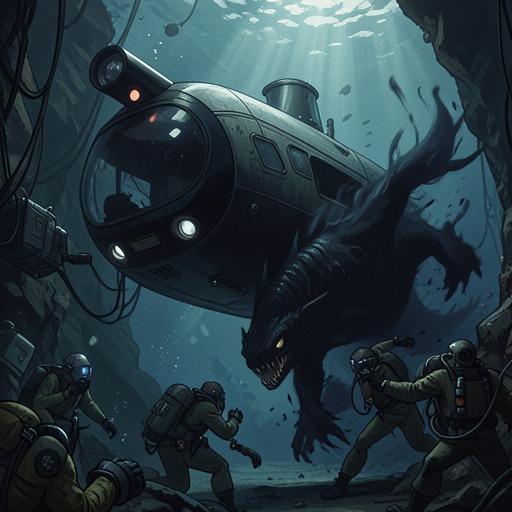
The moral argument becomes operational when sonar reports large life-forms approaching the Prometheus during excavation. With the Benthos still thirteen minutes away, Benedict orders the crew to continue digging, insisting that the vacuum cannot be torn apart. The captain warns that the approaching creatures are nearly half the size of the submarine and urges Benedict to abandon the operation. Benedict questions the captain’s nerve; Hoppe reiterates that his concern is for the crew. The exchange is more than a repetition of their earlier disagreement: danger is no longer an abstract possibility weighed against eventual benefits, but an approaching threat measured in minutes. Benedict’s refusal makes the priority of the task explicit, while the captain’s objection identifies the people put at risk by that priority.
The scene sharpens the distinction between accepting danger and claiming authority to spend other people’s safety. Benedict’s resolve is expressed as personal steadfastness, but it is the crew that must remain in the threatened vessel. His earlier appeal to explorers who pressed on despite losses therefore has a practical consequence: the ideal of perseverance can become a command that leaves others to absorb the cost. The novel does not make every risk avoidable; instead, it focuses attention on decisions made when warning signs are present and retreat remains an option under debate.
Power Behind the Expedition
The costs also extend beyond the immediate expedition. Later, Masao recognizes that the new UNIS project and lucrative JAMSTEC contract offered Benedict a legitimate route into the Mariana Trench. Dave Ross explains that the project provided Benedict access, while the Goliath could shadow the Benthos at the surface under the cover of a safety precaution. Masao then connects this arrangement to the lawsuits, monetary awards, and denial of the company’s right to appeal, accusing the people behind the plan of setting his company up to fail. These revelations place scientific exploration within a larger contest over access and institutional power. A mission presented as research and safety can also serve concealed strategic purposes, while its commercial and legal consequences fall on others.
The episode complicates Benedict’s appeal to the public good. The exploration is not governed solely by a disinterested search for knowledge: access to the Trench has been arranged through a contract and a coordinated presence at sea, and Masao understands the company’s collapse as part of a deliberate scheme. The evidence does not erase the possible value of the research, but it makes the language of public benefit harder to accept as a complete account of the mission. Scientific purpose, corporate interest, and state strategy can coexist; the moral question is whether those who invoke one purpose disclose the others to the people bearing the danger.
Consequences and Moral Limits
The physical environment supplies the final measure of what human plans cannot control. After Terry Taylor frees her wrists from electrical wire, the Benthos’s titanium plates begin to buckle under abyssal pressure. Level B implodes beneath 1,160 atmospheres. The scene does not by itself settle the competing claims about what risks were justified, but it gives those claims a material limit: the vessel’s structure cannot negotiate with pressure, and the crew’s exposure is not transformed into safety by a leader’s confidence or by the mission’s promised benefits.
Across these conflicts, exploration remains both a genuine pursuit of knowledge and a rationale that characters use to defend speed, secrecy, and sacrifice. Benedict’s argument depends on future lives saved and triumphs that might honor the dead; Hoppe’s rests on present responsibility for the crew; Terry’s doubts focus on whether concealed evidence has already distorted the choices available to them. The novel keeps those positions in tension rather than offering a simple rule against dangerous discovery. Its sharper ethical test is accountability: whether risks are recognized honestly, whether those who authorize them accept responsibility, and whether the people asked to endure them are treated as participants in a mission or as expendable means to its completion.