UNIS
The TrenchUNIS is a network of unmanned deep-sea robots designed to monitor seismic activity along the Mariana Trench. Conceived as an earthquake-warning system, the project joins scientific observation to an ambitious undersea deployment—and, as the story later reveals, gives Benedict Singer a legitimate pretext for sending his own operation into the trench.
Purpose and Development
The UNIS project began as a joint venture between the Japanese government and the Tanaka Oceanographic Institute. The Institute was building an artificial lagoon off the Monterey coast to study whales, and the contract to place seismic-detection robots on the Mariana Trench floor offered a way to finance that work. When several devices malfunctioned, Masao Tanaka sought Jonas Taylor’s help in retrieving one. Jonas initially refused, unable to face the trench after the disaster that had ended his career as a deep-sea pilot, but the possibility of redemption eventually drew him back.
The first deployment effort was therefore not simply a research expedition: it was also an attempt to recover an instrument and address problems with the project’s equipment. Later, after lawsuits and the Institute’s bankruptcy, JAMSTEC offered a new contract. Concerned by rising seismic activity along the Philippine and Pacific tectonic plates, the Japanese organization wanted an entire array of UNIS robots installed on the trench floor. The renewed project promised the Institute a financial way forward, but returning to the abyss exposed Masao to a different kind of cost: to fulfil the contract, he had to form a partnership with Singer and surrender controlling interest in the Institute he had founded.
Design and Monitoring Function
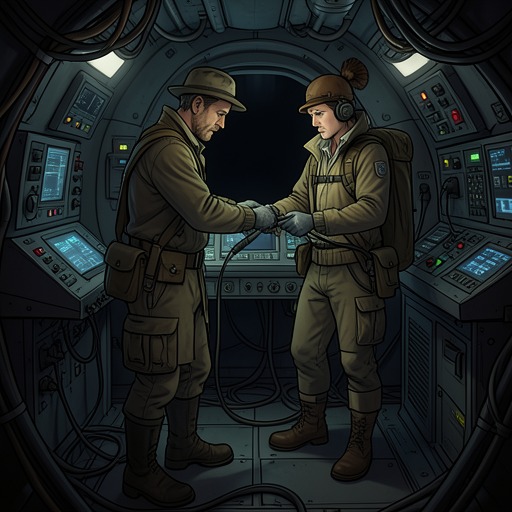
The robots are substantial pieces of hardware rather than small, disposable sensors. In the preparation room, two dozen UNIS units stand in rows. One is described as a five-foot-high, four-foot-wide titanium barrel, closed by a watertight, pressurized seal and a titanium lid roughly two and a half feet across. Opening it reveals a hollow device containing its control systems. Terry activates the sonar equipment inside the shell before the unit is resealed for deployment.
Once buried in the seafloor, a UNIS unit is intended to record and track seismic disturbances in the Mariana Trench. The plan is to distribute twenty-five robots at selected intervals, creating a network of detectors rather than relying on a single instrument. The array is meant to provide Japan with advance warning that would help it predict and prepare for earthquakes affecting its island chain. The evidence establishes this intended function and the preparations for deployment; it does not establish that the completed array successfully predicted an earthquake.
Deployment from the Deep-Sea Fleet
UNIS depends on a large support system to reach its operating location. The Benthos has an underwater hangar on G deck that can be pressurized or vented for heavy equipment and robotic vehicles, and its docking station serves the Proteus, Prometheus, and Epimetheus submersibles. The hangar and docking arrangements make the robots part of a much larger machinery of transport: a unit must be handled aboard the deep-sea facility, transferred into a submersible, and carried to its designated position on the trench floor.
When the late arrival of the submarines changes the timetable, Singer outlines a staged operation. The Epimetheus is to descend with supplies and a partial replacement crew, then return to the surface in two days with the A team. Singer and the rest of the B team are to follow aboard the Prometheus after that return. Their planned week-long mission is to deploy no fewer than three UNIS robots. In a separate description of the procedure, Singer says the Prometheus will use its mechanical arms to extract a prepared robot from the flooded chamber and transport it to the assigned coordinates. These plans place the array’s scientific purpose inside a demanding, carefully scheduled expedition, where the timing and safety of the crew are also at stake.
The equipment’s deployment is not presented as proof that the mission is proceeding safely or that the recorded data will answer JAMSTEC’s questions. Masao asks whether the Epimetheus will return with the information required, and Singer says that doing so is his order while doubting that the Benthos records will show more than the Goliath’s. The uncertainty matters: the project’s value depends not only on placing instruments but on obtaining information useful to the people who commissioned them.
Political Function and Significance
UNIS changes meaning as the larger operation comes into view. For Masao, it is a scientific and financial undertaking: the renewed JAMSTEC contract could keep the Tanaka Oceanographic Institute open and provide an earthquake-warning array. For Singer, its deployment is also bound up with his own plans in the abyss. Later, Dave Ross explains that Singer was searching for a scientific expedition that would give him a legitimate reason to enter the Mariana Trench, with the Goliath shadowing the Benthos at the surface as a safety precaution. The UNIS project suited that purpose. The contract was not just a mission to install seismic equipment; it provided cover for access to the trench.
Masao recognizes the consequence when the arrangement is exposed. He connects the lucrative new contract, the class-action lawsuits, the unexpectedly large damages, and the courts’ refusal to allow an appeal, and concludes that his company had been deliberately driven toward bankruptcy. Ross confirms that the UNIS project supplied Singer with a legitimate opportunity to enter the trench. The robots themselves remain scientific instruments, but the project surrounding them is entangled with corporate control and covert planning. That contrast gives UNIS its larger narrative significance: a system designed to detect geological danger becomes the respectable public purpose behind an expedition whose real stakes exceed earthquake monitoring.