UNIS array
The TrenchThe UNIS array is a planned network of robots buried in the Mariana Trench floor to monitor seismic activity. Its installation requires the Prometheus to prepare the seabed and collect geological samples, linking the array’s scientific purpose to a risky expedition. The project also becomes a point of ethical conflict: its deployment is invoked to justify continued danger, while Terry Tanaka-Taylor’s report about the Proteus accident helps secure permission for the work to proceed.
Purpose and Installation
The array’s stated function is seismic monitoring. As Benedict Singer explains, each robot must be buried in the trench floor, so deployment is not simply a matter of placing instruments on the seabed. The Prometheus uses a vacuum to draw up sediment; Benedict describes this method as more efficient than relying on the submersible’s robotic arms. That explanation gives the vacuum a specific operational role: it is equipment needed to prepare locations for the robots, not an incidental tool.
The arrangement makes the array dependent on a sequence of work beneath the surface. The Prometheus must reach the floor, remove material, and establish sites where the robots can be buried. The need to complete that work helps explain why geological sampling and seabed preparation are integrated into the expedition. The array’s future coverage depends on the ship’s ability to keep moving through the trench and to identify places suitable for installation.
Surveying the Trench
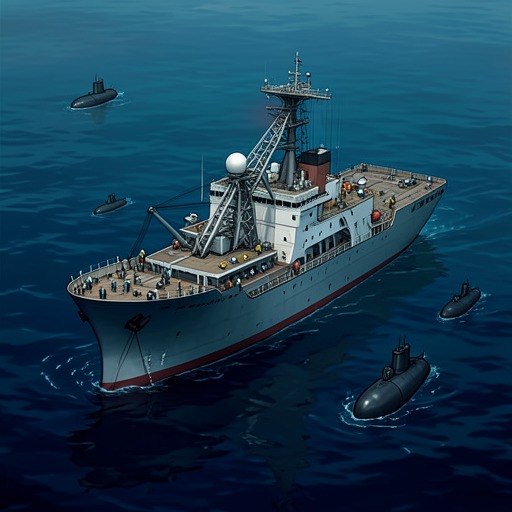
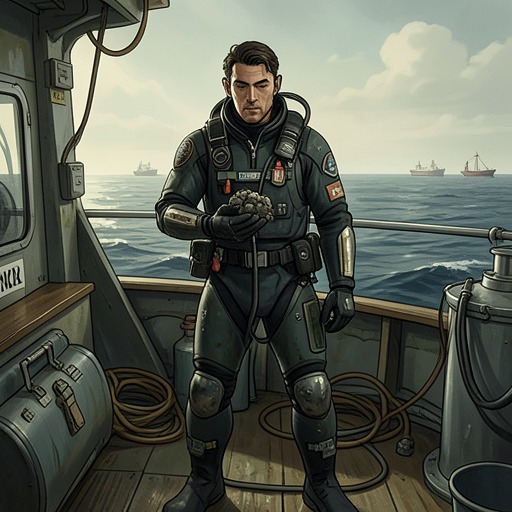
During a four-hour descent through darkness, the Prometheus stops at roughly one-kilometer intervals to collect sediment and rock. Benedict says the samples will be examined by geologists aboard the Benthos. Their results are intended both to map the Mariana Trench and to determine which terrains can support the next series of UNIS robots. The survey therefore serves two connected purposes: it builds a geological picture of the trench and informs where the monitoring equipment can be placed.
This work makes the array a project of staged expansion rather than a single deployment. Sampling precedes the selection of suitable terrain, and the chosen terrain must in turn accommodate buried robots. The Prometheus’s repeated descents to the seafloor translate an abstract scientific goal into a demanding physical procedure. The samples are not described as results of the array itself; they are information gathered to guide its further installation.
The distinction matters to the expedition’s progress. A survey can produce useful information without completing the installation, while a prepared site is only one part of a wider monitoring network. The account gives no final number of robots or completed sites. It presents the array as an ongoing undertaking whose expansion depends on the survey and installation work continuing.
Operational Stakes
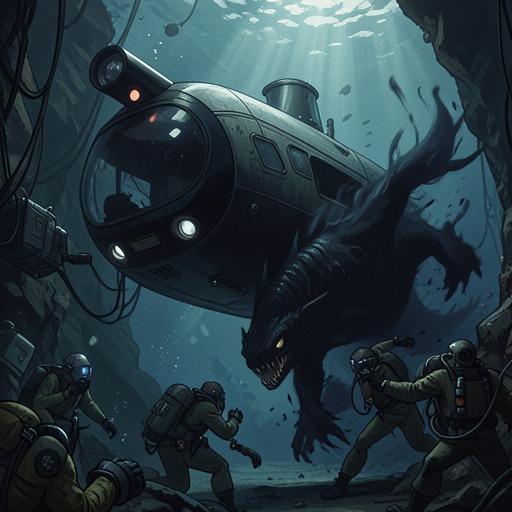
The need to continue that work becomes urgent when the Prometheus is jolted and sonar reports approaching life-forms. With the Benthos still some distance away, Benedict orders the crew to continue digging and says the vacuum must not be torn apart. The order places the installation equipment and the mission’s progress ahead of retreat: the vacuum remains in use even as the threat draws nearer. Captain Hoppe relays Benedict’s instruction to the crew, while the reported approach makes the cost of that decision immediate.
The moment exposes a tension built into the project. The robots are intended to monitor seismic activity, but getting them into the trench requires people and machinery to operate in dangerous conditions. Benedict treats the work as too important to abandon, even when the Prometheus is vulnerable and the Benthos cannot immediately reach it. His decision does not establish that the array is successfully deployed; it shows instead how the planned network becomes a reason to persist in hazardous work.
Benedict also frames the array in terms of public benefit. He argues that the expedition risks its own lives so that thousands may survive, and presents the UNIS array as having been created for that purpose. His language turns a technical system into a justification for accepting present danger. Captain Hoppe challenges the judgment behind that justification, objecting that the Prometheus is being sent too far ahead of the Benthos. The disagreement leaves the array’s value intact but makes the means of pursuing it part of the conflict.
The Proteus Report and Continued Deployment
The array’s continuation is also tied to Terry’s report on the May 22 accident in the Mariana Trench. In a document addressed to the director of JAMSTEC, Terry states that the available data show no other vessels or predatory life-forms involved. Her evaluation of sonar records from the Benthos and its surface vessel, Goliath, finds nothing abnormal before the Proteus lost hull integrity. She attributes the accident to piloting error, suggesting that the starboard bow plane struck a black smoker.
The report identifies restitution by Geo-Tech Industries for the families of the four victims, then asks that deployment of the UNIS array be allowed to continue. Terry writes that the Tanaka Institute will consider the matter closed unless further information is requested. As she rereads the report before deciding whether to email it, its conclusions carry consequences beyond the account of the accident: the claim that no predatory life-forms were involved supports a closure that leaves the deployment underway.
Benedict later confronts Terry over the possibility that the sonar records were doctored. He says that if she suspected this, then she lied to JAMSTEC, and argues that the end justifies the deed. His accusation does not independently establish that the records were altered; it reveals the pressure surrounding the report and the conflicting moral accounts of the project. Terry’s document presents piloting error and a request to continue deployment, while Benedict openly places the array’s claimed public purpose above the lives lost under their watch.
Narrative Significance
The UNIS array connects scientific ambition to both practical procedure and moral compromise. Its purpose is concrete—buried robots monitoring seismic activity—but its implementation requires repeated work on the trench floor, geological assessment, and equipment that Benedict refuses to abandon as danger approaches. At the same time, the disputed account of the Proteus accident makes the project’s continuation depend on what is reported, what may have been concealed, and who bears the consequences of treating the mission as necessary.
The array thus remains more than a collection of instruments in the story. It is the stated reason for surveying the trench, the objective behind the Prometheus’s seabed work, and an argument used to defend risk. The evidence shows a planned network and efforts to prepare for its expansion, not a completed system or a confirmed scientific result. Its significance lies in that unresolved interval between purpose and achievement: the promise of monitoring the trench is real within the expedition, but so are the dangers and contested decisions required to pursue it.