Guilt
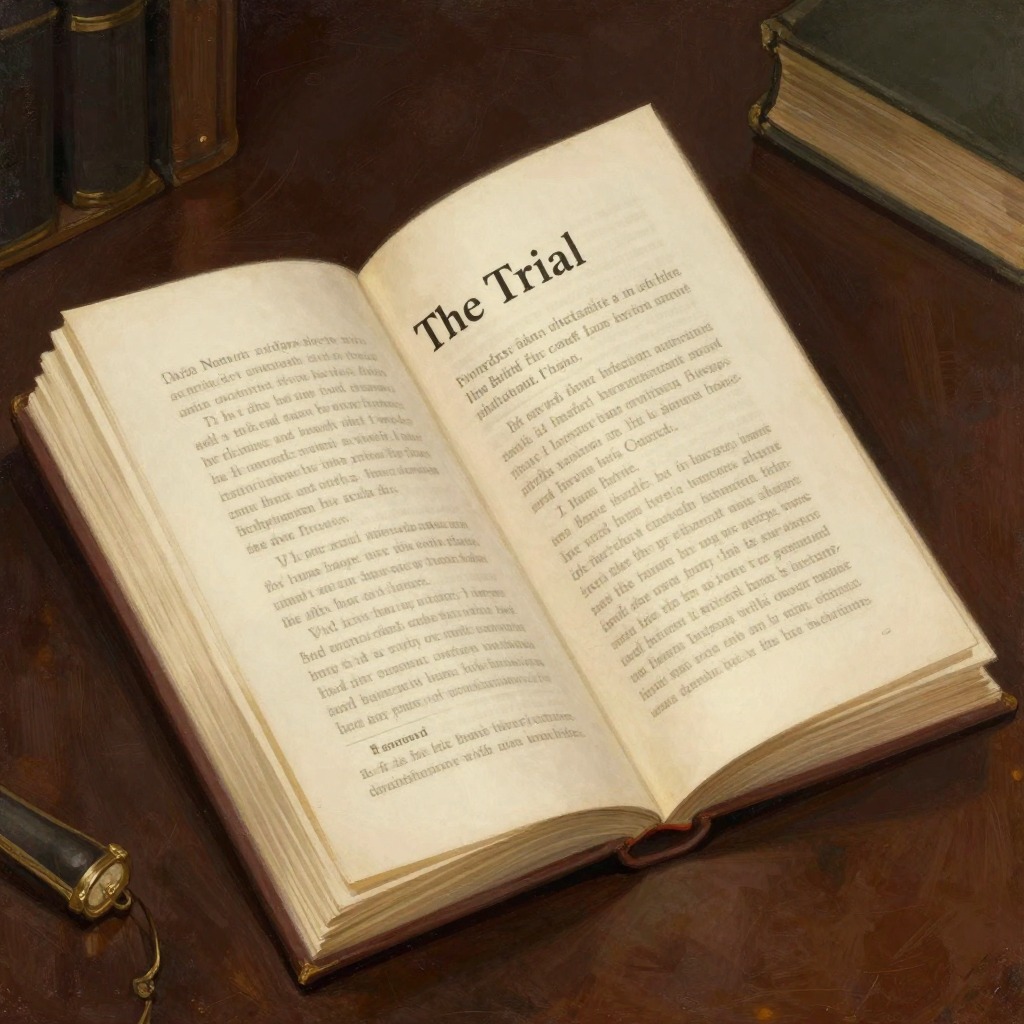
The TrialIn Franz Kafka's The Trial, guilt is the central, unprovable condition that defines the protagonist Josef K.'s existence from the moment of his arrest. It is not a matter of evidence or moral failing but a state imposed by the Court, which operates on the principle that "the court is attracted by the guilt" . This inversion of justice—where the accusation creates the guilt rather than the other way around—transforms guilt into an inescapable metaphysical attribute that the accused can neither refute nor escape.
The Court's Presumption of Guilt
The Court's entire machinery is built on the presumption that the accused is guilty. When Josef K. protests his innocence, the examining judge's notebook—a misshapen, thumbed-over school exercise book—contains the charge that K. is a "house painter," a deliberate misidentification that reveals the Court's indifference to factual truth . The policeman Willem explains the Court's logic: "Our authorities as far as I know, and I only know the lowest grades, don't go out looking for guilt among the public; it's the guilt that draws them out, like it says in the law, and they have to send us police officers out" . This doctrine means that the arrest itself is proof of guilt, not a step toward determining it. The Court's organization is vast, employing "policemen who can be bribed, oafish supervisors and judges of whom nothing better can be said than that they are not as arrogant as some others," and its purpose is "to arrest innocent people and wage pointless prosecutions against them" . The presumption of guilt is so absolute that the painter Titorelli tells K., "it's impossible to make [the court] think otherwise" about a defendant's guilt .
The Inescapability of Guilt
Guilt in The Trial is not a temporary accusation but a permanent state. The prison chaplain tells K. directly, "You are considered guilty. Your case will probably not even go beyond a minor court. Provisionally at least, your guilt is seen as proven" . When K. protests, "But I'm not guilty," the chaplain responds, "That is true... but that is how the guilty speak" . This circular logic traps the accused: any denial of guilt is itself evidence of guilt. The chaplain's parable of the doorkeeper reinforces this, showing a man from the country who spends his entire life waiting for access to the law, only to learn at the end that the door was meant only for him—and that the doorkeeper will now close it. The story illustrates how the law's structure makes guilt a condition of existence rather than a verdict to be reached. K. himself comes to understand that "the verdict does not come suddenly, proceedings continue until a verdict is reached gradually" , meaning guilt is not discovered but constructed over time.
Guilt as a Social and Existential Condition
Guilt in the novel extends beyond the legal sphere to permeate every aspect of K.'s life. The opening line—"Someone must have been telling lies about Josef K., he knew he had done nothing wrong but, one morning, he was arrested" —establishes that guilt is a social phenomenon, generated by rumor and accusation rather than by action. The Court's proceedings are not public, and the accused has no access to the files against him (E00307–E00308), making it impossible to know what one is guilty of. The trial itself becomes a kind of existential sentence: K. is summoned to a first cross-examination on a Sunday , and the Court's offices are located in attics of tenement buildings , suggesting that guilt is a condition that follows the accused into the most mundane spaces. The painter Titorelli explains that even an "apparent acquittal" is temporary, as "the court never forgets" and can order re-arrest at any time . Guilt, once imposed, can never be fully removed.
The Thematic Significance of Guilt
Guilt in The Trial functions as a critique of legal and bureaucratic systems that presume guilt rather than innocence, and as a metaphor for the human condition under opaque, arbitrary authority. K.'s struggle is not to prove his innocence—which the system makes impossible—but to understand what he is guilty of. The Court's logic, as the chaplain says, requires one to "accept it as necessary" rather than as true , and K. concludes bitterly, "The lie made into the rule of the world" . His final words, "Like a dog!" , express the shame of a guilt that outlives him, a condemnation that has no basis in any act he committed but that the system has made inescapable. Guilt, in Kafka's world, is not something one has; it is something one is.