Josef K.
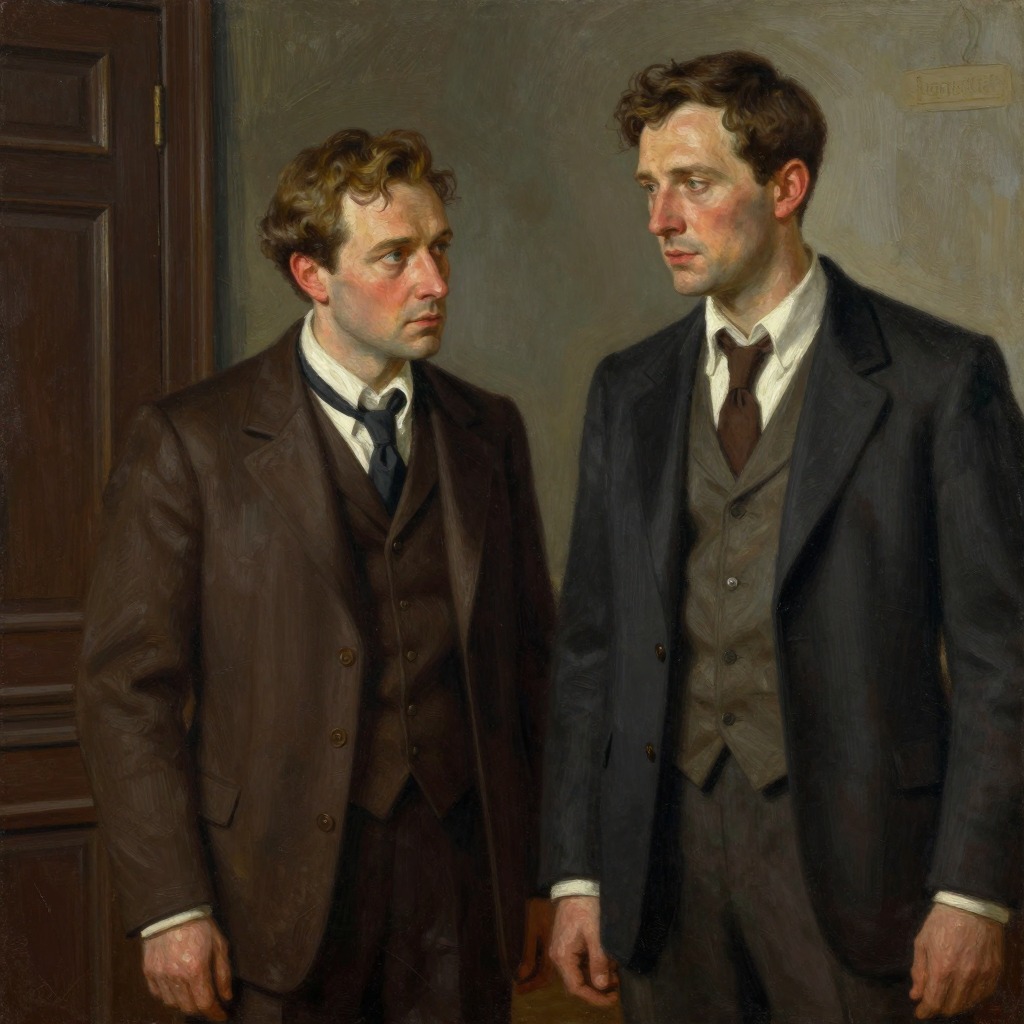
The TrialJosef K. is the central figure of Franz Kafka's novel The Trial, a thirty-year-old chief clerk at a large bank whose life is shattered when he is arrested in his boarding house one morning without being told the nature of his offense. His entire subsequent existence becomes consumed by a struggle against a court whose workings are invisible, whose logic is impenetrable, and whose power is absolute. K.'s trajectory from confident professional to bewildered defendant to passive victim forms the novel's core, making him one of the most iconic representations of modern existential and bureaucratic alienation.
Identity and Background
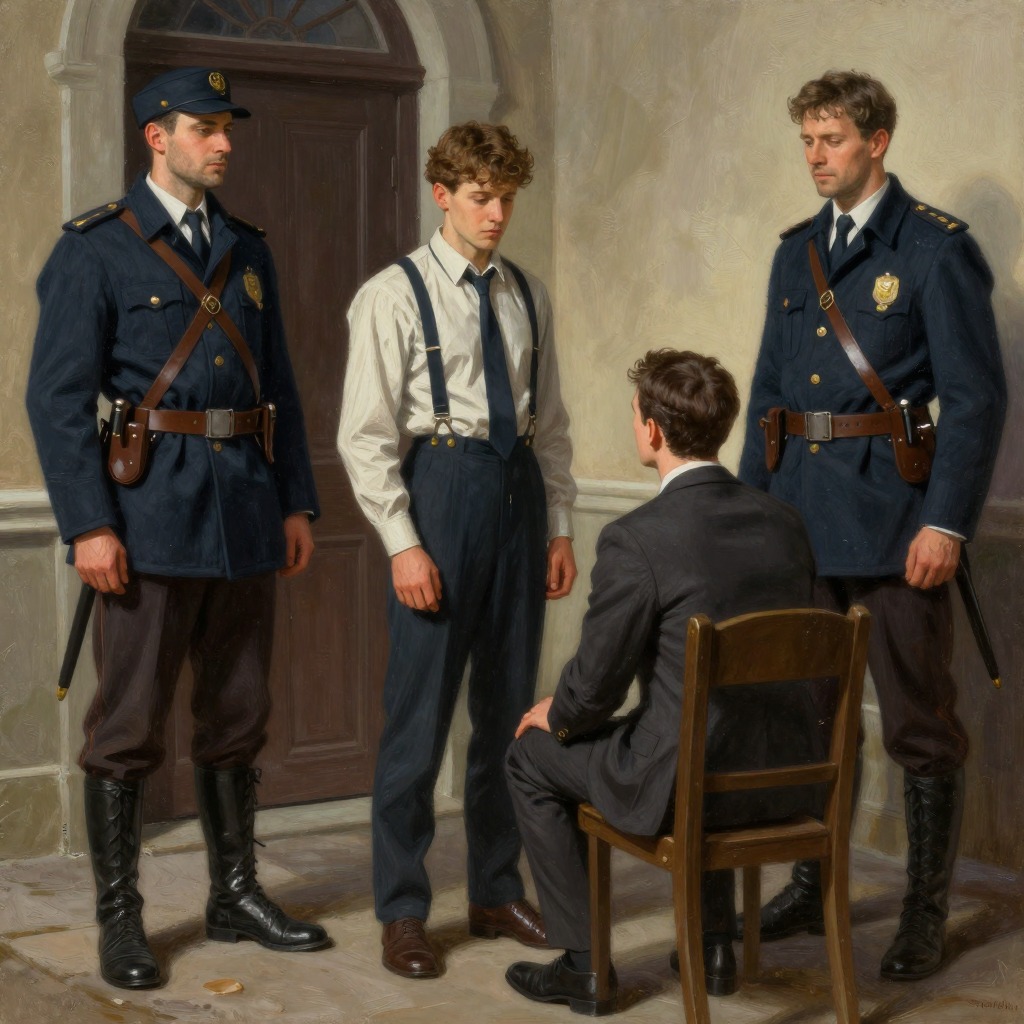
Josef K. is a successful, ambitious man who has risen to a high position at a bank, where he commands respect and manages a staff. He lives in a lodging house run by Mrs. Grubach, and his life follows a regular pattern: he works late, takes walks, visits a regular table at a pub, and occasionally sees a woman named Elsa, a waitress at a wine bar. On the morning of his thirtieth birthday, he is arrested by two warders, Franz and Willem, who enter his room while he is still in bed. K. immediately insists on his innocence, demanding to see identification papers and an arrest warrant, but the warders offer no explanation. The arrest itself is paradoxical: K. is told he is under arrest, yet he is permitted to continue working at the bank and living his normal life. This contradiction defines the nature of the court's power over him—it is pervasive yet intangible, a condition rather than a discrete event.
Arc Through the Plot
K.'s journey through the trial is marked by a series of encounters that progressively erode his confidence and autonomy. His first cross-examination takes place in a tenement attic, where he confronts an examining magistrate and a packed, hostile audience. K. delivers a passionate speech denouncing the court's corruption, but the crowd's allegiance proves illusory, and he leaves feeling he has accomplished nothing. Subsequent visits to the court offices reveal a sprawling, squalid bureaucracy housed in attics, where defendants wait passively on benches and the air is suffocating. K. seeks help from a lawyer, Dr. Huld, but finds his defense stalled by the lawyer's endless, evasive monologues. He then consults a painter, Titorelli, who explains the three theoretical outcomes of a trial—absolute acquittal, apparent acquittal, and deferment—but makes clear that none offers genuine freedom. K. decides to dismiss Dr. Huld, but the act of defiance yields no tangible progress. The final turning point occurs in the cathedral, where a prison chaplain tells K. the parable of the doorkeeper, a story about a man from the country who spends his life waiting for access to the law. The parable suggests that K.'s entire struggle may be founded on a misunderstanding of the law's nature. On the evening before his thirty-first birthday, two men in frock coats arrive at his lodging and lead him to a quarry, where they execute him with a butcher's knife. His last words are "Like a dog!"
Key Actions and Objectives
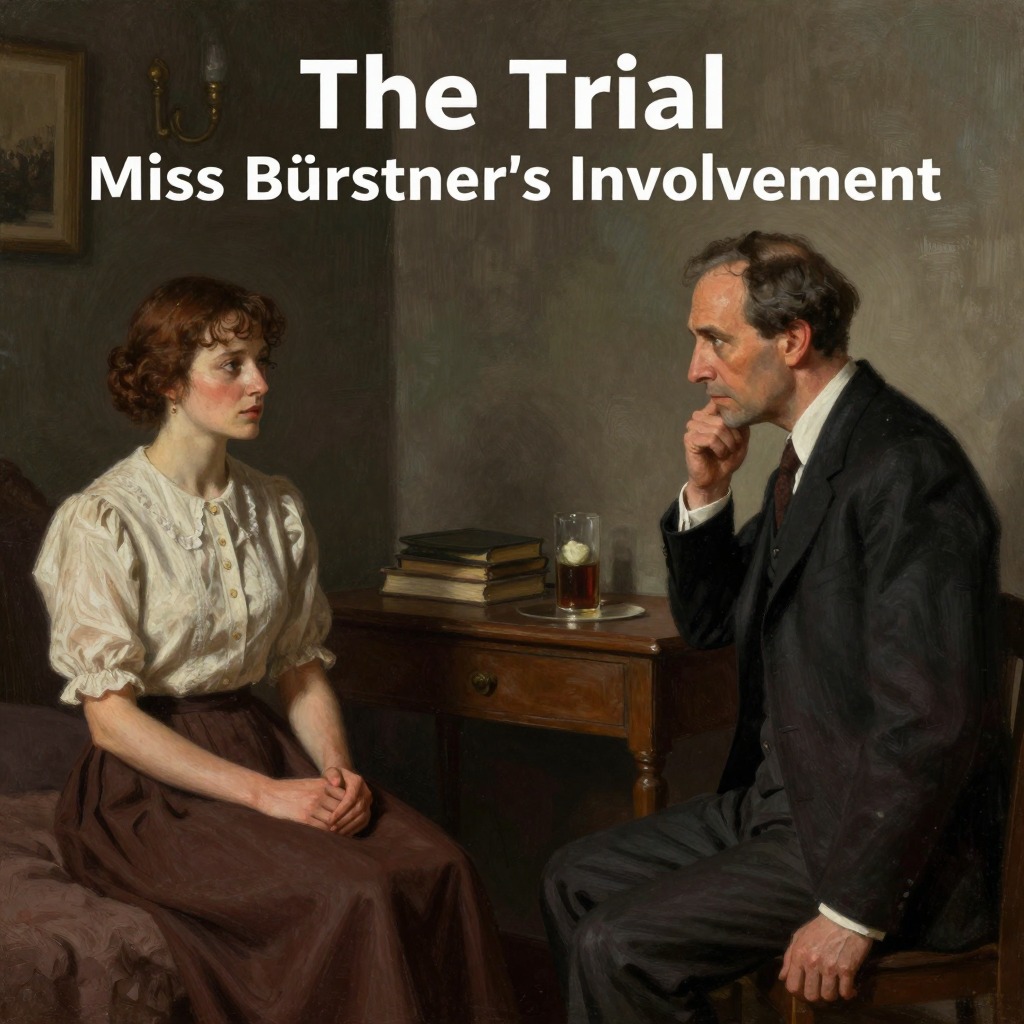
K.'s primary objective throughout the novel is to prove his innocence and bring the trial to a favorable conclusion. He attempts to achieve this through a series of actions: he demands transparency from the warders and the supervisor during his arrest; he delivers a public defense at his first hearing; he visits the court offices to understand the system; he hires and then fires a lawyer; he consults a painter who claims to have influence over judges; and he seeks advice from a businessman, Block, who has been entangled in the system for years. Each action, however, leads only to deeper confusion. K. also tries to use personal relationships as leverage, particularly with women. He pursues Miss Bürstner, a fellow tenant, after the arrest takes place in her room, hoping to enlist her sympathy. He becomes involved with Leni, Dr. Huld's nurse, who offers to help him but whose motives are ambiguous. The court usher's wife also propositions him. K. reflects that he is "accumulating women to help me," but none of these connections yield any real advantage. His most significant intellectual action is his engagement with the parable of the doorkeeper, which forces him to confront the possibility that the law is not a system of justice but a structure of necessity that demands acceptance rather than understanding.
Relationships and Conflict
K.'s relationships are defined by the trial and are almost uniformly adversarial or transactional. His uncle, Karl, a country landowner, learns of the case through a letter from K.'s cousin Erna and rushes to the city, dragging K. to Dr. Huld. The uncle's concern is as much for family reputation as for K.'s welfare. At the bank, K.'s position is threatened by the deputy director, who exploits K.'s distraction to poach clients and undermine his authority. The director, though well-disposed toward K., is increasingly under the deputy director's influence. K.'s relationship with Dr. Huld is one of growing frustration: the lawyer speaks at length about the court's inner workings but produces no tangible results, and K. comes to suspect that Huld's real loyalty is to the court officials he cultivates. The painter Titorelli offers a more candid but equally bleak picture, describing a system where acquittal is never final and the defendant must remain perpetually vigilant. The most profound conflict is internal: K. oscillates between defiance and resignation, between the belief that he can master the trial through reason and the growing suspicion that the trial is a condition of existence itself. The chaplain's parable crystallizes this conflict, suggesting that K.'s very efforts to understand the law may be what trap him.
Change and Ending
K. undergoes a profound transformation over the course of the novel. He begins as a self-assured, rational man who believes that his innocence and social standing will protect him. By the end, he is passive, exhausted, and stripped of all illusions. On the night of his execution, he dresses in black and waits for his killers, recognizing them as "some ancient, unimportant actors" sent to dispose of him cheaply. He briefly considers resistance but abandons the idea, realizing that "there would be nothing heroic about it." He allows himself to be led to a quarry, where the two men lay him against a stone and stab him. His final thought is a question: "Where was the judge he'd never seen? Where was the high court he had never reached?" His last words, "Like a dog!" express the ultimate degradation—a life and death reduced to something contemptible, with the shame of it "outliving him." The ending is not a resolution but a confirmation of the court's absolute, incomprehensible power.
Narrative Role and Evaluation
Josef K. functions as both protagonist and everyman, a figure whose experience of arbitrary authority and incomprehensible legal process resonates far beyond the specific circumstances of the novel. Kafka's third-person narration stays close to K.'s consciousness, rendering the world through his perceptions and misunderstandings, so that the reader shares his confusion and growing dread. K. is not a hero in any conventional sense; he is often arrogant, impatient, and self-deceiving, and his attempts to manipulate the system are as flawed as the system itself. Yet his struggle is genuinely sympathetic because it is a struggle against something that refuses to be named or confronted. The novel's power derives from the tension between K.'s rational, worldly intelligence and the irrational, otherworldly machinery of the court. His failure is not a failure of character but a failure of the world to make sense. In this, K. becomes a symbol of the modern individual's confrontation with opaque systems of power—legal, bureaucratic, existential—that operate according to their own inscrutable logic and ultimately demand submission, not understanding.
Josef K. has been portrayed by several notable actors in film adaptations. In Orson Welles's 1962 film, Anthony Perkins played the role, with Welles himself taking the part of the advocate. The 1993 film adaptation, directed by David Jones and based on Harold Pinter's screenplay, featured Kyle MacLachlan as Josef K. and Anthony Hopkins as the priest. These performances have contributed to the character's enduring presence in popular culture, each interpretation emphasizing different aspects of K.'s psychological journey through the absurd legal system.