Miss Bürstner
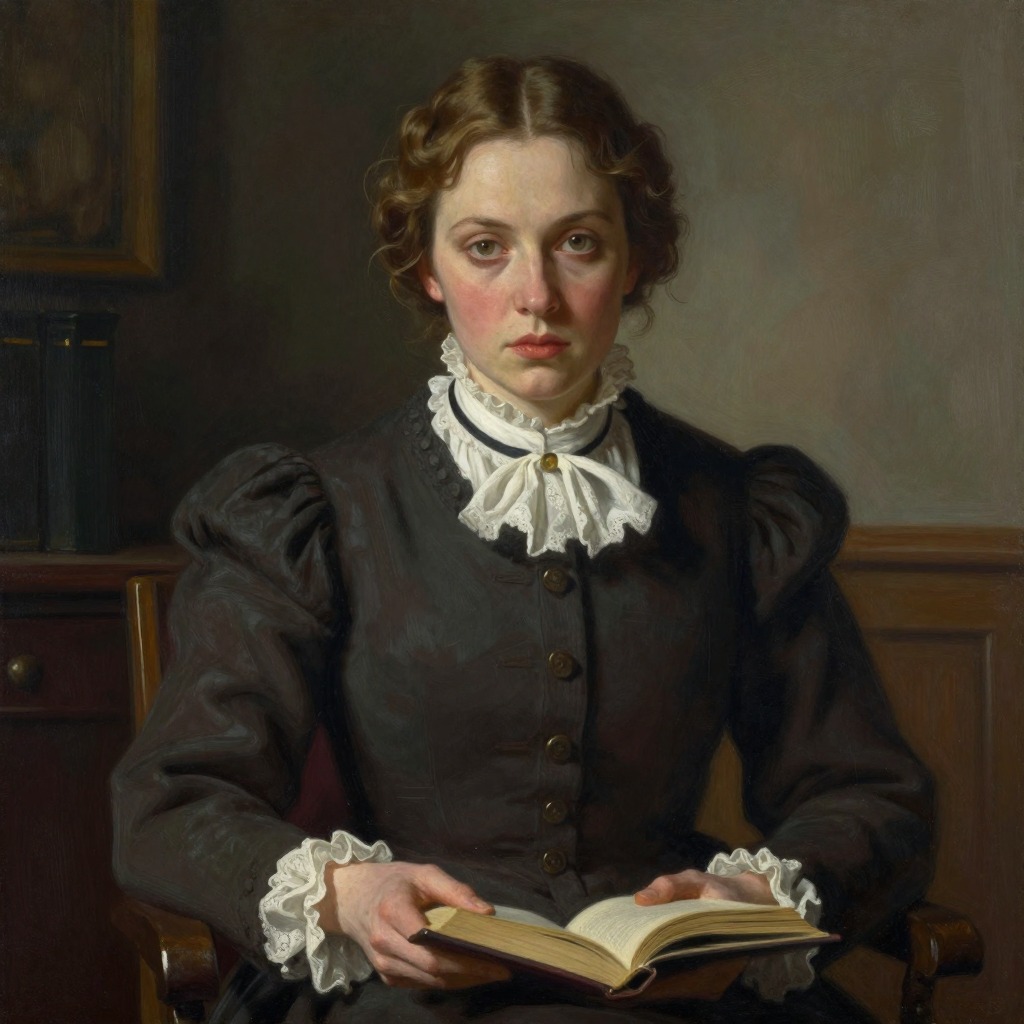
The TrialMiss Bürstner is a young typist who rents a room in Mrs. Grubach's lodging house, the same building where Josef K. lives. She works early and returns late, and K. has exchanged no more than a few words of greeting with her before the morning of his arrest. Her room is commandeered by the arresting officers for the preliminary hearing, and her bedside table is used as a desk for the proceedings. A white blouse hangs on the handle of her open window, and her photographs are disturbed by the three bank employees brought along by the supervisor. K. later apologizes to her for the intrusion, but his apology quickly becomes a pretext for a deeper, more unsettling encounter.
Encounter in the Night
On the evening of his arrest, K. waits for Miss Bürstner to return home, lying on his couch and smoking a cigar until nearly midnight. When she finally arrives, shivering and pulling a silk shawl over her slender shoulders, K. emerges from the darkness of his room, whispering her name. She is startled but agrees to let him into her room for a few minutes. K. attempts to explain the morning's events, but his account is vague and evasive. He reenacts the scene of the arrest, positioning furniture to show where the supervisor and policemen sat, and calls out his own name, "Josef K.!" The cry is heard by Captain Lanz, Mrs. Grubach's nephew, who is sleeping in the adjoining room. Miss Bürstner goes pale and lays her hand on her heart. K. tries to calm her, kissing her forehead, but she insists he leave. At the door, he takes hold of her, kisses her on the mouth and then over her whole face "like a thirsty animal lapping with its tongue when it eventually finds water," finally kissing her neck and throat. He leaves only when a noise comes from the captain's room. Miss Bürstner gives him a tired nod, offers her hand to kiss as if she does not know what she is doing, and goes back into her room with her head bowed.
Avoidance and the Intervention of Miss Montag
In the days following this encounter, Miss Bürstner systematically avoids K. He tries to reach her in many ways: he sits in his room without the light on, watching the hallway; he gets up an hour earlier in the morning hoping to find her alone; he writes letters to her both at the office and at the flat, offering to make amends and begging for a chance to speak. The letters are not returned, but there is no answer. On the following Sunday, a clear sign emerges: Miss Montag, a French teacher with a slight limp, moves into Miss Bürstner's room. Miss Montag then confronts K. on behalf of her friend, explaining that Miss Bürstner considers a meeting unnecessary and of no benefit to anyone. K. is angered by this intervention and, in a gesture of defiance, goes to Miss Bürstner's room and knocks. There is no answer. He opens the door and finds the room transformed: two beds stand against the wall, clothes are piled on chairs, and a wardrobe stands open. Miss Bürstner has gone out while Miss Montag was speaking to him. K. is left standing in the hallway, observed by Miss Montag and Captain Lanz from the dining room door.
Narrative Role and Thematic Significance
Miss Bürstner functions as a catalyst for K.'s psychological deterioration and a mirror of the trial's encroachment on his personal life. Her room is violated by the court's agents before she even knows of the proceedings, and her body becomes a site of K.'s displaced aggression and desire. K.'s obsessive pursuit of her—his waiting, his letters, his forced entry into her room—parallels his futile attempts to gain control over his case. She represents a normal, private life that becomes inaccessible to him once the trial begins. Her final appearance in the novel is a fleeting, ambiguous glimpse: as K. is led to his execution, he sees a young woman who resembles Miss Bürstner coming up into a square. He follows her direction not to catch up with her, but so that he will not forget the reproach she represents for him. She then turns off into a side street, and K. lets his companions lead him on. Her image thus haunts the very end of his life, a reminder of the human connection and the possibility of innocence that the trial has destroyed.