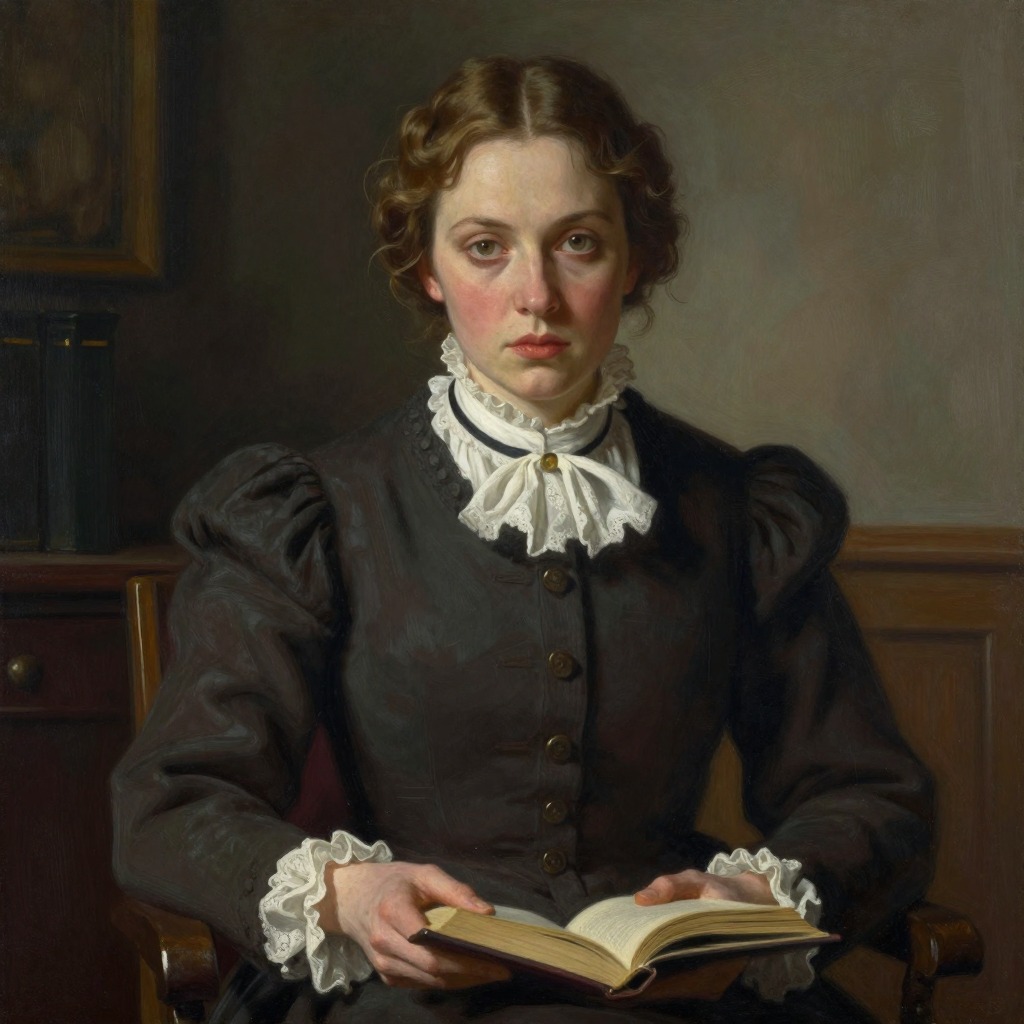
Miss Montag
The TrialMiss Montag is a minor but strategically significant character in Franz Kafka's The Trial, a pale, febrile German teacher with a slight limp who moves into Miss Bürstner's room and acts as an intermediary to sever K.'s contact with Miss Bürstner, thereby reinforcing the court's encroachment on his personal life.
Identity and Introduction
Miss Montag is introduced as a German teacher who, despite her name, is German. She is described as pale and febrile, with a slight limp, and had previously occupied a room of her own in Mrs. Grubach's lodging house. Her physical frailty and nervous demeanor contrast with the decisive role she plays in K.'s affairs. She appears in the narrative only after K.'s arrest has disrupted his domestic life, and her entry into Miss Bürstner's room marks a deliberate rearrangement of the household that isolates K. from the woman he had sought to approach.
Role as Intermediary
Miss Montag's primary function is to act as a barrier between K. and Miss Bürstner. After K. writes letters to Miss Bürstner begging for a meeting and receives no reply, Miss Montag moves into Miss Bürstner's room, a move that K. interprets as a clear sign that Miss Bürstner wishes to avoid him. Miss Montag then formally requests a conversation with K. in the dining room, where she explains that Miss Bürstner is unwell and that a meeting would be of no benefit to anyone. She speaks on behalf of her friend, claiming to be relatively impartial, and insists that the idea of a meeting is futile. K. finds her manner controlling and her words calculated to dismiss him without direct confrontation.
Relationship with Captain Lanz
During the conversation in the dining room, Captain Lanz, Mrs. Grubach's nephew, enters and deferentially kisses Miss Montag's hand. This gesture, which K. observes with irritation, binds Miss Montag and the captain into a group that seems to align against him. K. perceives their alliance as a means of keeping him at a distance from Miss Bürstner while appearing harmless and unselfish. The captain's presence reinforces K.'s sense that the household is being rearranged to exclude him.
Confrontation with K.
K. reacts to Miss Montag's intervention with anger and suspicion. He accuses her of exaggerating the importance of his request to speak with Miss Bürstner and of trying to make him appear foolish. After the conversation, K. attempts to enter Miss Bürstner's room but finds it empty, with two beds now placed behind one another and clothes piled on chairs, confirming that Miss Montag has moved in. When he leaves the room, he sees Miss Montag and Captain Lanz watching him from the dining room doorway, their glances heavy with meaning. K. rushes back to his own room, humiliated and frustrated.
Thematic Significance
Miss Montag embodies the court's indirect but pervasive influence on K.'s life. She is not an official of the court, yet her actions serve to isolate K. from a potential ally and to reinforce the sense that his personal relationships are being systematically dismantled. Her pale, febrile appearance and her role as a go-between suggest a world in which even seemingly neutral figures become instruments of the opaque forces that govern K.'s fate. She represents the way the trial seeps into every corner of K.'s existence, turning ordinary social interactions into maneuvers of exclusion and control.