Moorland landscapes
The TrialThe moorland landscapes are a series of paintings produced by the court painter Titorelli, which Josef K. acquires during his visit to the artist's cramped attic studio. They serve as a tangible emblem of the court's suffocating, inescapable reach and the hollow, transactional nature of the connections K. forms in his attempt to navigate his trial.
Appearance and Production
The paintings are small, unframed, and covered in dust, which swirls into K.'s face when Titorelli blows it off, momentarily robbing him of breath. Each depicts a "moorland landscape" featuring two sickly trees, well separated from each other in dark grass, with a multi-colored sunset in the background. Despite being presented as a series with counterparts, the paintings are virtually indistinguishable from one another; when Titorelli offers a third, claiming it is similar, K. observes that it is "exactly the same moorland landscape." Titorelli admits he has painted many such landscapes, noting that while some find them too gloomy, others—like K.—love gloomy themes. The paintings are produced in bulk, suggesting a mechanical, formulaic output that mirrors the court's own repetitive and impersonal procedures.
Acquisition and Transaction
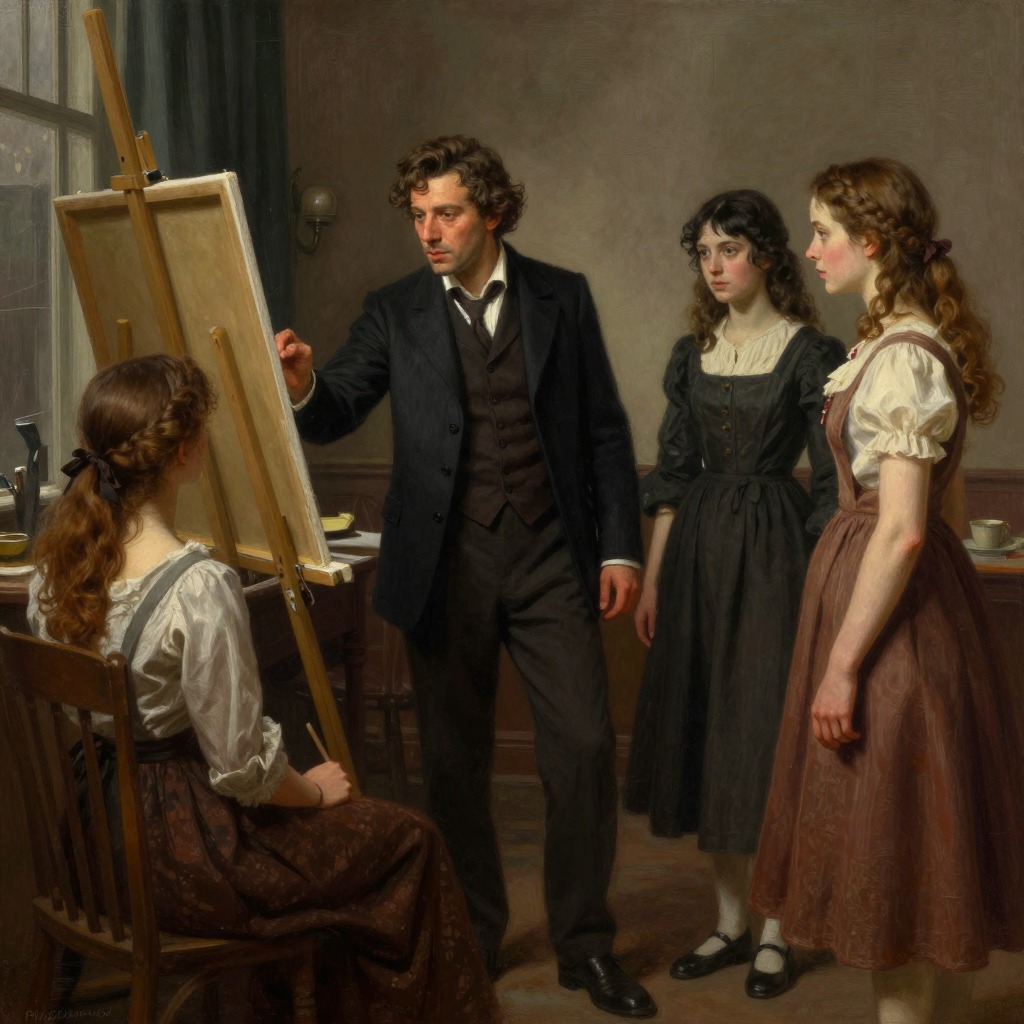
K. does not seek out the paintings but is maneuvered into buying them by Titorelli, who exploits K.'s impatience to leave the stifling studio. After explaining the three possible outcomes of a trial—absolute acquittal, apparent acquittal, and deferment—Titorelli delays K.'s departure by crawling under his bed to retrieve the dusty pile of paintings. K., eager to escape and feeling obligated not to offend the painter who has promised future help, agrees to purchase them without any genuine interest. He buys three paintings in rapid succession, each identical to the last, and when Titorelli offers a fourth, K. cuts him off, telling him to wrap them all up. Titorelli refuses to name a price, deferring payment to a future meeting, which further binds K. to him. K. then has a court servant carry the paintings to a cab, and upon arriving at the bank, he locks them in the lowest drawer of his desk to keep them from the deputy director's view, treating them as an embarrassing secret.
Symbolic Significance
The moorland landscapes are a microcosm of the court's logic: they are repetitive, inescapable, and drain the individual of agency. Their identical, gloomy content reflects the court's monolithic and oppressive nature, offering no variation or hope. The transaction itself—a forced purchase under social pressure, with payment deferred and obligations left open—mirrors K.'s relationship with the court, where he is constantly drawn into compromising exchanges that yield no real progress. The paintings also serve as a physical reminder of Titorelli's role as a "trustee of the court," a figure who, despite his apparent helpfulness, is deeply embedded in the system K. is trying to fight. By locking them away, K. acknowledges their contaminating presence, yet he cannot discard them, just as he cannot escape the trial itself. The landscapes thus become a silent, persistent symbol of the court's ability to infiltrate every corner of K.'s life, even his office, and to reduce all interactions to a sterile, repetitive exchange.