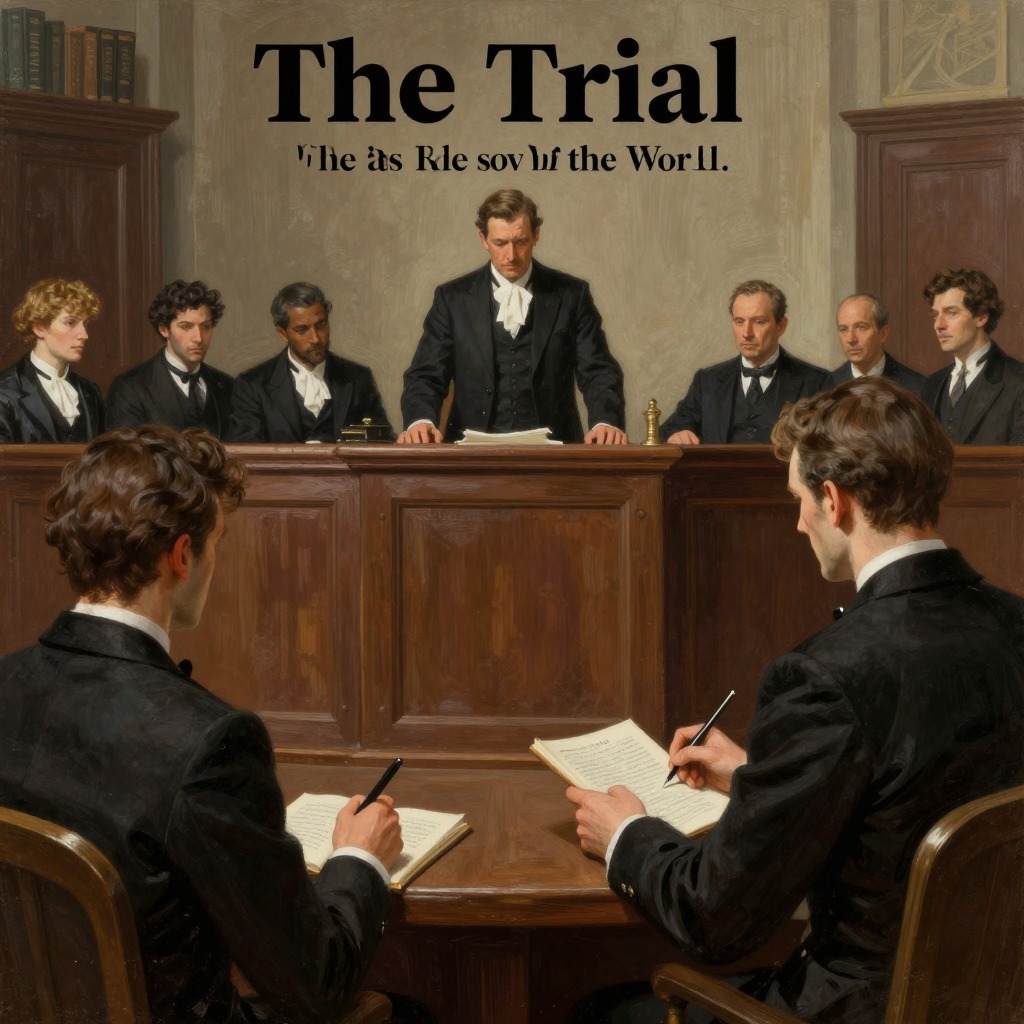
Portrait of a judge
The TrialThe Portrait of a judge is a charged object in Franz Kafka's The Trial, appearing in two distinct versions that together expose the vanity, theatricality, and institutional self-deception of the court. One hangs in the office of the lawyer Dr. Huld; the other is the current work of the painter Titorelli. Both portraits depict judges in poses of majestic authority that the narrative systematically contradicts, turning the paintings into emblems of the gap between the court's self-image and its actual squalor.
The Portrait in Dr. Huld's Office
When K. first enters Dr. Huld's darkened office, he is immediately struck by a large picture hanging to the right of the door. It shows a man wearing judge's robes, seated on a lofty throne whose gilding shines forth from the painting. The judge is not posed in dignified calm: his left arm is pressed against the back and armrest, while his right arm is completely free and only grasps the armrest with his hand, as if about to jump up at any moment in vigorous outrage to make some decisive comment or even to pass sentence. The accused is presumably meant to be imagined at the foot of the steps, the top one of which is visible in the picture, covered with a yellow carpet. K. points to the picture and says, "That might be my judge." Leni, the lawyer's nurse and mistress, immediately deflates this impression. She tells K. that the judge comes to the house quite often, that the picture is from when he was young, but that he can never have looked anything like it, as he is "tiny, minute almost." Despite that, she explains, he had himself made to look bigger in the picture because he is "madly vain, just like everyone round here." The portrait thus functions as a lie: the judge's actual physical insignificance is replaced by a painted grandeur that the narrative refuses to let stand.
Titorelli's Portrait and the Goddess of Justice
K. encounters a second portrait of a judge in the cramped, stifling attic studio of the painter Titorelli. This picture, executed in pale, unclear pastel colors, shows a different judge: a heavy man with a full, black, bushy beard that extends far up his cheeks. Like the portrait in Dr. Huld's office, this judge is shown holding tightly to the arm of his throne and seeming ominously about to rise from it. When K. asks about a large, incomprehensible figure in the middle of the throne's backrest, Titorelli explains that it is the figure of justice, but that he had to paint it according to the contract as a combination of justice and the goddess of victory, complete with wings on her heels. K. objects: "Justice needs to remain still, otherwise the scales will move about and it won't be possible to make a just verdict." Titorelli admits he has never seen the figure or the throne; it is all invention, dictated by the client. As he works, adding a reddish shadow around the judge's head, the figure of justice, left pale, begins to look less like a goddess of justice or victory and more like "a perfect depiction of the God of the Hunt." The portrait is thus a composite of incompatible ideals—justice, victory, and predatory pursuit—revealing the court's fundamental confusion of judgment with violence.
The Judge's Vanity and the Court's Hierarchy
Titorelli explains that the judges are extremely vain and have permission from higher up to be painted in such grand poses, with strict rules about what sort of portrait each can have. The judge in the pastel portrait, for instance, wanted it for a woman. The painting's grandiose pose—the judge on a throne like a president of the court—is a fiction: the real judge is not very high up and has never sat on any such throne. The portrait is a product of the court's elaborate system of self-aggrandizement, a system that extends to the very architecture of its offices. K. later learns that the court offices are located in attics, and that the court's equipment is strictly regulated. The contrast between the judges' painted magnificence and their actual working conditions—cramped, airless attics—underscores the court's obsession with appearance over substance.
The Portrait as a Symbol of the Court's Pervasive Reach
The portrait of a judge is not an isolated object but part of a network of signs that mark the court's presence. K. notices that the defendants in the court offices wear badges on their collars, and that the examining judge himself wears one. The portrait, like the badges, is a visible marker of an invisible hierarchy. It also connects to the court's peculiar relationship with art: Titorelli, the court painter, inherited his position from his father, and the rules for painting judges are so numerous and secret that only certain families know them. The portrait is thus a product of a closed, hereditary system that controls even the representation of its own authority. When K. later sees the portrait in Dr. Huld's office, he is reminded of the court's omnipresence: the lawyer's room, like the court offices, is part of a world where every object seems to belong to the court. The portrait, with its false promise of a majestic, rational justice, becomes a symbol of the court's ultimate inscrutability and its power to impose its own image on reality.