Titorelli
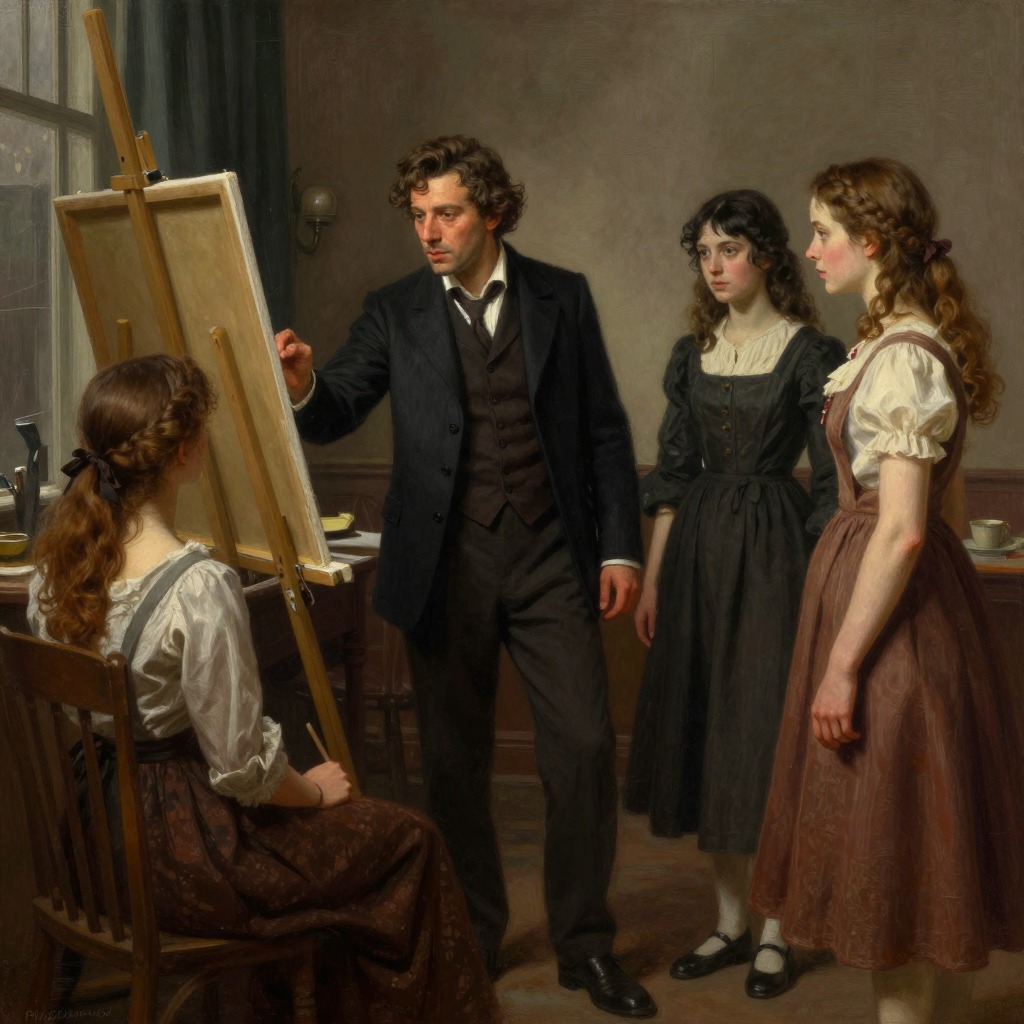
The TrialTitorelli is a painter who lives in a cramped attic studio in one of the poorest quarters of the city, near the court offices. He is introduced to Josef K. by a manufacturer who has bought Titorelli's moorland landscapes for years out of charity and who, after learning that Titorelli works for the court, gives K. a letter of recommendation. Titorelli's studio is a wretched, stifling room with a fixed window that cannot be opened, a bed covered in many-coloured bedding, and an easel holding a portrait of a judge. The room is constantly besieged by local girls, whom Titorelli describes as a burden; they have made a key to his door, hide under his bed, and paint their lips with his brushes. Titorelli himself is barefoot and dressed only in a nightshirt and loose yellowish linen trousers when K. first meets him, and he speaks with a mixture of pride and weariness about his position.
Position and Role as Court Trustee
Titorelli reveals that he is a trustee of the court, a position that is not publicly acknowledged but that he claims carries more influence than official roles. He inherited the position from his father, who was court painter before him, and the rules governing how judges of various grades are painted are so numerous and secret that only members of certain families know them. Titorelli keeps his father's notes in a drawer and carries the rest of the rules in his head, making his position, in his own words, "quite unassailable." He explains that all the judges want to be painted like the old, great judges were, and he is the only one who can do that. This gives him personal contact with the judges, whom he describes as vain, and he uses these contacts to help poor defendants now and then.
The Three Possibilities for a Defendant
When K. asks for help, Titorelli lays out three possible outcomes for a trial: absolute acquittal, apparent acquittal, and deferment. Absolute acquittal, he says, is the best but impossible for anyone to achieve through influence; it could only happen if the accused is truly innocent, and in that case no help is needed. Apparent acquittal involves Titorelli writing a document asserting K.'s innocence, taking it to the judges he knows, and collecting their signatures. The judge handling K.'s case would then acquit him as a favour, but the acquittal is only temporary: the charge is withdrawn but still hangs over the defendant's head, and a higher court can order re-arrest at any time. Deferment, by contrast, keeps the trial permanently in its earliest stages through continuous personal contact with the court, requiring the defendant to report to the judge regularly and never let the case out of sight. Titorelli explains that both methods prevent conviction but also prevent proper acquittal, and that the difference between them is a matter of a hair's breadth.
Relationship with the Court and Its Officials
Titorelli's studio is itself part of the court offices, which occupy almost every attic in the building. A second door behind his bed leads directly into a long corridor lined with benches, identical to the waiting area K. visited earlier. Titorelli has given a key to this door to the judge he is currently painting, so the judge can wait for him in the studio when he is not home. The judge climbs over Titorelli's bed to enter, waking him in the morning. Titorelli speaks of the judges with a mixture of familiarity and contempt, noting their vanity and the strict rules about how they may be portrayed. He also mentions that the girls who pester him belong to the court as well, adding, "everything belongs to the court."
Narrative Role and Significance
Titorelli functions as a cynical educator who makes explicit the court's logic of endless, inescapable proceedings. His three-part taxonomy of acquittal—absolute, apparent, and deferment—gives K. a vocabulary for understanding his situation, but each option is revealed to be a trap: absolute acquittal is a myth, apparent acquittal is temporary and leads to re-arrest, and deferment is a lifelong burden of vigilance. Titorelli's own position, inherited and unassailable, mirrors the hereditary, closed nature of the court itself. His studio, with its suffocating air and its direct connection to the court offices, becomes a physical symbol of the way the court permeates every space a defendant might try to occupy. When K. leaves, Titorelli sells him three identical moorland landscapes, a final gesture that underscores the emptiness and repetition at the heart of the system he serves.