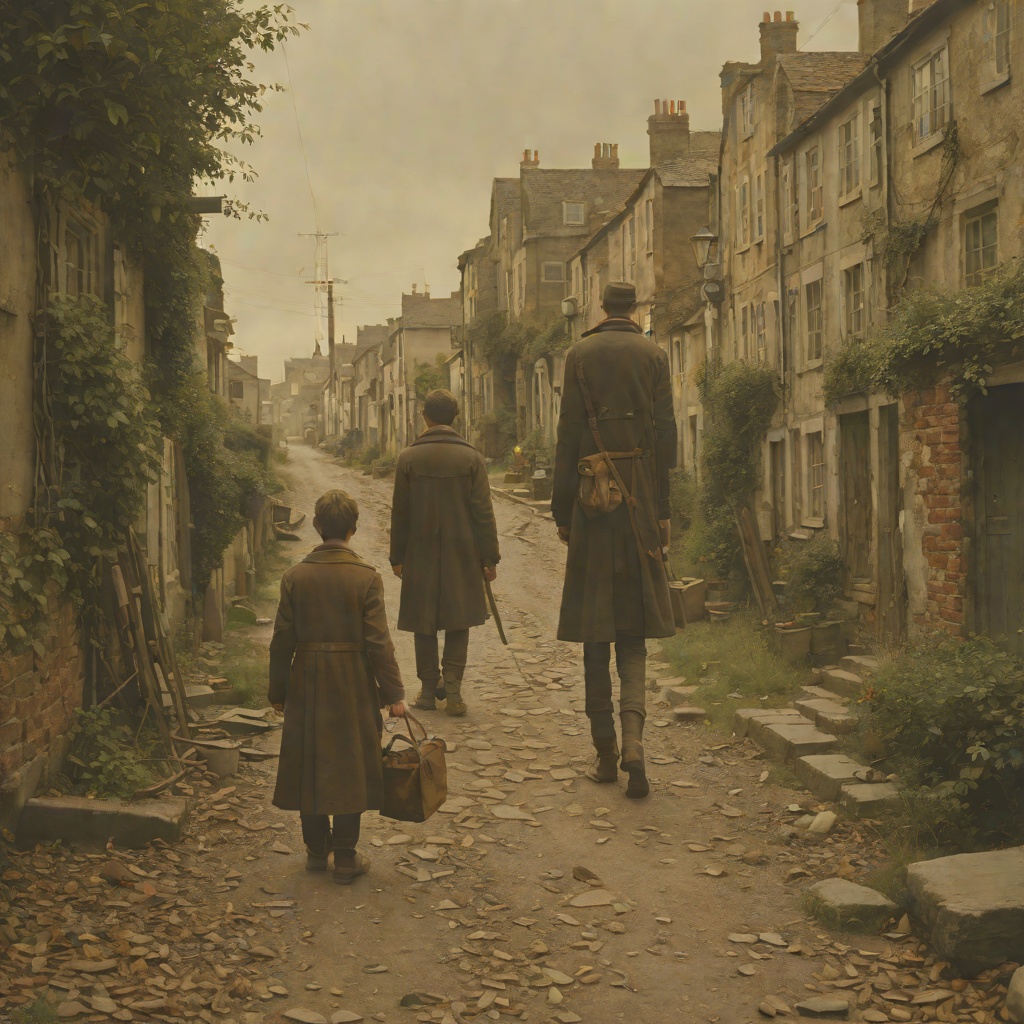
Harold Fry and his father
The Unlikely Pilgrimage of Harold FryThe relationship between Harold Fry and his father is the foundational wound of Harold's life, a silence and rejection that shaped his character, his marriage, and his pilgrimage. From a childhood of being told he was a 'dirty beggar' to being expelled from home on his sixteenth birthday, Harold's father taught him that he was unwanted. This early abandonment, compounded by his mother's desertion, left Harold with a profound sense of ordinariness and an inability to connect, a pattern that echoed through his relationship with his own son, David. The memory of his father's final rejection—a small man throwing teaspoons and yelling he had no son—became a recurring torment during the walk, and the relationship stands as the dark origin of the silence Harold spends his journey trying to break.
A Childhood of Silence and Rejection
Harold's earliest memories of his father are defined not by cruelty but by a profound, almost pathological aversion to his presence. As a boy, Harold tried to chew without noise because his father didn't like to hear him masticate. Sometimes his father would say nothing, only hold his ears and close his eyes, as if the boy were a pain inside his head; other times he would call Harold a dirty beggar. This was a household where the war had made people funny, as a neighbour once said, and where Harold's mother would answer her husband's insults by screwing out a cigarette and retorting, 'Takes one to know one.' The young Harold wanted to touch his father, to stand close beside him and know the feeling of an adult arm around his shoulder, and to ask what happened before he was born and why his father's hands trembled when he reached for his glass. But such intimacy was impossible. His father would complain, 'That boy's staring at me,' and his mother would swipe Harold's knuckles, not hard but as if she were brushing off a fly, and say, 'Leave off, sonny. Go and play outside.' The rejection was constant, and the silence it created became the template for Harold's entire emotional life.
The rupture came on his sixteenth birthday. His father presented him with an overcoat and showed him the door. The coat was not new; it smelt of mothballs, and there was a bus ticket in the inside pocket. It was a gesture of expulsion disguised as a gift, and it marked the end of Harold's childhood. His Aunty Sheila, his favourite among the aunts, said, 'It seems sad to see him go,' though she did not cry, and she bent to offer a kiss, bringing such waves of scent that Harold had to walk away to avoid being silly and hugging her. It came as a relief to leave his childhood behind, yet the silence of those early years followed him into his marital home, lodging itself behind the carpet and curtains and wallpaper. Even as an adult, Harold wore a tie every day, but he sometimes wondered if he was hanging on to an order or a set of rules that had never really existed, and he reflected that maybe it would have been different if he had had a proper education, finished school, gone to university. Instead, he had been cast out, and the sense of being ordinary, of lacking colour, stayed with him.
The Echo of Abandonment
The father's rejection was compounded by the mother's desertion. Harold remembered his mother's suitcase by the door, and the moment she left. As a teenager, he had asked her, 'Where are you going?' and she had lifted her suitcase and arranged a long silk scarf round her neck, hanging down her back like hair. She did not answer him. The memory of that silence, of lying in his bed as a teenager listening to the silence that did not hold his mother, became one of the most painful images of Harold's life. His father, already broken by the war, was left to raise a son he clearly did not want, and the household collapsed into a mutual, unspoken grief. Harold's father's hands trembled when he reached for his glass, a tremor that Harold would later understand as the legacy of the war, but which at the time only deepened the distance between them.
This early experience of being unwanted shaped Harold's understanding of himself. He had always been too English, by which he supposed he meant that he was ordinary. He lacked colour. Other people knew interesting stories, or had things to ask. He didn't like to ask, because he didn't like to offend. This self-effacement, this fear of being a burden, was the direct inheritance of a childhood in which his very existence seemed to cause his father pain. The silence of his early years had followed him into his marital home, and it was this silence, more than any single event, that would come to define his relationship with his wife, Maureen, and with his son, David.
The Father's Final Rejection
The last time Harold visited his father, the old man was in a nursing home, suffering from dementia. The carer had Harold by his jacket sleeve, almost tugging him out of range, and said, 'I am terribly sorry. But he seems disturbed. Maybe you had better leave it for today.' As Harold hurried away, glancing over his shoulder, his final impression was of a small man throwing teaspoons and yelling that he had no son. This image—the father denying his son's existence even as the son stood before him—became a recurring torment for Harold. It was the ultimate expression of the rejection that had defined his life, and it was a memory he could not escape, even on his pilgrimage. He relived it as he walked, picturing himself lying in his room as a teenager, listening to the silence that did not hold his mother, and remembering the last time he had visited his father.
The father's dementia did not soften the memory; it only made it more brutal. The man who had expelled his son at sixteen was now, in his final years, still denying that he had a son at all. For Harold, this was the culmination of a lifetime of being told he was unwanted. It was a wound that had never healed, and it was one of the many weights he carried as he walked towards Berwick-upon-Tweed.
The Inheritance of Silence
The relationship with his father was not merely a source of pain; it was the origin of Harold's deepest failures as a man. The silence he learned at home followed him into his marriage and his fatherhood. He had done what his father never had—he had found work, supported a wife and son, and loved them, if only from the sidelines—but he could not break the pattern of emotional distance. When his own son, David, fell into depression and addiction, Harold did not know how to reach him. David hanged himself in the garden shed, and Harold discovered him. In his confession letter to the garage girl, Harold wrote that he wished with all his heart that David had spoken to him, but the silence that had been his inheritance made such speech impossible. The father who had held his ears and closed his eyes at the sound of his son chewing had taught Harold that a father's love was conditional, or absent, and Harold had learned the lesson too well.
This inheritance of silence was also the engine of Harold's pilgrimage. As he walked, he unleashed the past that he had spent twenty years seeking to avoid, and it chattered and played through his head with a wild energy. He measured distance not in miles but with his remembering. The memories of his father, his mother, and his son all surfaced, and he was forced to confront the pattern of abandonment and rejection that had shaped his life. The walk was, in part, an attempt to break that pattern, to become a different kind of man, one who could speak and be heard. But the shadow of his father was long, and it was only by walking to the very end of England that Harold could begin to understand the depth of the wound and the possibility of a different future.