Harold Fry and the garage girl
The Unlikely Pilgrimage of Harold FryThe relationship between Harold Fry and the garage girl begins as a fleeting, almost accidental encounter, yet it becomes the spark that ignites his entire pilgrimage. Stopping at a garage for a burger on his way to post a letter to Queenie Hennessy, Harold finds himself in conversation with a young woman behind the till. When she learns of his purpose, she speaks with unexpected conviction about her aunt's cancer, insisting that medicine is not the only answer. 'You have to believe,' she tells him. 'That's what I think. It's not about medicine and all that stuff. You have to believe a person can get better. There is so much in the human mind we don't understand. But, you see, if you have faith, you can do anything.' The words strike Harold with a force he cannot explain. He gazes at her in awe, seeing her as if she stands in a pool of light, her hair and skin shining with luminous clarity. Though he admits he never quite got the hang of religion, the word 'faith' rings in his head with an insistence that bewilders him. At sixty-five, he had begun to anticipate only the difficulties of aging—stiffening joints, ringing ears, watering eyes—but this sudden surge of feeling makes his body shake with sheer energy. He leaves the garage, turns in the direction of the A381, and promises himself that at the next post box he will stop. The girl's simple assertion becomes the foundation of his resolve: as long as he walks, Queenie must live.
The Birth of the Pilgrimage
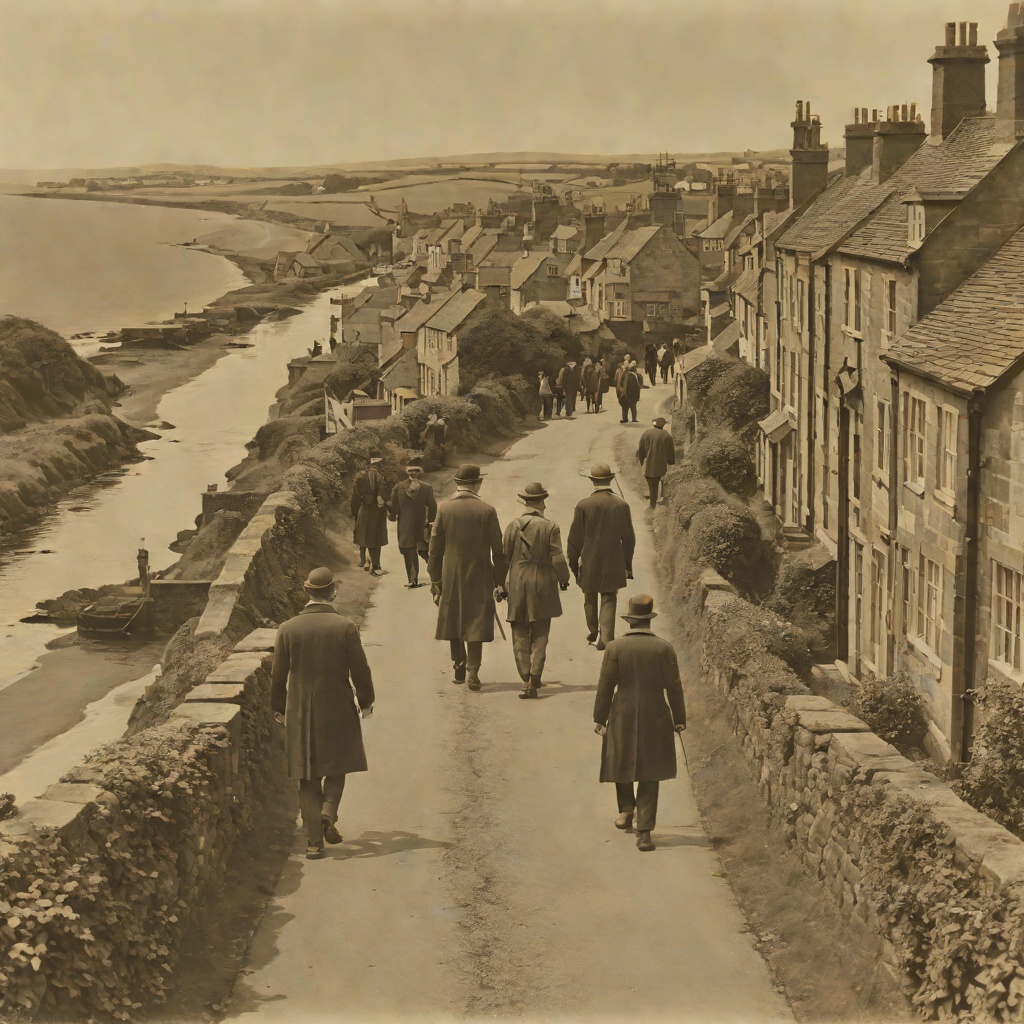
The garage girl's words do not merely comfort Harold; they transform his intention. What began as an errand to post a letter becomes a decision to walk the length of England. Standing in a phone box, he pictures Queenie dozing at one end of the country and himself at the other, with roads, fields, rivers, woods, moors, peaks and valleys—and so many people—in between. There is no deliberation, no reasoning; the decision comes in the same moment as the idea. He laughs at the simplicity of it. 'Tell her Harold Fry is on his way,' he instructs the voice on the other end of the line. 'All she has to do is wait. Because I am going to save her, you see. I will keep walking and she must keep living.' When the voice asks about visiting hours and parking restrictions, he insists, 'I'm not in a car. I want her to live.' The girl's faith has given him a framework for his own desperate hope, and he carries it with him as he walks out of Kingsbridge, past the sea lying behind him and the rolling hills and blue outline of Dartmoor stretching before.
Postcards and Gifts Along the Way
As Harold walks, the garage girl remains a constant, if distant, presence in his thoughts. At Buckfast Abbey, he buys postcards and a souvenir pen, and briefly contemplates a jar of the monks' honey before deciding it might not survive the journey in his plastic bag. He buys it anyway, asking for extra bubble wrap. Sitting by a window overlooking the lavender garden, he writes his cards: one to Queenie, one to Maureen, and one addressed to 'Dear Girl in the Garage (Happy To Help),' thanking her and signing it 'From the man who said he was off for a walk.' The postcards continue throughout his journey, a thread connecting him to the stranger who set him on this path. He sends her many lovely postcards, each one a small acknowledgment of the debt he owes her. The girl, for her part, keeps them, and they become the tangible evidence of the extraordinary thing her words have set in motion.
The Confession Letter
Harold's relationship with the garage girl reaches its deepest point not in person but through a letter. In a chapter titled 'Harold and Another Letter,' he writes to her with a confession that he has shared with no one else. 'Dear Girl in the Garage,' he begins, 'I owe you the full story.' He tells her that twenty years ago he buried his son, David, who hanged himself in the garden shed with rope tied to one of the hooks he used for garden tools. The coroner said it must have taken a long time to tie the noose, and Harold wishes they hadn't told him that. He describes finding David, lifting him down, praying despite not being a religious man, and being too late. He writes of his drinking—bottles kept in paper bags under his desk—and of the night he dismantled the garden shed and then broke into the brewery and did something terrible. He confesses that Queenie knew it had to be him and took the blame, was fired on the spot, and disappeared. 'I let her go. I let her take the blame. But I gave up drinking.' The letter is an act of profound vulnerability, a confession offered to a near-stranger because she is the one who gave him faith, and because he owes her the truth of what that faith has cost him.
The Girl's Visit to Maureen
The relationship comes full circle when the garage girl arrives at Maureen's door. A ring at the doorbell in the early morning brings Maureen downstairs to find a sallow-faced young girl with lank hair, wearing a black duffel coat although it is already warm. Over tea and several apricot flapjacks, the girl explains that she is the one who gave Harold the burger all those weeks ago. She tells Maureen that Harold sent her many lovely postcards, but that due to his sudden rise to fame there had been an inconvenient number of fans and journalists hanging about the garage, and in the end her boss had been obliged to ask her to leave for health and safety reasons. When Maureen expresses horror that she lost her job, the girl dismisses it, saying she didn't like the job anyway—customers were always shouting and in too much of a hurry. But what she said to Harold about the power of faith has been bothering her ever since. 'I think I gave him the wrong impression,' she says, fidgeting and anxious. Maureen protests that Harold was inspired by her words, that it was her faith that gave him the idea to walk. But the girl sits bunched up in her coat, gnawing at her lip, and pulls an envelope from her pocket. She holds out several sheets of paper with a trembling hand. Maureen frowns, reading the visible side: 'Salsa for the over sixties?' The girl flips the papers over. 'The writing's on the other side. It's a letter from your husband.' Maureen reads in silence, weeping over each sentence, the loss that wrenched them apart twenty years ago as lacerating and incomprehensible as if it were happening afresh. When she finishes, she thanks the girl, folds the letter, runs her nail along the crease, and posts it back inside its envelope. She sits, very still.
Significance of the Encounter
The garage girl is the unwitting catalyst for everything that follows. Her words about faith—'if you have faith, you can do anything'—give Harold permission to believe in the impossible. She is the first of many strangers who will shape his journey, but she is unique in that she sets it in motion. Her visit to Maureen reveals the ripple effects of Harold's pilgrimage: the girl loses her job because of the fame his walk brings, yet she comes not to complain but to deliver his confession letter, troubled by the impression she may have given. In doing so, she becomes the instrument through which Maureen finally confronts the truth of David's death and Harold's suffering. The girl's own doubt—her fear that she gave Harold the wrong impression—mirrors the novel's larger meditation on faith: whether it is a force for good or a delusion, whether belief can truly save a person or merely sustain them in their hope. Harold's letter to her, and her delivery of it to Maureen, completes a circuit of confession and revelation that neither of them could have foreseen. She is, in the end, not just the girl in the garage who sold Harold a burger, but the person who gave him a reason to walk, and the one who finally brings his wife face to face with the grief he has carried for twenty years.