Harold's renunciation of possessions
The Unlikely Pilgrimage of Harold FryHarold Fry's renunciation of possessions marks the deepest transformation of his pilgrimage from Kingsbridge to Berwick-upon-Tweed. What began as an impulsive decision to walk to St Bernadine's Hospice to save Queenie Hennessy, a former colleague dying of cancer, became, by the time he reached Cheltenham, a deliberate stripping away of everything that tied him to his old life. The act was not a single gesture but a process of simplification that reached its climax when he parcelled up his wallet, watch, and other belongings and posted them home to his wife Maureen, keeping only what was essential or what belonged to others. In doing so, Harold turned his walk into something far more than a physical journey: it became a test of faith, a renunciation of the self he had been for twenty years, and a preparation for the reckoning with grief that lay ahead.
The Road to Cheltenham
The renunciation was the culmination of a gradual shedding that began almost as soon as Harold left home. On his first night, in a small hotel with palm trees cowering from the coastal wind, he inspected his feet with a quiet pride, noting the soft pale toes, the tenderness around the nails, and a possible blister forming at the top of his heel, and pronounced them 'Not bad.' He was still thinking in terms of plasters and a good breakfast then, still imagining the nurse telling Queenie that all she had to do was keep living. But the journey was already changing him. Walking the single-track lanes towards South Brent, he felt the exhilaration of being 'in the world by himself,' a single vulnerable figure without his mobile phone, and the freedom of pushing into the unknown was so great he had to smile. The past he had spent twenty years avoiding began to surface as he walked, and he measured distance not in miles but with his remembering.
The gifts he carried for Queenie — the pot of honey from Buckfast Abbey, the rose quartz pendant, the glittering paperweight from Exeter Cathedral, a Roman key ring, and a wool hat — were rewrapped and kept, but other objects began to fall away. In Cheltenham, he donated his washing powder to a student going into a laundrette, offered his wind-up torch to a woman from Prestbury who could not find her key, gave his plasters and antiseptic cream to the mother of a distressed child with a bleeding knee, and handed his comb to the child by way of distraction. The guide to Britain he gave to a bewildered German couple lost near Cleeve Hill, and since he knew the plant dictionary by heart, he suggested they might like that too. Each gift was a small act of renunciation, a letting go of the things that had seemed necessary but were not.
The Decision to Simplify
The decisive turn came after a night spent in an empty woodshed, his second night in the open. Harold had been troubled by something he could not name, something that remained even as he understood that he must keep to the roads, stick to his yachting shoes despite their wear and tear, and follow the map in his mind rather than any road map. He had learned from the kindness of the woman with food and from Martina, who had treated his feet and given him her partner's rucksack, brass compass, and blue duct tape, that it was as much a gift to receive as to give, requiring both courage and humility. Lying in the sleeping bag in a barn, he found a peace that showed him what he must do. The renunciation was not about discarding objects for their own sake but about remaining true to the instincts that made him Harold, as opposed to anyone else. He saw that when a person becomes estranged from the things they know, strange things take on a new significance, and it seemed important to allow himself to be true to that estrangement.
The Parcel to Maureen
Two days after the night in the barn, Maureen was coiling her bean plants against stakes when she was called to the gate to receive a parcel. Inside she found a new selection of gifts, along with Harold's wallet, watch, and a postcard showing a woolly Cotswold sheep. The note read: 'Dear Maureen. Please find enclosed my debit card, etc. I am going to walk without so many things. If I keep it simple, I know I can get there. I think of you often. H.' She climbed the slope to the front door without noticing that she had feet. The wallet she stowed in his bedside drawer, beneath the photographs of herself and David, and the postcard she pinned to Rex's map of England. The gesture was both a declaration of faith in the walk and a message to Maureen that he was no longer the man who had left, that he was becoming someone else, someone who could keep it simple and believe he would get there.
Walking Without Possessions
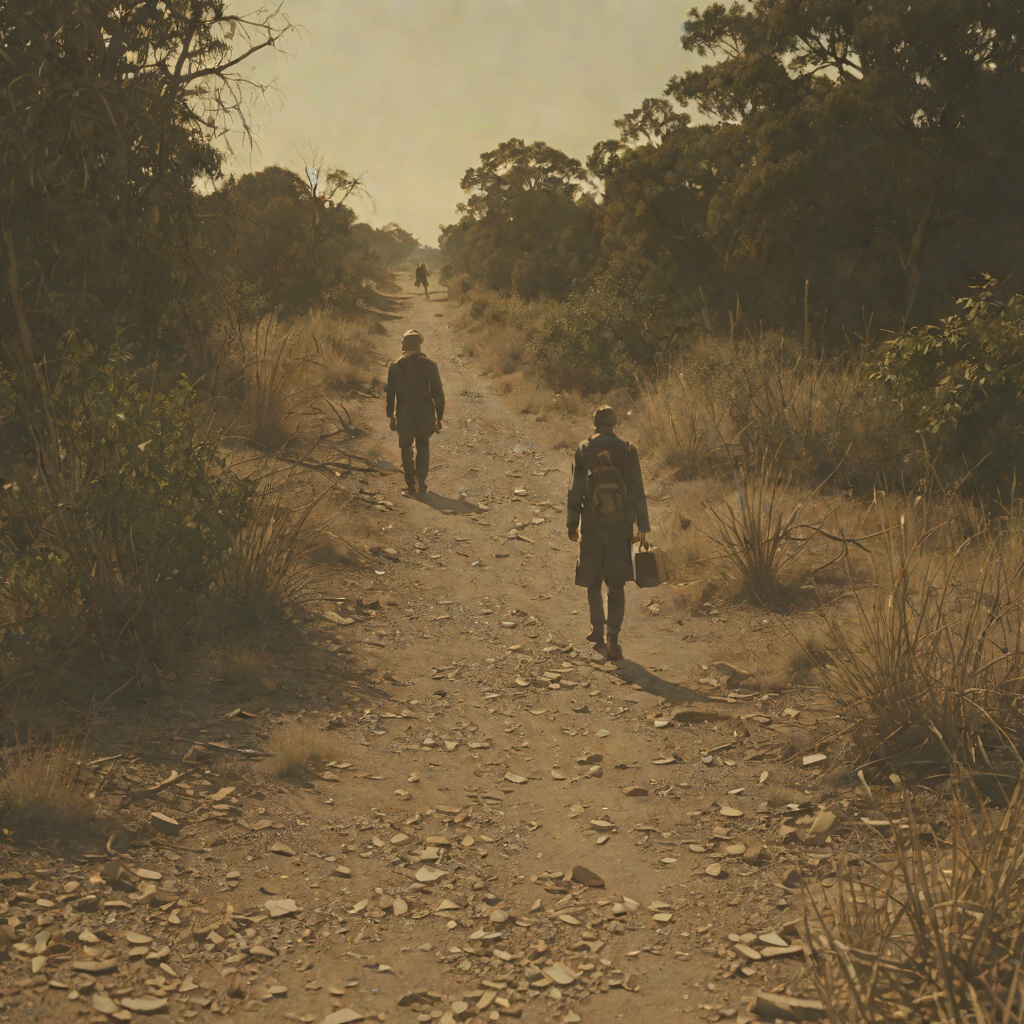
After the renunciation, Harold's pilgrimage entered a new phase. He continued to sleep outside, choosing dry places and being careful not to upset things. He washed in public lavatories, fountains, and streams, and rinsed his clothes where no one was watching. He thought of that half-forgotten world lived in houses and streets and cars, where people ate three times a day, slept by night, and kept each other company, and he was glad they were safe and glad too that he was at last outside them. He took the A-roads, B-roads, lanes, and tracks, following the compass that quivered northwards, going by day or by night as the mood took him, mile after mile. If the blisters were bad, he bound them with duct tape. He slept when the need came and then returned to his feet and walked again, under the stars and the tender light of the moon. It seemed to Harold that he had been waiting all his life to walk. He no longer knew how far he had come, but only that he was going forward. The pale Cotswold stone became the red brick of Warwickshire, and the land flattened into middle England. He reached his hand to his mouth to brush away a fly and felt a beard growing in thick tufts. Queenie would live. He knew it.
The renunciation also deepened his connection to the strangers he met. He told the story about Queenie and the garage girl and asked strangers if they would help, and in return he listened. He might be offered a sandwich, a bottle of water, or a fresh set of plasters, but he never took more than he needed and gently refused lifts, walking equipment, or extra packages of food. He had learned that it was the smallness of people that filled him with wonder and tenderness, and the loneliness of that too. The world was made up of people putting one foot in front of the other, and a life might appear ordinary simply because the person living it had done so for a long time. Harold could no longer pass a stranger without acknowledging the truth that everyone was the same and also unique, and that this was the dilemma of being human. He walked so surely it was as if all his life he had been waiting to get up from his chair.
The Meaning of the Act
The renunciation of possessions was Harold's way of honouring the feeling that had inspired him in the first place, the conviction that as long as he walked, Queenie must live. It did not matter that other people would do the pilgrimage differently, or that he had no mobile phone, no planned route, no road map. He had a different map, one made up of all the people and places he had passed. The act of giving away his wallet and watch was also a renunciation of the life that had produced them, the life of a man who had buried his son and drunk to stop feeling, who had let Queenie take the blame for his own terrible act and then disappeared. The confession he later wrote to the garage girl revealed the depths of what he was walking away from: the garden shed where David hanged himself with rope tied to a hook for garden tools, the bottles kept in paper bags under his desk, the dismantled shed, the break-in at the brewery, and Queenie's firing. By shedding his possessions, Harold was shedding the weight of that past, preparing himself to arrive at St Bernadine's Hospice not as the man who had failed everyone but as a pilgrim who had walked to save a life. The strangest part, he thought, was that a driver might overtake him and briefly observe an old fellow in shirt and tie, perhaps a pair of yachting shoes, and see no more than another man off down the road. It was so funny, and he was so happy, so much at one with the land beneath his feet, he could laugh and laugh with the simplicity of it.