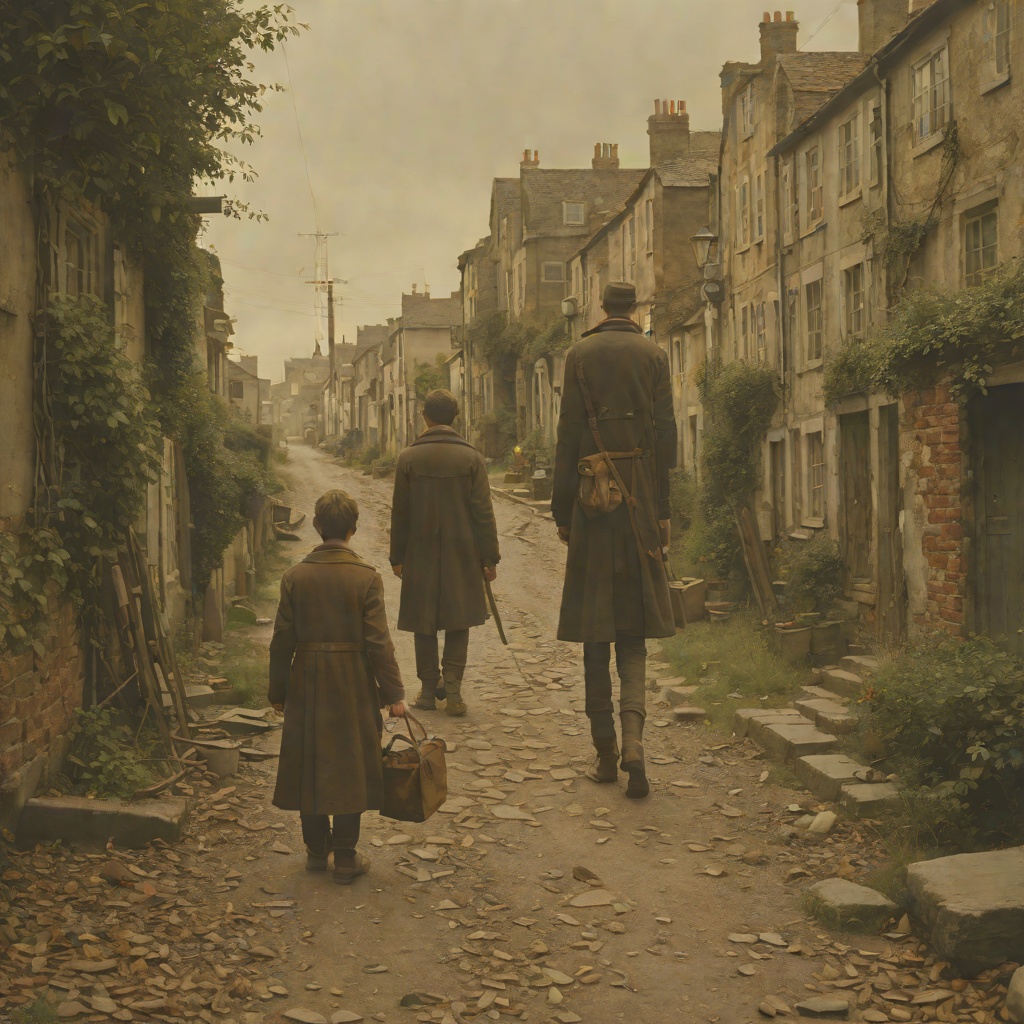
Harold's sixteenth birthday expulsion
The Unlikely Pilgrimage of Harold FryOn his sixteenth birthday, Harold Fry was handed an overcoat and shown the door. The coat was not new; it smelt of mothballs, and there was a bus ticket in the inside pocket. It was his father's way of ending the boy's childhood—not with anger, not with explanation, but with a worn garment and a gesture toward the outside world. Harold left home that day, and the abruptness of the departure, the absence of any farewell beyond a single kiss from his favourite aunt, would mark him for the rest of his life. It was the moment his silence began.
The Coat and the Door
The overcoat was the sum total of Harold's inheritance from his father. It was presented on his sixteenth birthday, the traditional threshold of manhood, yet there was nothing ceremonial about it. The coat was second-hand, smelling of mothballs, with a bus ticket still in the pocket—details Harold would remember with exactness decades later. His father did not speak of the future, did not offer advice or blessing; he simply produced the coat and showed Harold the door. The gesture was final and wordless, a dismissal rather than a send-off. Harold's Aunty Sheila, his favourite among the aunts, bent to offer him a kiss, bringing such waves of scent that he had to walk away to keep from hugging her. She said, 'It seems sad to see him go,' though she did not cry. No one else marked the occasion.
Leaving Childhood Behind
It came as a relief to leave his childhood behind. Harold had loomed over his father even as a teenager, yet he had always felt smaller than the man who had never truly parented him. The silence of his early years—the absence of a mother who had walked out with a suitcase and a silk scarf, the emptiness left by a father who had never filled the space—had been a constant companion. Leaving home was an escape from that stillness, and Harold embraced it. He did what his father never had: he found work, supported a wife and son, and loved them, if only from the sidelines. But the silence of his childhood followed him into his marital home, lodging itself behind the carpet and curtains and wallpaper. He wore a tie every day, as if hanging on to an order or a set of rules that had never really existed. He lacked colour, he believed; he was ordinary, too English, without interesting stories or the confidence to ask questions. He wondered if it might have been different with a proper education, had he finished school and gone to university. But his father had given him an overcoat and shown him the door, and that was the end of it.
The Silence That Followed
The expulsion was not an isolated event but the beginning of a pattern. Harold's silence in his marriage mirrored the silence of his childhood home. When his son David was born, Harold felt the fragility of the infant's head with splintering tenderness, yet he could not bridge the distance that grew between them. David's depression, his addiction to mixing alcohol with pills, his inability to find work—all of it unfolded in a house where words had never come easily. When David hanged himself in the garden shed, using rope tied to one of the hooks Harold used for garden tools, Harold discovered the body. He prayed, though he was not a religious man, saying, 'Dear God, please let him be OK. I will do anything.' He lifted his son down, but there was no life. He was too late. The coroner's verdict was suicide, and the detail that haunted Harold most was that David, full of alcohol and pills, must have taken a long time to tie the noose. Harold's wife Maureen took it terribly; she would not leave the house, put up net curtains to keep the neighbours from prying, and began talking to David as if he were still with her. She kept his room exactly as it was the day he died. Every time she looked at Harold, he knew she saw David dead.
The Weight of the Past
Harold's sixteenth birthday expulsion was the first in a series of abandonments that defined his life. His mother had left him and his father years before, lifting her suitcase and arranging a long silk scarf round her neck, hanging down her back like hair. His father, in turn, expelled him at sixteen. And when Harold's own life collapsed after David's death, he too became a man who could not stay. He began drinking, keeping bottles in paper bags under his desk at the brewery, just wanting to stop feeling. One night, drunk, he dismantled the garden shed; even that was not enough, so he broke into the brewery and did something terrible. Queenie Hennessy, who knew it had to be him, took the blame and was fired on the spot. She disappeared, warned to get out of the South West. Harold let her go. He let her take the blame. But he gave up drinking. The pattern was complete: a boy expelled from home became a man who could not hold his family together, who let a friend take his punishment, who let his wife stop loving him. The silence that began with the overcoat and the door had followed him everywhere.
Walking Away from the Silence
Decades later, when Harold received a letter from Queenie telling him she was dying of cancer, he walked out of his house in Kingsbridge without a coat, wearing his yachting shoes, and began a pilgrimage to Berwick-upon-Tweed. The walk was, in part, an attempt to escape the silence that had defined him. As he walked, he unleashed the past he had spent twenty years avoiding; it chattered and played through his head with a wild energy. He measured distance not in miles but with his remembering. He saw Maureen in the front garden of Fossebridge Road, digging in French-bean plants; he recalled the fragility of David's head when he was born; he heard the hollow cackle of a crow and was suddenly a teenager again, lying in bed, overwhelmed with loneliness. The walk became a way of confronting what the sixteenth birthday had set in motion. He learned that it was the smallness of people that filled him with wonder and tenderness, and the loneliness of that too. The world was made up of people putting one foot in front of the other; a life might appear ordinary simply because the person living it had done so for a long time. Harold could no longer pass a stranger without acknowledging the truth that everyone was the same, and also unique. He had been waiting all his life to walk. The boy who had been shown the door at sixteen had finally found a way to leave the silence behind—not by escaping it, but by walking through it, one step at a time, until he reached the other end of England and the woman he had failed to save.