Loneliness
The Unlikely Pilgrimage of Harold FryLoneliness in The Unlikely Pilgrimage of Harold Fry is not a simple absence of company but a pervasive, often crushing weight that shapes the lives of nearly every character. It is the silent burden carried by the silver-haired gentleman in the café, the desolation of the cycling mother, and the profound isolation of Harold and Maureen Fry, a married couple who have spent twenty years sleeping in separate rooms. The novel treats loneliness as both a private affliction and a universal human condition, one that is hidden beneath the ordinary surfaces of daily life—buying milk, filling a car with petrol, posting a letter—and revealed only through the unexpected openness of Harold's pilgrimage. The walk itself becomes the mechanism by which this loneliness is confronted, shared, and ultimately transformed, as Harold moves from a man who has repressed his past to one who carries the stories of others within his heart.
The Loneliness of the Ordinary
Harold's journey begins with a startling recognition of his own vulnerability and isolation. Setting out from the hotel on a perfect spring day, he is struck by how exposed he is—a single figure on the road, without his mobile phone, wondering who would hear his cries if he fell or if someone sprang from the bushes. This initial fear gives way to a more exhilarating sense of freedom, yet the underlying solitude remains. The novel repeatedly emphasizes that loneliness is not confined to the road but is woven into the fabric of everyday existence. In the café, Harold encounters a silver-haired gentleman who confesses, with great difficulty, that he licks his trainers as part of a private ritual, and that he is tormented by the small hole in the toe of his partner's shoe. Harold realizes that this elegant man, who appears no different from anyone else on a station platform, is carrying an appalling weight inside—the superhuman effort it takes sometimes to be normal, to be a part of things that appear both easy and everyday. The loneliness of that effort, Harold understands, is shared by people all over England, and it is this recognition that moves him to pass his paper napkin and offer a simple, human response.
The Weight of the Past
For Harold, loneliness is inextricably bound to the past he has spent twenty years trying to avoid. As he walks, he unleashes memories that chattered and played through his head with a wild energy, measuring distance not in miles but in remembering. He recalls the fragility of his son David's head when he was born, the hollow cackle of a crow that transports him back to his teenage bed, overwhelmed with loneliness, and the image of his mother lifting her suitcase and arranging a long silk scarf round her neck as she prepared to leave. The most feared memory surfaces near Taunton, when he is forced to relive the afternoon, twenty years ago, when it had all come to an end—the moment he reached for the wooden door and found a silence that was not what it should be. This memory, which he had been so good at repressing, drives him to fury, and his calf explodes as if the skin-side of the muscle had been sliced open, sending him to the ground. The physical collapse mirrors the psychological one: loneliness has made a home in his body, and the walk is the only way to expel it.
The Loneliness of Those Left Behind
While Harold walks, Maureen endures a parallel solitude in Kingsbridge. She has moved back into the main bedroom, a gesture Harold assumes means she has packed his things, but her loneliness is no less acute for the change. Despite the flourishing of her garden, her friendship with Rex, and the letters of support arriving daily from well-wishers and cancer victims, there are times when she feels bereft, the solitariness of her single cup of tea making her want to scream. She never tells Rex, but on those occasions she returns to the bedroom, draws the curtains, and, lying under the duvet, wails. The novel makes clear that being alone requires such constant effort—it would be so easy to stop getting up, to stop washing, to stop eating. Maureen's loneliness is compounded by her grief for David, whose room she keeps exactly as it was the day he died, and by her inability to let him be dead. She talks to him, waits for him, and every time she looks at Harold, she sees David dead. This shared but unspoken grief has driven them apart, creating a loneliness that is all the more profound for being experienced side by side.
The Loneliness of the Road
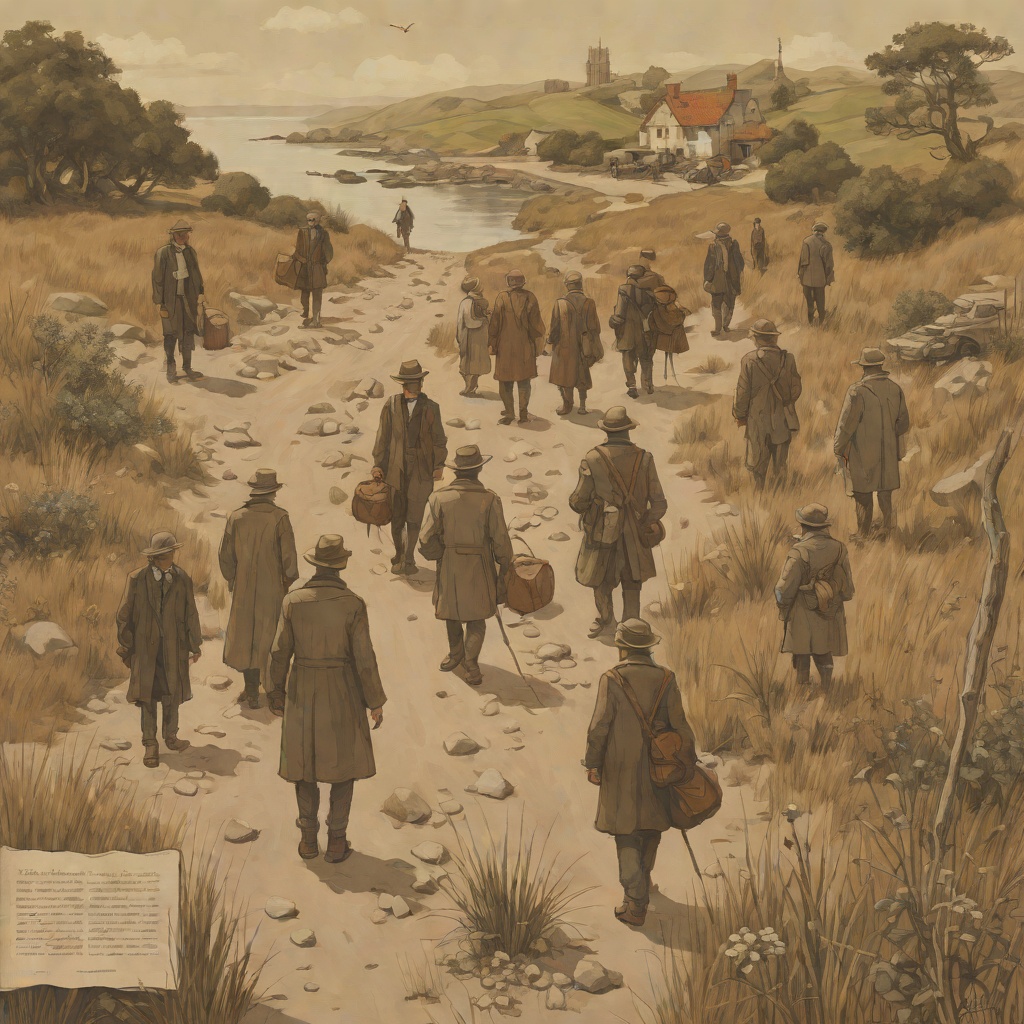
As Harold's pilgrimage continues, his loneliness deepens into something almost existential. He walks by day or by night, mile after mile, binding his blistered feet with blue duct tape until the shoe becomes a part of himself. He sleeps under the stars, washes in public lavatories and streams, and feels himself both inside and outside the world he passes—connected, and yet passing through. The strangest part, he reflects, is that a driver might overtake him and see no more than an old fellow in shirt and tie, off down the road, never guessing the enormity of what he carries. In the darkest hours, the nightmare pictures he thought he had left behind return: himself flailing with an axe at the wooden planks of his garden shed, his fists sprouting blood over thousands of coloured glass pins, Maureen turning her back and disappearing into a dazzling ball of light. He shouts once but no sound comes back, and he feels the cold deep inside him, as if even his bones are freezing over. He closes his eyes to sleep, convinced he will not survive, and having no will to fight that. In this state, he is no more than a body that houses a walk—blue-duct-tape feet and Berwick-upon-Tweed. The loneliness has become total, a stripping away of everything except the road and the memory of his son.
The Redemption of Sharing
Yet it is precisely this extremity of loneliness that opens the way to connection. Harold learns that it is the smallness of people that fills him with wonder and tenderness, and the loneliness of that too. The world, he comes to see, is made up of people putting one foot in front of the other, and a life might appear ordinary simply because the person living it has done so for a long time. He can no longer pass a stranger without acknowledging the truth that everyone is the same, and also unique, and that this is the dilemma of being human. This understanding transforms his relationship to his own solitude. He accepts the gifts of strangers—the walking socks, the blue duct tape, the brass compass from Martina, who kisses his cheek and tells him he owes her nothing—and learns that it is as much of a gift to receive as it is to give, requiring both courage and humility. In Cheltenham, he begins to shed his possessions, donating his washing powder, his wind-up torch, his plasters and antiseptic cream, his comb, his guide to Britain, keeping only the compass and rucksack because they are not his to give away. The act of giving, of listening, of carrying a little of others as he goes, becomes the antidote to loneliness. And in his confession letter to the garage girl, he finally speaks the unspeakable: the story of David's suicide, his own drinking, the destruction of the garden shed, and Queenie's taking the blame. In telling his story, he breaks the silence that has sustained his loneliness for twenty years, and in doing so, he begins to let go. The novel ultimately suggests that loneliness is not a condition to be escaped but a truth to be acknowledged and shared—and that in the sharing, however imperfect, lies the possibility of redemption.