Martina's treatment of Harold's feet
The Unlikely Pilgrimage of Harold FryMartina's treatment of Harold's feet is the turning point of Harold Fry's pilgrimage, the moment when a stranger's practical care rescues the walk from collapse and gives it new meaning. Harold arrives at her door in Taunton in a state of physical ruin: his calf has exploded as if sliced open, his knees and palms are spiked from a fall on the paving stones, and his feet are a landscape of infection. The young Slovakian woman, who introduces herself as Martina, offers him a room for the night, and in doing so becomes the first person to treat his walk as a shared responsibility. Her care is not merely medical; it is the first sustained kindness Harold has received since he left Fossebridge Road, and it reshapes his understanding of what the pilgrimage can be.
The Condition of Harold's Feet
Harold's feet, when Martina first examines them, are the physical record of his folly. He had set out from Kingsbridge in his yachting shoes, a man who 'only ever walk to get to the car,' as his wife Maureen had reminded him, and the shoes were never meant for such a journey. By the time he reaches Taunton, the damage is severe. Martina kneels on the carpet, reties her ponytail, and spreads one of her towels carefully, smoothing out the folds, while the traffic and rain and wind jam the branches of the tree against the glass. She holds out her cupped hands, waiting, and Harold removes his socks and shoes, although it hurts to bend, and unpeels the most recent set of plasters. His naked feet are an unhealthy white verging on grey, the indent of his socks making ridges into the skin. Blisters swell from his toes, heels, and instep; some are bleeding, others are inflamed sacs of pus. The nail of his big toe is tough as a hoof, a dark blueberry colour where it has rammed against the end of his shoe, and a thickened layer of skin grows over his heel, cracked in places and also bleeding. He has to hold his breath against the smell. 'You don't want to see any more,' he says, but Martina does not flinch.
The Treatment and Its Method
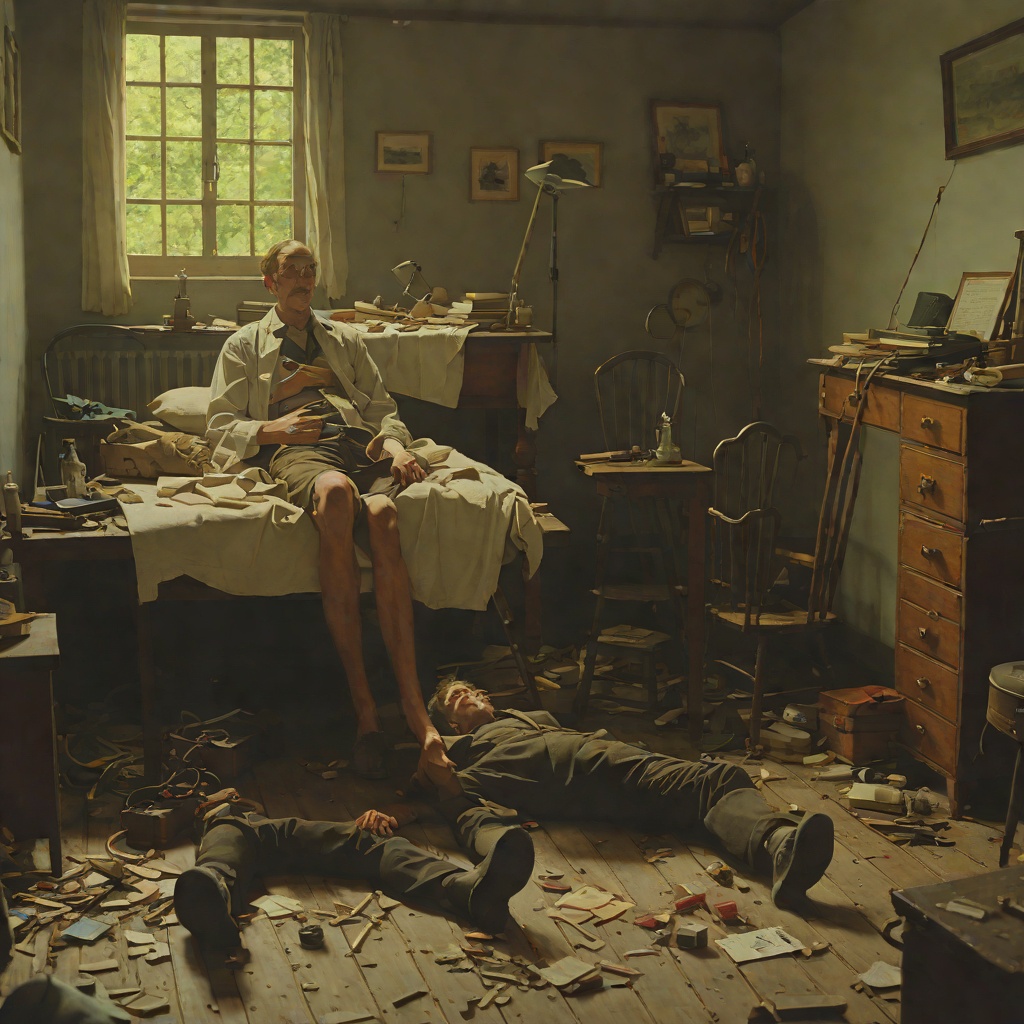
Martina's treatment is methodical and intimate. She lifts his leg and peers at the underside, noting that the bruise goes all the way to the back of the knee. She warns him that if he continues to walk on the leg it will get worse, and that the blisters need treating. She punctures the first pocket of pus with a needle, pressing out the fluid while carefully leaving the flap of skin intact, and Harold does not flinch. She guides his left foot towards a bucket of soft, warm water, and Harold looks at the ceiling so as not to look in the wrong place, an act he reflects is 'such an English thing to do.' The treatment is, he feels, 'an intensely private act; almost between the woman and his foot, and not the rest of him.' Martina drains the bigger blisters, bandages his feet, and insists that he learn to do it himself. Her care extends beyond the immediate crisis: she reties her ponytail as she works, and her language is as unvarnished as her methods. 'If you think you're going to get to fucking Berwick, we need to get you right, Harold,' she says, and Harold, hearing his walk referred to as a shared responsibility for the first time, could have wept with gratitude.
The Gifts and the Departure
Martina's care does not end with the bandages. While she is at her cleaning job, Harold fixes his reading glasses with plasters, wedges open the back door, and clears the small garden, finding her partner's tools and tidying the edges of the lawn, pruning back the branches of the hedge, walking with bare feet because he cannot remember what he has done with his shoes. When she returns, she presents him with a brown paper bag containing his yachting shoes, resoled and polished, with fresh laces. 'You don't get service like that on the NHS,' she says, moving away before he can thank her. That night they eat together, and Harold insists on paying for the room, but she refuses. Later, as he packs his plastic bag, she knocks on his door and hands him two pairs of walking socks, a roll of blue duct tape, an empty rucksack, and a brass compass—all of them her partner's things. He is about to insist he cannot take anything more, but she kisses him softly on the cheek and says, 'Go well, Harold. And you owe me nothing for the room. You were my guest.' The compass is warm and heavy in his hand. He leaves with the first light, propping a postcard against his pillow to thank her, and also the set of laminated place mats because her need for them might be greater than Queenie's. He pats her partner's dog at the foot of the stairs and closes the front door quietly, not wishing to wake her, though she is watching from her bathroom window with her face pressed to the glass. He does not look back, but he wonders if she is worrying about his blisters or his yachting shoes, and wishes he were not leaving her alone with only a dog and some boots.
The Legacy of Martina's Care
The gifts Martina gives Harold become the instruments of his survival. The blue duct tape, in particular, recurs throughout the pilgrimage as a symbol of her care and of Harold's transformation. When his shoes begin to disintegrate—the soles thin as fabric, his toes nearly through the leather—he binds them with the roll of blue duct tape, round and round and round, crossing underneath the foot and up over towards the ankle, so that the shoe becomes a part of himself. He begins to believe the shoes have a will of their own, and he becomes 'blue-duct-tape feet and Berwick-upon-Tweed.' The compass quivers northwards and he follows, going by day or by night as the mood takes him, mile after mile. The rucksack carries his few possessions. Martina's treatment also teaches Harold a lesson about receiving that he carries with him: the kindness of the woman with food and that of Martina, he reflects, offered him comfort and shelter even when he was afraid of taking them, and in accepting he learned that it is as much a gift to receive as to give, requiring both courage and humility. This lesson shapes his subsequent interactions with strangers, as he learns to accept their offerings of sandwiches, water, and plasters while gently refusing lifts and walking equipment. When he later sheds his possessions in Cheltenham, donating his washing powder, wind-up torch, plasters, antiseptic cream, comb, and guidebooks to strangers, he keeps the compass and the rucksack because they are not his to give away. Martina's care, and the trust she placed in him, remains with him for the rest of the walk, a quiet testament to the power of a stranger's kindness to sustain a man on the longest journey of his life.