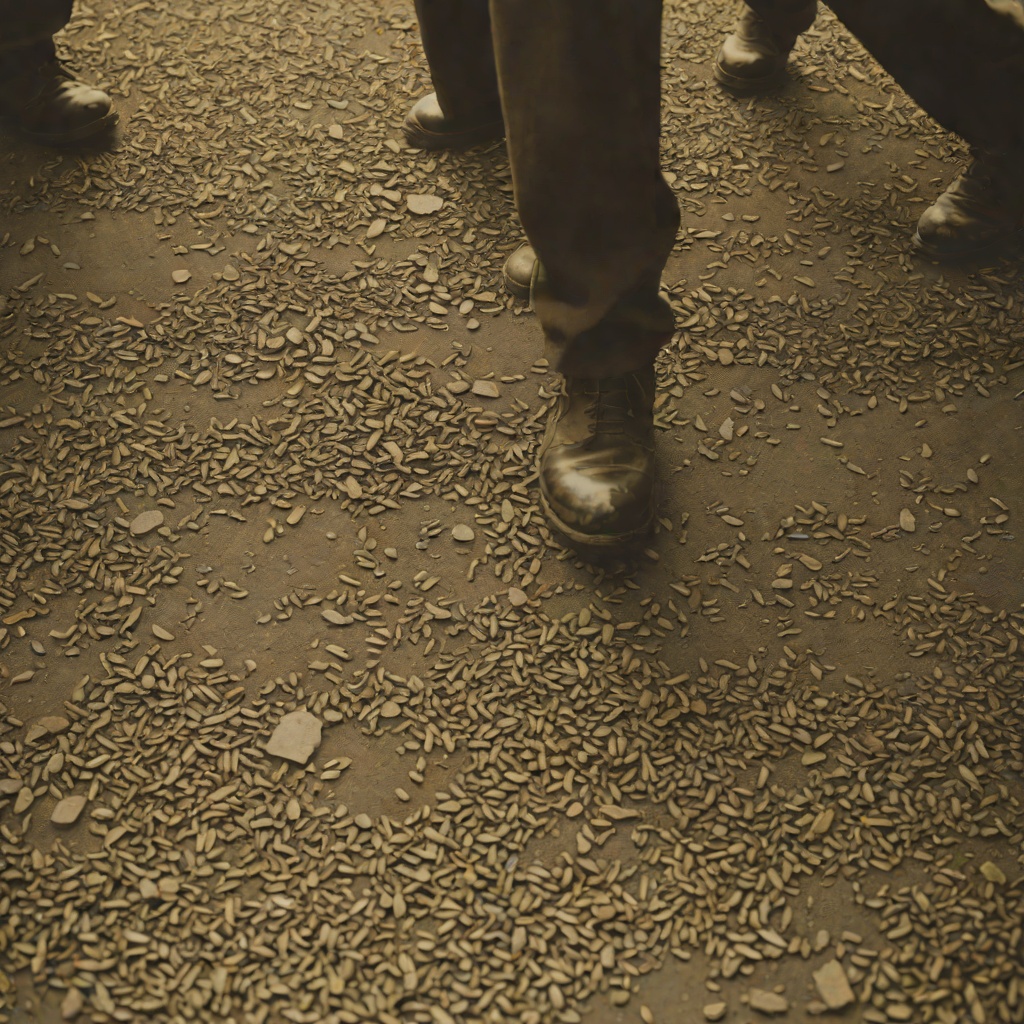
One foot in front of the other
The Unlikely Pilgrimage of Harold FryOne foot in front of the other is the simple, almost childlike formula that becomes the governing law of Harold Fry's pilgrimage from Kingsbridge to Berwick-upon-Tweed. It is the phrase that transforms an impossible journey of hundreds of miles into a sequence of achievable steps, and it is the novel's most persistent and resonant expression of faith. The mantra appears at the very moment Harold commits himself to the walk, recurs through his moments of physical agony and mental dissolution, and finally becomes the measure of what he has accomplished. It is not merely advice about walking; it is the book's answer to the question of how a person changes, how a life is repaired, and how a man who has spent twenty years avoiding the past can finally walk through it.
The Mantra as a Speech Act
The phrase first takes on its power in the phone box where Harold, having just learned that Queenie Hennessy is dying, announces his intention to save her. He tells the nurse, 'Tell her Harold Fry is on his way. All she has to do is wait. Because I am going to save her, you see. I will keep walking and she must keep living.' The commitment is made before any plan exists, and the mantra is the mechanism that makes the commitment survivable. When Harold later explains his method to Mick, the young man who buys him a lemonade south of Coventry, he articulates the logic with perfect clarity: 'I don't push it and I don't hang about. If I just keep putting one foot in front of the other, it stands to reason that I'm going to get there.' The phrase is a performative utterance in the strictest sense: it does not describe the walk, it creates it. Each repetition of the formula is an act of will that converts the vast, unknowable geography of England into the next single step.
The Body and the Mantra
The mantra is inseparable from the physical suffering of the walk. On his first night in a hotel, Harold inspects his feet with a quiet pride, noting the toes that are 'soft and pale,' the tenderness around the nails, and a possible blister forming at the top of his heel. The next day, the blister becomes more painful, and he finds a way of shoving his toes towards the front of his shoe to avoid the leather biting into his ankle. It is at this point of bodily distress that the mantra takes on its most striking form. Harold is no longer thinking of Queenie or Maureen, no longer seeing the hedgerows or the horizon. He is the words themselves: 'You will not die,' and the words are also his feet. The sentence marches in different orders in his head — 'Die you will not,' 'Not will you die,' even plain 'Not not not' — and the scrambling of the syntax reveals how the mantra has become a bodily rhythm rather than a rational thought. The words and the steps have merged into a single act of survival.
The physical dimension of the mantra continues throughout the journey. When the blisters become unbearable, Harold binds them with duct tape, the same roll given to him by Martina along with a brass compass and a rucksack that had belonged to her absent partner. The tape is a practical application of the mantra's logic: each strip of tape is a small repair that allows the next step, and the next. The mantra also governs the rhythm of the walk itself. Harold takes the A-roads, B-roads, lanes and tracks, following the compass northwards, going by day or by night as the mood takes him, mile after mile after mile. He sleeps when the need for it comes, and then returns to his feet and walks again, under the stars and the tender light of the moon. The mantra is what makes this endless motion possible, and it is also what makes it meaningful.
The Mantra as a Philosophy of Life
The phrase expands beyond the physical act of walking to become a philosophy of human existence. Walking with strangers — a tax inspector who is a Druid and has not worn shoes for ten years, a young woman searching for her real father, a priest who confesses to tweeting during mass, a white witch from Glastonbury, a homeless man who drank away his house, a mother of six who confides that she had no idea life could be so solitary — Harold learns that 'the world was made up of people putting one foot in front of the other.' The mantra is no longer only his own; it is the hidden structure of every ordinary life. A life might appear ordinary, he realizes, simply because the person living it has been doing so for a long time. The phrase becomes a way of seeing the dignity in the mundane, the courage in the unremarkable, and the shared dilemma of being human: everyone is the same, and also unique.
This philosophical expansion is anticipated early in the journey by the woman with food, who offers Harold bread and butter and slices of apple when he collapses into a seat beside her. She watches him eat greedily, apologizing but unable to stop, and then observes that walking should be the simplest thing, 'just a question of putting one foot in front of the other,' yet it never ceases to amaze her how difficult the things that are supposed to be instinctive really are. She extends the thought to eating, talking, even loving — all of them difficult. Harold adds 'Sleeping.' The exchange establishes the mantra as a meditation on the difficulty of the instinctive, and it is the first time the phrase is spoken by someone other than Harold himself. The woman's words plant the seed that the mantra is not merely a technique for walking but a way of understanding all human effort.
The Mantra and the Transformation of the Self
The mantra is also the instrument of Harold's transformation from a man who has spent his life sitting to a man who has been waiting all his life to walk. The change is registered in his body: he feels a beard growing in thick tufts, his fingers become dark with chipped and brown nails, and he walks so surely that it seems as if all his life he had been waiting to get up from his chair. The mantra is what allows this transformation to happen, because it replaces the overwhelming question of whether he will reach Berwick with the manageable task of taking the next step. He no longer knows how far he has come, but only that he is going forward. The pale Cotswold stone becomes the red brick of Warwickshire, the land flattens into middle England, and Harold knows with certainty that Queenie will live. The mantra has carried him not only across England but out of the paralysis of his old life.
The mantra's power is finally confirmed by the person who has been most resistant to it. Maureen, who has spent years in a place where language has no significance, who answers Harold's question about whether his walking is acceptable with the flat 'It has to be,' and who has suppressed Queenie's message out of jealousy and grief, is the one who names what Harold has done. Holding him tight after the grief passes, she kisses his salty wet cheeks and tells him, 'You got up, and you did something. And if trying to find a way when you don't even know you can get there isn't a small miracle, then I don't know what is.' The mantra, which began as a private formula for survival, has become the proof of a miracle. And in the novel's final affirmation, Maureen whispers, 'I love you, Harold Fry. That is what you did.' The simple act of putting one foot in front of the other, repeated long enough, has become an act of love.