The Past
The Unlikely Pilgrimage of Harold FryThe Past is not merely a backdrop in Harold Fry's story but the very ground upon which his pilgrimage is fought and won. For twenty years, Harold has been a man in retreat, a figure defined by what he refuses to remember. His walk to Berwick-upon-Tweed is, in its deepest sense, a journey into that buried territory, a forced reckoning with the memories he has suppressed since the death of his son, David. The past is the silent antagonist he must face, the weight he carries in his yachting shoes, and, ultimately, the source of the understanding that allows him to let go. It is the engine of his suffering and the key to his redemption, a paradox that the novel explores with relentless, compassionate precision.
The Weight of a Buried Life
Harold's relationship with the past is defined by a lifetime of avoidance. He reflects that the silence of his early years had followed him into his marital home, lodging itself behind the carpet and curtains and wallpaper, a haunting that no tie or pretense of order could dispel. This silence was the inheritance of a childhood marked by his mother Joan's desertion and his father's cold dismissal on his sixteenth birthday, when he was handed an overcoat that smelled of mothballs and shown the door. He had been relieved to leave that childhood behind, yet he came to see that there was no escaping one's beginnings. The past was the past, and it had shaped him into a man who felt too English, too ordinary, a man who lacked colour and who wore a tie every day, clinging to a set of rules that may never have existed. This sense of being defined by absence, by what he could not say or feel, was the foundation of his estrangement from his own life.
The past was also the site of his most profound failure. The memory of the afternoon, twenty years ago, when it had all come to an end, was one he most feared, and he was normally so good at repressing it. The memory would surge upon him unbidden—the feel of his hand reaching for a wooden door, the warmth of the sun, the smell of mouldering, heated-up air, and a stillness that was not what it should be. This was the day he discovered David's body in the garden shed, a moment so traumatic that his mind had built a fortress against it. The past, in this form, was not a sequence of events but a single, unbearable image that he had spent two decades trying not to see.
Walking as a Reckoning
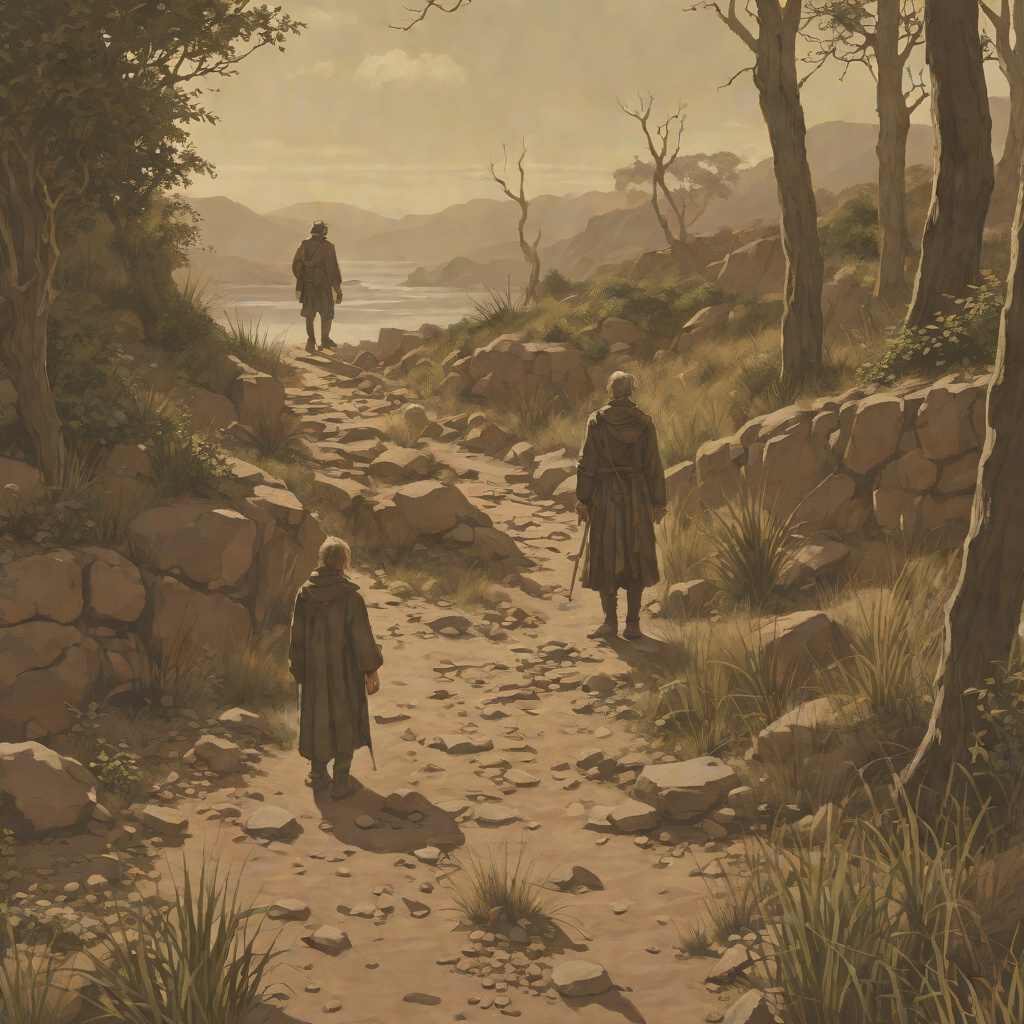
The act of walking became the mechanism that broke down his defenses. As Harold left the familiar confines of Kingsbridge and Fossebridge Road, he found that the physical rhythm of putting one foot in front of the other unleashed the past he had spent twenty years seeking to avoid. It chattered and played through his head with a wild energy that was its own. He no longer saw distance in terms of miles; he measured it with his remembering. The landscape itself became a trigger: passing allotments, he saw Maureen in the front garden, digging in French-bean plants; he saw a bird's broken egg and recalled with splintering tenderness the fragility of David's head when he was born; he heard the hollow cackle of a crow and was suddenly a teenager lying in his bed, overwhelmed with loneliness. The walk did not simply allow these memories to surface; it forced them into the open, making the past an inescapable companion on the road.
This confrontation was not gentle. At times, the memories were so overwhelming that they drove him to physical extremes. On the outskirts of Taunton, a memory surged into his mind, one of those that Harold most feared. He shot his elbows out sideways to go faster and drove his feet against the paving stones with such fury he hadn't the breathing to keep up, but nothing would hide him from the memory of that afternoon. The strain culminated in a physical collapse, his calf exploding as if the skin-side of the muscle had been sliced open, his knees buckling and his body lurching to the ground. The past was not merely a mental burden; it was a force that could break his body. Yet it was precisely through this breaking that the process of healing could begin, as his collapse led to his rescue by Martina, who treated his feet and gave him the tools—the walking socks, the blue duct tape, the brass compass—to continue.
The Unbearable Truth of David's Death
The deepest layer of the past, the one Harold had to excavate with the most pain, was the full story of his son's death and his own role in the aftermath. In a letter to the garage girl, he finally confessed the truth he had carried for two decades. He had buried his son, a thing no father should have to do. David had been depressed and addicted to mixing alcohol with pills, unable to get a job, and he had hanged himself in the garden shed with some rope tied to one of the hooks used for garden tools. The coroner said it must have taken a long time to tie the noose, a detail that haunted Harold. It was Harold who discovered him, who lifted him down, but there was no life. He was too late. This confession was not just a recitation of facts; it was an act of witnessing, a breaking of the silence that had defined his marriage and his life.
The past also held the shame of his own collapse in the wake of David's death. Harold had started drinking to keep himself steady before the coroner's report, and he kept the bottles in paper bags under his desk. In a drunken, desperate state, he had dismantled the garden shed, and when that wasn't enough, he broke into the brewery and did something terrible. Queenie knew it had to be him, and she took the blame, was fired on the spot, and disappeared. Harold let her go. He let her take the blame. But he gave up drinking. This was the moral wound at the heart of his past, the knowledge that he had allowed another to suffer for his own failure, and it was this wound that his pilgrimage was, in part, an attempt to heal.
The Past Transformed
The journey's ultimate achievement was not to escape the past but to change his relationship to it. As he walked, Harold began to understand that the past could not be changed, just as inoperable cancer could not be cured. This was a devastating realization, one that nearly broke him, but it was also the beginning of acceptance. He came to see that the world was made up of people putting one foot in front of the other, and that a life might appear ordinary simply because the person living it had done so for a long time. He could no longer pass a stranger without acknowledging the truth that everyone was the same, and also unique. This recognition of shared humanity, born from his own confrontation with the past, allowed him to see his own history not as a unique and isolating shame but as part of the common human dilemma.
In the end, Harold's relationship with the past was transformed from one of anguish to one of integration. He was sure that Queenie would remain with him, and David too. There would be Napier, and Joan, and Harold's father with those aunts, but there would be no more fighting them, and no more anguish for the past. They were part of the air he walked through, just as all the travellers he had met were part of it. He saw that people would make the decisions they wished to make, and some of them would hurt both themselves and those who loved them, and some would pass unnoticed, while others would bring joy. The past was no longer a weight to be carried or a wound to be hidden; it was simply a part of the landscape of his life, a collection of people and moments that had made him who he was. This was the quiet, hard-won peace that the walk delivered, a peace that allowed him to finally be present in his own life, ready for whatever would follow from Berwick-upon-Tweed.