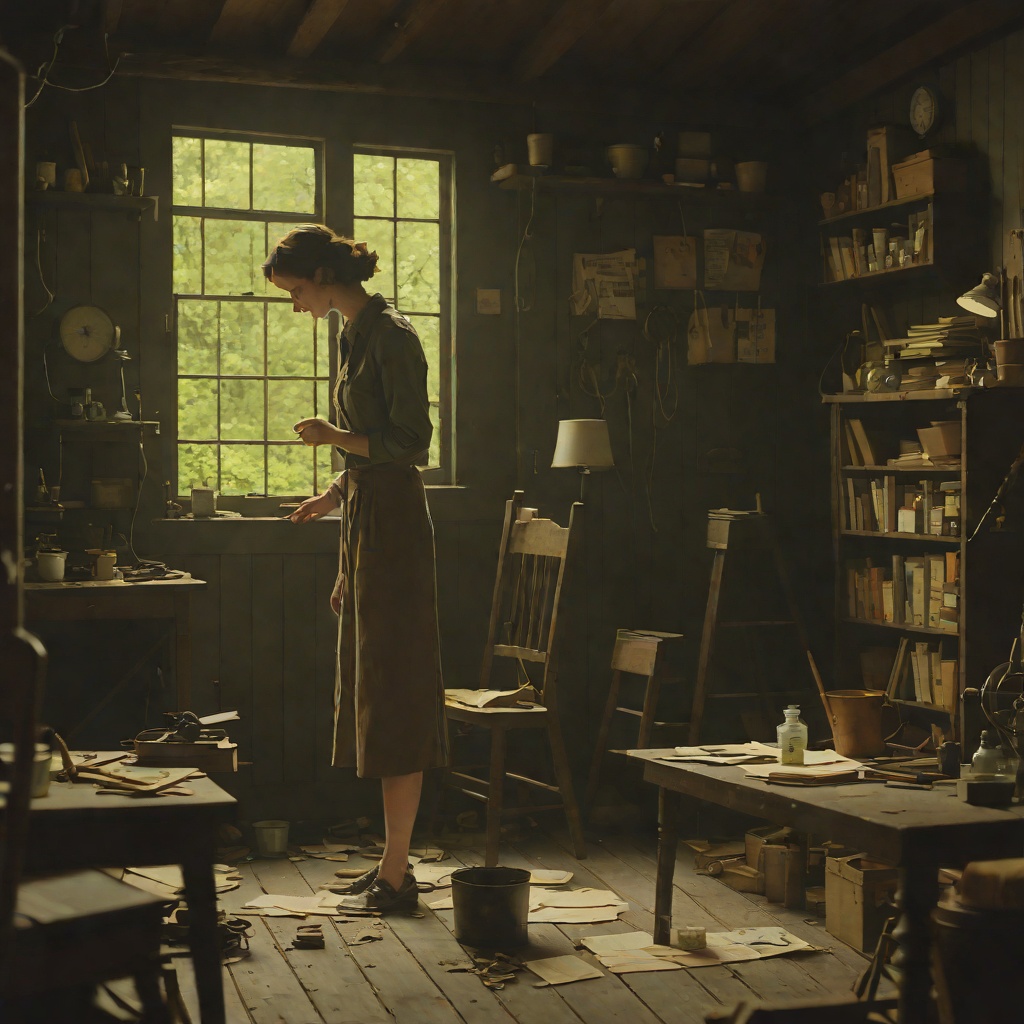
The garage girl visits Maureen
The Unlikely Pilgrimage of Harold FryThe garage girl's visit to Maureen at 13 Fossebridge Road is the novel's pivotal scene of revelation and confession, where the young woman who inspired Harold's pilgrimage delivers his confessional letter about David's suicide, admits that her own faith story was a fraud because her aunt died years ago, and prompts Maureen to confess that she suppressed Queenie's message. This encounter shatters the sustaining illusions of both women, forces the buried truth of twenty years into the open, and ultimately redirects Maureen toward Berwick-upon-Tweed, setting the stage for the couple's reconciliation.
The Visitor at the Door
A ring at the doorbell in the early morning brought Maureen downstairs to find a sallow-faced young girl waiting on the threshold, with lank hair, and wearing a black duffel coat although it was already warm. The girl asked to come in, addressing Maureen as Mrs Fry. Over tea and several apricot flapjacks, the girl revealed that she was the one who had given Harold the burger all those weeks ago. He had sent her many lovely postcards; although due to his sudden rise to fame there had been an inconvenient number of fans and journalists hanging about the garage. In the end her boss had been obliged to ask her to leave for health and safety reasons. Maureen expressed her sympathy, saying Harold would be very sorry to hear this, but the girl insisted she did not like the job anyway because customers were always shouting and in too much of a hurry.
The girl's real purpose soon emerged. She told Maureen that what she had said to Harold about the power of faith had been bothering her ever since, and she feared she had given him the wrong impression. Maureen protested that Harold had been inspired by her words, that it was her faith that gave him the idea to walk. The girl sat bunched up in her coat and gnawed at her lip so hard Maureen was afraid she would draw blood. Then she tugged an envelope out of her pocket and removed several sheets of paper, holding them out with a trembling hand.
The Letter and the Confession
Maureen's mouth bent into a frown as she read the first thing she saw: "Salsa for the over sixties?" The girl reached for the papers and flipped them over, explaining that the writing was on the other side. It was a letter from Harold, which had come to the garage, and her friend had warned her to fetch it before the boss saw. Maureen read in silence, weeping over each sentence. The loss that had wrenched them apart twenty years ago was as lacerating and incomprehensible as if it was happening afresh. When she finished, she thanked the girl and folded the letter, running her nail along the crease, then posted it back inside its envelope and sat very still.
The letter itself was Harold's confession to the girl in the garage, in which he owed her the full story. Twenty years ago he had buried his son, something no father should have to do. He wanted to know the man David would become, and still did. To this day he did not understand why David did it. David was depressed, and addicted to mixing alcohol with pills, and could not get a job, but Harold wished with all his heart that David had spoken to him. David hanged himself in the garden shed, using some rope tied to one of the hooks Harold used for garden tools. He was so full of the alcohol and pills that the coroner said it must have taken a long time to tie the noose. The verdict was suicide. It was Harold who discovered him. At the time he prayed, although he had told the girl at the garage that he was not a religious man, saying, Dear God, please let him be OK. I will do anything. He lifted David down, but there was no life. He was too late.
Harold's letter continued with the aftermath. His wife took it terribly and would not leave the house. She put up net curtains because she did not want the neighbours prying. Gradually those people moved away and no one knew about them, or what had happened. But every time Maureen looked at him, Harold knew she saw David dead. She began talking to David, saying he was with her, and she was always waiting for him. Maureen kept his room exactly as it was the day he died, which made Harold sad all over again, but it was what his wife wanted. She could not let him be dead, and Harold understood that it was too much for a mother to bear. Queenie knew all about David but said nothing; she looked out for Harold, fetched tea with sugar and talked about the weather. Only once she said, Maybe you've had enough now, Mr Fry, because Harold was drinking. It started off as just one to keep him steady before the coroner's report, but he kept the bottles in paper bags under his desk. When he was really out of it one night, he dismantled the garden shed, but even that was not enough, so he broke into the brewery and did something terrible. Queenie knew it had to be him and she took the blame. She was fired on the spot and then disappeared. Harold heard she had been warned to get out of the South West, if she knew what was good for her, and overheard a secretary who was friendly with Queenie's landlady saying that she had not left a forwarding address. He let her go. He let her take the blame. But he gave up drinking. Maureen and he fought for a long time, and then gradually they stopped talking. She moved out of their bedroom. She stopped loving him. There were many times he thought she would leave, but she did not.
The Fraud Revealed
Maureen reached out her hand for the girl's, which was small as a child's but surprisingly warm, and gave it a squeeze. She told the girl she was not a fraud, that it was she who had begun Harold's journey, and that she had inspired him when she talked about her aunt. The girl let out another sob and plunged her face back into the tissue. Raising her head again, she blinked her poor eyes and took a shuddering deep breath. "That's just it," she said at last. "My aunt's dead. She went years ago."
Maureen felt something falling away. The room seemed to give a tremendous jolt, as if she had just missed her step on the stairs. She asked about the girl's faith, saying she thought it had saved her aunt, that that was the whole point. The girl dug her teeth into the corner of her upper lip, so that her jaw shot out sideways, and said, "If cancer's got hold of you, there's nothing that's going to stop it." It was like seeing the truth for the first time, and realizing she had known it all along. Of course there was no stopping terminal cancer. Maureen thought of the many people who had come to trust in Harold's walk, and of Harold trudging even while they spoke. A shiver ran through her. The girl repeated that she had told Harold she was a fraud.
Maureen pummelled her forehead lightly with her fingertips. She could feel more coming from a long way deep inside, but unlike the truth about David, this caused her racking shame. She said slowly, "If anyone is the fraud here, I'm afraid it's me." The girl shook her head, clearly not understanding. Maureen began to tell her story, quietly and slowly, not looking at the girl because she had to focus on tugging out each word from the secret place where she had been hiding them for all this time. She told how, twenty years ago, after David's suicide, Queenie Hennessy had come to 13 Fossebridge Road, asking for Harold. She had looked very pale, and was carrying flowers. There was something extremely ordinary and yet very dignified about her.
The Call to Action
The garage girl did not answer at first. She took a further flapjack and for several minutes seemed to be thinking of nothing other than the taste of it. Then she said she did not think it was true that Harold had walked out on Maureen, and she did not think Maureen was a fraud either, saying, "We all make mistakes. But I do know one thing." Maureen moaned, rocking her head in her hands, wondering how she could ever mend the mistakes of so long ago, believing her marriage was over. The girl told her plainly, "If I were you, I wouldn't be stuck here, making biscuits and talking to me. I'd be doing something." Maureen protested that she had driven all the way to Darlington and it made no difference. The girl replied, "That was when things were good. A lot has happened since then." Her voice was so slow and certain that Maureen lifted her head. The girl's face was still pale, but it suddenly shone with disarming clarity. Maureen maybe gave a start, or even cried out, because the garage girl laughed. "Get yourself to Berwick-upon-Tweed."
Significance and Aftermath
The visit operates as the novel's great unravelling of sustaining fictions. The garage girl's confession that her aunt died years ago exposes the fragility of the faith that launched Harold's pilgrimage, the very faith Maureen had defended moments earlier. Yet the girl's honesty becomes the catalyst for Maureen's own confession about suppressing Queenie's message, a secret she had hidden for twenty years. The scene reverses the direction of revelation: the girl who came to deliver Harold's letter leaves having received Maureen's confession, and the woman who had been paralyzed by grief and waiting is told to act. The girl's final instruction, to get herself to Berwick-upon-Tweed, directly counters Maureen's earlier despair that her trip to Darlington had made no difference, insisting that much has happened since then. This moment of shared truth-telling, in which both women admit to being frauds of a kind, clears the way for Maureen to join Harold at St Bernadine's Hospice, where the couple will finally face Queenie together and begin their reconciliation. The scene thus transforms the garage girl from a minor figure who inspired the walk into the agent who reunites the estranged couple, and it transforms Maureen from a woman trapped in the past into one willing to move toward the future.