the photograph albums
The Unlikely Pilgrimage of Harold FryThe photograph albums at 13 Fossebridge Road are the Fry family's most guarded possession, volumes that no one looks at, their edges felted with a layer of dust. They hold the visible record of a household that has spent two decades refusing to see itself. When Maureen Fry finally pulls them from the best room and wipes the dust away with her skirt, she is not merely revisiting old pictures; she is dismantling the story she has told herself since her son David hanged himself in the garden shed. The albums are the counter-evidence to a lifetime of blame, and their rediscovery sets in motion the slow, painful revision of everything Maureen believes about her husband Harold and about herself.
The Hidden Photographs in Harold's Bedside Drawer
Before Maureen ever opens the albums, she finds their secret counterpart in Harold's absence. After he leaves on his pilgrimage to walk to Berwick-upon-Tweed, she goes through his papers searching for some explanation of why he is walking to Queenie Hennessy. There are no letters, no photographs, no half-scribbled directions — nothing but a picture of herself just after they were married, and another crumpled black-and-white one of David that Harold must have hidden there, because she clearly remembers sticking it in an album herself. The discovery is unsettling in its silence, reminding her of the months after David left, when the house itself seemed to hold its breath. That Harold had secretly kept these two images — the young wife she had been and the son he was never supposed to have loved — is the first hint that the albums' official record is incomplete, that Harold has been carrying his own private archive of the family's lost happiness.
Maureen's Rediscovery and the Revision of Memory
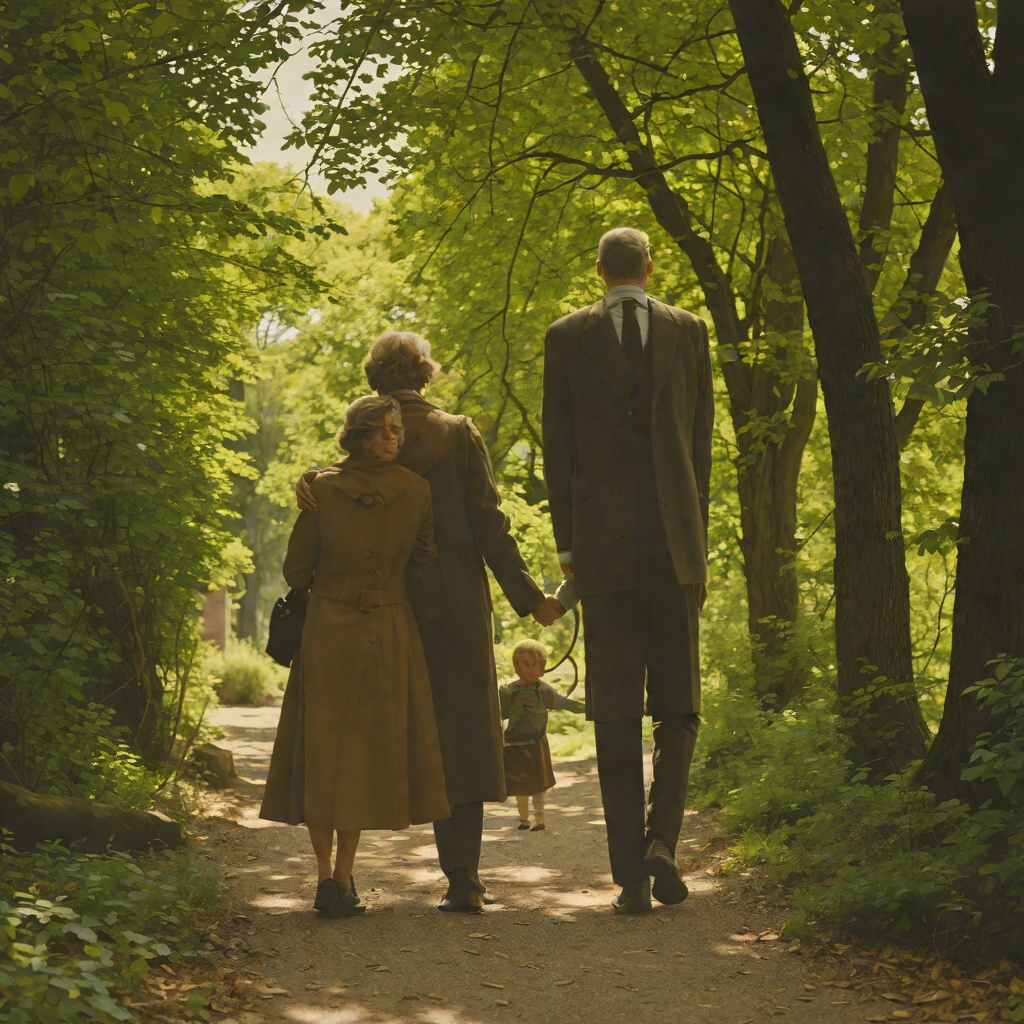
The albums themselves are mostly of Maureen and David, but tucked among the pages are others that tell a different story. Maureen studies every page, blotting back tears, and finds images she had forgotten or refused to remember: David lying in Harold's lap as a baby while his father looks down at him, hands in midair as if forbidding himself to touch; David sitting on his father's shoulders while Harold craned his neck to balance him upright; David as a teenager side by side with Harold, the young man in black and long-haired, the father in jacket and tie, both of them peering over the goldfish pond. She laughs at these pictures, recognizing that they had tried for closeness — not in an obvious way, not in a way that was everyday, but Harold had wanted it, and even David occasionally. The albums force her to admit what her grief had obscured: that the man she has spent years rebuking for never holding their son, for not giving him the love a child needs, had in fact reached for David again and again.
The Photograph of David's First Shoes
The most devastating image is the one that makes Maureen start and look again. It is the photograph of David with his first pair of shoes, the boy balanced on one leg, and it is the hand that catches her — the hand supporting David as he balances. A cold shiver slips the length of her spine, because the hand is not hers. It is Harold's. She remembers now that she took the photograph herself, that Harold held David's hand while she fetched the camera. How had she blocked that piece of the past from her head? For years she has blamed Harold for never holding their son, and here is the proof, hidden in plain sight in the album she has kept but never opened. The image does not merely exonerate Harold; it indicts Maureen's own memory, revealing how completely grief has rewritten the family's history.
The Bantham Photograph and Maureen's Self-Reckoning
Maureen finds again the day at Bantham, when David swam out into the current and nearly drowned. She watches Harold fiddling over his laces, and thinks of the years she spent rebuking him for that day. Then she sees the image through a new perspective, as if she had turned the camera and pointed it back on herself. Her stomach jumps. There is a woman at the water's edge, shouting and waving her hands, but not running into the sea — a mother half mad with fright, but doing nothing about it. If David had almost drowned at Bantham, she had been equally to blame. The albums, which she had kept as evidence of Harold's failures, turn out to be the mirror in which she must confront her own paralysis, her own refusal to act, her own share in the family's catastrophe.
The Albums and the Burden of the Past
The albums are the material form of the past that Harold spends his walk trying to outrun. As he walks through England, he measures distance not in miles but with his remembering, and the images that surface in his mind are the same ones locked in the albums: Maureen in the front garden of Fossebridge Road wearing an old shirt of his, her hair tied back against the wind and her face smutched with dirt as she digs in French-bean plants; the fragility of David's head when he was born, recalled with splintering tenderness at the sight of a bird's broken egg. The albums hold what Harold cannot say aloud — that he loved his son, that he tried, that the failure was not for want of feeling. When he finally writes his confession to the garage girl, he describes the unbearable details the albums could never capture: discovering David hanged in the garden shed with rope tied to one of the hooks he used for garden tools, lifting him down too late, the coroner's verdict of suicide, the long time it must have taken to tie the noose. The albums end where the horror begins; they preserve the family as it was before the shed, before the silence.
The Albums' Role in Reconciliation
The albums ultimately serve as the bridge across the twenty years of estrangement between Harold and Maureen. By forcing Maureen to see Harold's hand in the photographs, they break the cycle of blame that has kept the couple in separate beds, hovering over the surface of what could never be said. The images of Harold holding David, balancing him on his shoulders, peering with him over the goldfish pond, are the proof that the love Maureen accused him of never giving was there all along — hidden, awkward, not everyday, but real. When Harold finally returns and Maureen holds him, kissing his salty wet cheeks and whispering that she loves him, the reconciliation is made possible by the revision the albums began. The dust on their edges is the dust of a family's self-deception, and in wiping it away Maureen does not find a different past; she finds the same past seen truly, and in that truth the possibility of forgiveness.