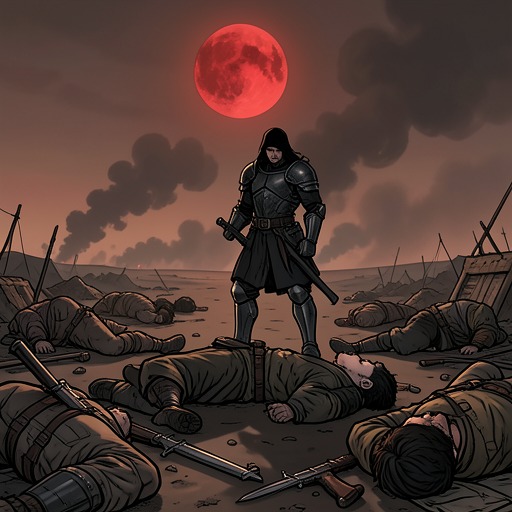
Attack on Lord Virgil’s tax envoy
The Vampire Prince’s BrideThe Attack on Lord Virgil’s tax envoy marks a decisive escalation in the Rebeluna conflict: what appears at first to be a highway robbery is interpreted by Darius’s circle as the deliberate financing of a larger-scale attack. The incident exposes the insurgents’ ability to choose symbolic targets, exploit outdated habits, and remove resources without allowing the violence to become an indiscriminate massacre.
Causes and Background
The attack is discussed in the context of growing reports involving shifters and suspected Rebeluna activity. Cleo asks which envoy was attacked the previous evening, and the answer identifies Lord Virgil’s annual tax shipment. Virgil continues to insist on delivering his taxes in gold, believing that the traditional method is safer. That preference makes the convoy valuable and predictable at the same time: its wealth is concentrated in a form that can be seized immediately, and its route and purpose are sufficiently recognizable for an ambush.
The choice of Virgil’s shipment also reflects the contrast between an old political order and an insurgency willing to use modern, practical tactics. Cleo responds that Virgil might now adopt a check or electronic transfer, treating the attack’s logistical lesson with dry practicality. The exchange makes the gold more than loot. It is the material expression of a system still relying on inherited custom while its enemies adapt around it.
Course of the Ambush
The Rebeluna fighters disguise themselves as a roadblock, turning an ordinary obstruction into a trap. Once Lord Virgil’s convoy stops or attempts to pass, they shoot the tires of his Hummer, immobilizing the vehicle and removing the possibility of a rapid escape. They then take the gold and leave without lingering to kill anyone. The operation therefore combines direct violence with a carefully limited objective: seize the funds, preserve mobility, and avoid the additional exposure that a massacre would create.
The restraint is significant because it distinguishes the attack from simple bloodlust. The attackers are prepared to use firearms and physical force, but the evidence indicates that killing is not necessary to accomplish their immediate purpose. Their conduct suggests a disciplined raid designed to produce resources and perhaps fear while keeping the operation focused on its strategic value.
Interpretation and Immediate Stakes
Darius acknowledges that the attack should have been anticipated, while Gordon argues that the gold is likely being gathered to finance an assault on a much larger scale. Gordon’s assessment changes the meaning of the convoy raid. The incident is no longer an isolated theft; it becomes evidence of preparation, with each successful seizure potentially strengthening the Rebeluna’s capacity for coordinated violence.
The attack also reveals a weakness in the authorities’ understanding of the threat. The group has many reports of shifter activity to investigate, and the Rebeluna’s recognizable style must be distinguished from other incidents rather than assumed automatically. This uncertainty gives the insurgents room to operate. Their signature is visible enough to provoke suspicion, yet the wider pattern is diffuse enough to delay a unified response.
Consequences and Narrative Significance
The immediate consequence is the loss of Lord Virgil’s annual gold taxes and the exposure of the convoy’s vulnerability. The deeper consequence is strategic alarm. A shipment once treated as secure has become a source of funding for an adversary capable of reconnaissance, impersonation, coordinated fire, and controlled withdrawal. The political class can no longer regard its inherited procedures as protection in themselves.
As an event, the ambush functions as a compact value shift from administrative security to insurgent initiative. The convoy begins as a routine instrument of authority and ends as proof that authority can be interrupted on the road and converted into resources for its opponent. Its importance lies not only in what the Rebeluna takes, but in what the raid reveals: the rebellion is gathering the means to move from scattered attacks toward a larger campaign.